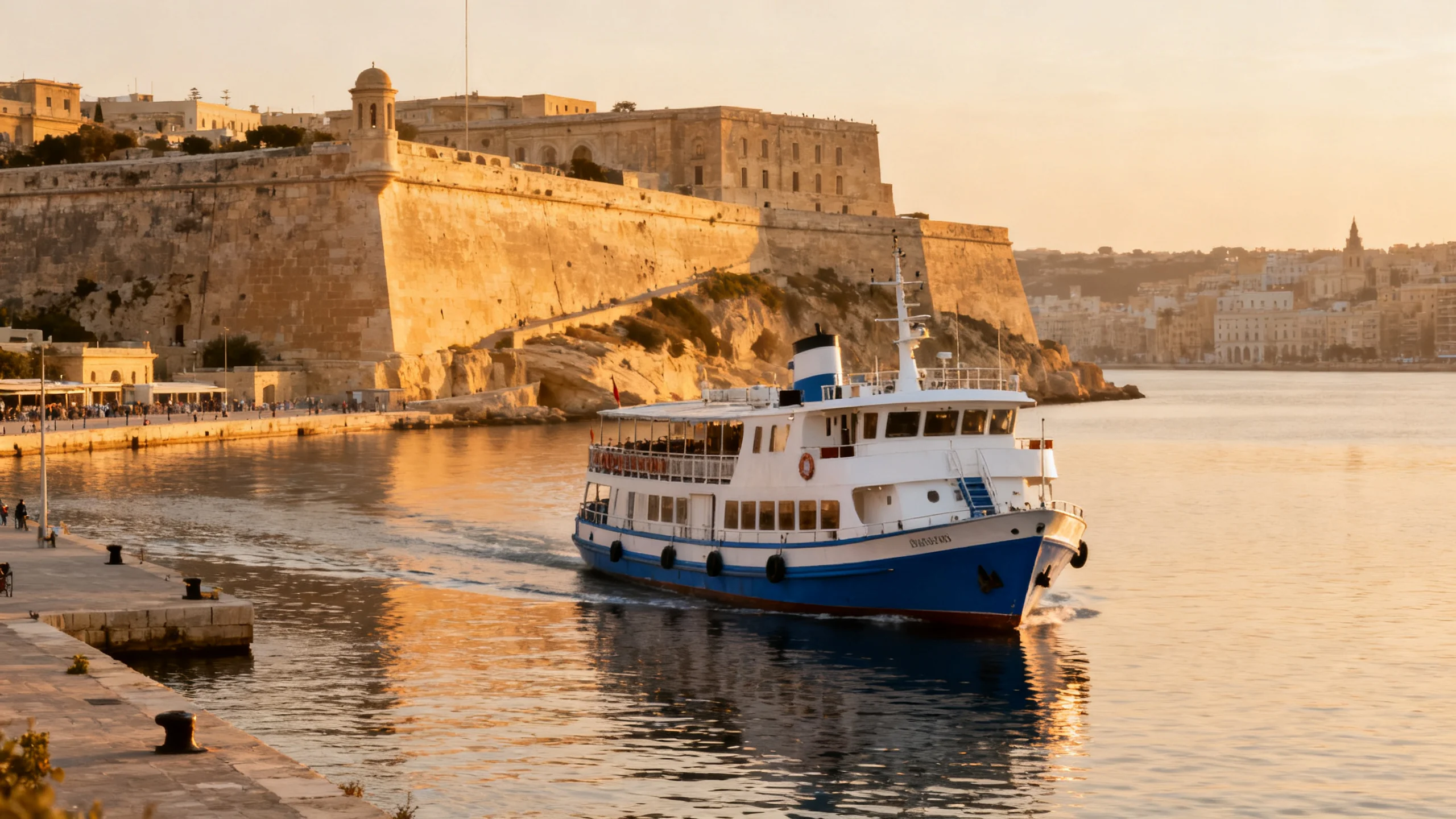
Valletta sits on a 900 m by 600 m peninsula in the centre-east of Malta, with the airport 7 km south-west and the rest of the country fanning out from there. The four practical ways to arrive are by airport bus, by ferry from Sliema, by car (with limited parking inside the walls), and by Bolt or taxi.
From the airport
The terminal is at Luqa, around 7 km from the Triton Fountain at the Valletta city gate. Three options:
- Bus X4 runs direct from the airport to Valletta City Gate, around 25 minutes, €2.50 one way (€2 cashless on a Tallinja card). Departures every 30 minutes from 05:00 to 23:00. The bus stops at the lower part of the airport terminal; follow the “Public Bus” signs on the ground level.
- Bolt (the dominant ride-hailing app in Malta) from the airport to Valletta typically costs €15 to €22 depending on demand and time of day. Bolt is cheaper than the taxi rank at the terminal by a substantial margin.
- Airport taxi rank is fixed-price by zone: €25 to Valletta or Floriana, paid at the small taxi-office kiosk before you walk to the rank. Receipts are issued.
If you are arriving late (after 23:00) the X4 bus stops running. Bolt and the taxi rank are the only options. Renting a car at the airport only makes sense if Valletta is one stop in a wider Malta-and-Gozo trip; cars are a burden inside Valletta itself.
By ferry from Sliema
The Sliema-Valletta ferry is the most underused transport asset in Malta. It crosses from Sliema Strand Wharf to Marsamxett harbour in Valletta in five minutes, costs €1.50 one way (€2.80 return), and runs every 30 minutes from roughly 07:00 to 22:00 (later in summer, up to 23:30 on Fridays and Saturdays). No booking, walk on. The Valletta-side dock at Lascaris Wharf puts you a 5-minute uphill walk from St John’s Co-Cathedral and the centre of the old town.
This is the ferry to use if you are based in Sliema or St Julian’s. Driving the same route takes 20 minutes off-peak and up to 45 in afternoon traffic, plus the cost of parking.
By bus from the rest of Malta
Most Malta bus routes terminate at the Valletta City Gate terminus in Floriana, immediately outside the bastion walls. From there it is a 5-minute walk through the gate into the old town. Useful lines:
- #13 from Sliema and St Julian’s (slow, 30-45 minutes, often crowded)
- #202 from Sliema via Mdina (long, around 60 minutes)
- #51 from Mdina and Rabat (45 minutes)
- #41, #42 from Mellieha and the north (70-80 minutes)
- #74 from the south coast and Hagar Qim (60 minutes)
- #81, #85 from Marsaxlokk (45 minutes)
Buses run frequently from 05:30 to 23:00, with reduced overnight routes. The Tallinja card (€21 unlimited 7 days, or €15 unlimited card with €2 cashless single fares) is worth it for any stay over four days with daily bus use.
By car and where to park
Valletta is largely closed to non-resident cars. There is no public on-street parking inside the walls. Three parking options just outside:
- MCP Car Park at Floriana, the largest underground facility immediately outside the city gate. €1.40 per hour, €15 per 24 hours. Pre-booking online at mcpcarpark.com saves about 20%.
- Phoenicia Hotel car park in Floriana, public-access at €18 per day.
- Free street parking in Floriana along the Mall and side streets, but typically full by 09:30 on weekdays.
From any of these you walk through the city gate in 5 to 10 minutes. The cheap option is street parking, the convenient option is the MCP underground.
If your trip is Malta-and-Gozo and you have a rental car, the practical pattern is: park at MCP, walk into Valletta for the day, return to the car at the end. Driving across the Marsa peninsula to the Three Cities (€2 dghajsa from Lascaris instead) makes no sense from a Valletta car park.
Crossing to the Three Cities
The Three Cities (Birgu, Senglea, Cospicua) sit directly across the Grand Harbour. Three ways:
- Traditional dghajsa water taxi from Lascaris Wharf below Upper Barrakka Gardens. €2 per person each way. Pick the operator that quotes the public rate; some try to upsell guided tours. The crossing takes 10 minutes including the loading.
- Public commuter ferry from the same wharf, €1.50, every 30 minutes from 06:30 to 19:00 (later in summer). Faster, less character.
- By road via the Marsa peninsula, a 6 km detour. Bolt is €8 to €12 depending on traffic. Use this only with luggage or in heavy rain.
Inside Valletta: moving around
Valletta is small enough to walk. The peninsula is 900 m end to end and the grid is regular, so getting lost is hard. The streets running parallel to Republic Street (the main spine) drop in steep flights of low limestone steps toward the harbour on both sides. The walk from the city gate to Fort St Elmo at the far tip is about 1.2 km on a flat-then-slightly-downhill line; the return is the same with a few low steps to climb.
Two practical notes:
- The Barrakka Lift (lower entrance on Lascaris Wharf, upper exit at Upper Barrakka Gardens) costs €1 each way and saves you the steep 60 m climb from the ferry dock to the gardens. Use it if you are visiting Upper Barrakka and the Saluting Battery directly from the ferry.
- Public toilets inside the walls are scarce. The cathedral, the National Museum of Archaeology and the larger cafés have them. Plan accordingly.
Accessibility
Valletta has UNESCO-protected paving (limestone slabs, sometimes uneven) and many small low steps in the side streets. The main Republic Street and Merchants Street are walkable for wheeled mobility, but the descending lanes toward the harbour are not. The St James Cavalier Cultural Centre and several of the major museums are wheelchair-accessible. The Barrakka Lift provides step-free access between the upper city and the harbour level.