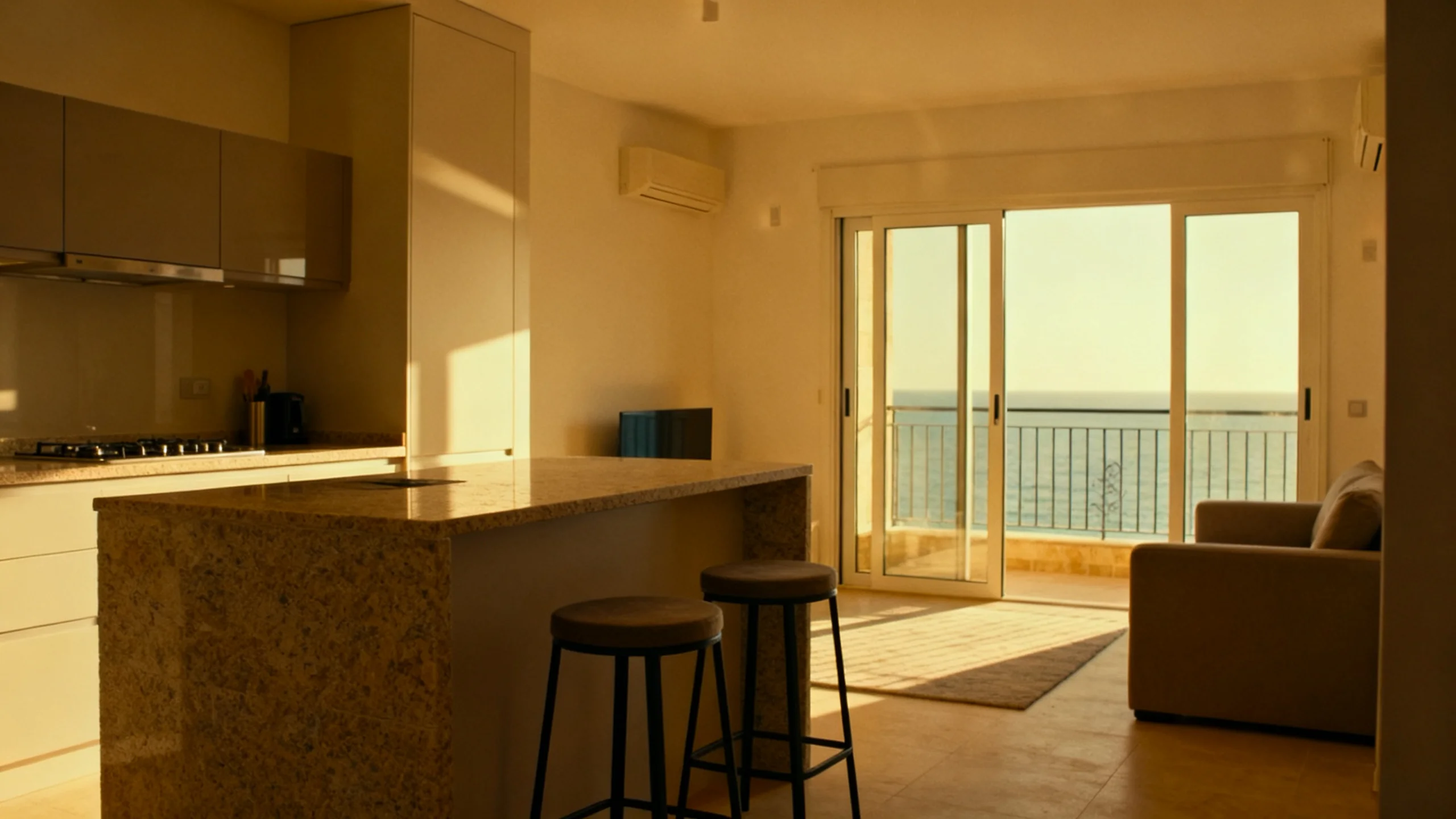
Airbnb and platform rentals across Malta and Gozo. Where they work (Gozo, Mdina, Sliema longer stays), where they don't (Valletta short stays). What to verify.
The self-catering apartment category covers everything from a €60-a-night Bugibba studio to a €280-a-night Gozo farmhouse. Across Malta, the platforms (Airbnb, Booking.com self-catering, Vrbo, MaltaHolidayHomes) list several thousand properties. The format works for some kinds of Malta trips and not for others.
This is the honest comparison: where self-catering wins, where it loses to hotels, and what to verify before booking.
Where self-catering wins
Gozo (the strong case)
The converted farmhouse with private pool, available almost exclusively as self-catering, is the strongest single accommodation type in the country. See the Gozo farmhouses piece for the detailed treatment.
Why it works: the slow-Gozo rhythm benefits from your own kitchen, your own pool, your own quiet courtyard. The farmhouses are designed for stays of 3+ nights; the daily-rate economics make sense for couples and small families.
Mdina-area extended stays
For 4+ night Mdina stays, self-catering townhouse rentals at €180-280 a night are often a stronger choice than the small hotel inventory inside the walls. You get more space, your own kitchen for slow mornings, and the same evening access to the silent city.
Sliema family travel
Families with kids benefit from a Sliema apartment over a hotel room: separate bedrooms, a kitchen for breakfast, a washing machine for the trip’s laundry, a flat seafront promenade outside. The apartment-hotel category (Marina Hotel Tigne, Pergola, etc.) blurs the line between self-catering and hotel.
Longer stays (7+ nights)
Self-catering economics improve with stay length. Most platforms offer 10-15% weekly discounts. The cleaning fees amortise across more nights. The kitchen access reduces dining costs by €30-50 per day for two people.
Specialist groups
Travellers with dietary requirements (gluten-free, vegan, kosher) often find self-catering simpler than restaurant-only travel. The Maltese supermarkets handle most international dietary needs; the cuisine is naturally gluten- and dairy-heavy in restaurants but easily worked around at home.
Where self-catering loses
Short Valletta stays (1-3 nights)
For 1-3 nights inside the Valletta walls, the boutique hotels are the stronger choice. The hotel’s breakfast, the proximity to St John’s Co-Cathedral, the concierge for restaurant bookings, and the simpler check-in all matter more than the kitchen access at this length.
The Valletta apartment market is also more variable in quality than the boutique hotel segment. Some apartments are beautifully restored; others are tired conversions of difficult-to-restore historic buildings.
One-night transit stays
If you are sleeping somewhere for a single night before a connecting flight or before driving to Gozo, the hotel format works better. Check-in is faster, no key-collection logistics, no kitchen to clean.
First-time Malta visitors
The convenience of a hotel breakfast and concierge service compounds for travellers who do not yet know the country. For repeat visitors, self-catering becomes more attractive.
Solo travellers
The cost-per-person economics of self-catering apartments do not work well for one person. A solo traveller pays the same rate as a couple for the property; the kitchen, the second bedroom, the laundry facility all go partly unused. Solo travellers do better at boutique hotel singles or hostels.
What to verify before booking
The Malta self-catering market is decently regulated (all rentals require a tourism license) but the listing quality on the platforms varies significantly. Eight things to verify:
1. The exact address (or at least the street). Some listings hide the precise location. For Valletta and Mdina, the street matters for noise. For Sliema, the floor level and orientation matter.
2. Interior photos of every room. Reject listings that only show exterior architecture or staged living-area photos. You need to see the bedrooms, the bathroom, the kitchen, and the actual entry hall.
3. Recent reviews (last 6 months). Older positive reviews can mask recent maintenance issues. Look for mentions of hot water, AC functioning, pest issues, noise.
4. Air conditioning in every bedroom. Essential for July-August. Some older properties have AC only in the living room.
5. Wi-Fi speed. Most listings say “Wi-Fi”; few specify the speed. If you are working remotely, ask for a speedtest.net result.
6. Check-in mechanism. Some properties have on-site hosts; others use lockbox key-collection. Both work but you should know in advance.
7. Cleaning fees. Often listed separately from the nightly rate; can add €40-100 to a short stay. Factor this into the total cost when comparing to hotels.
8. Cancellation policy. Self-catering cancellation policies are typically stricter than hotels. Read the fine print.
Pricing across the country (typical mid-range)
Valletta self-catering apartments:
- One-bedroom: €120-200 a night.
- Two-bedroom: €180-280.
Sliema and St Julian’s:
- One-bedroom Tower Road: €90-140.
- Two-bedroom: €130-200.
- Inland Sliema: €60-90 (one-bedroom).
Mellieha village:
- Townhouse rental: €120-200.
- Studio or one-bedroom: €70-110.
Bugibba / Qawra:
- Studio: €40-60.
- One-bedroom: €50-90.
- The cheapest sustained stock on the island.
Mdina-area townhouses:
- Standard one-bedroom: €120-180.
- Larger 2-3 bedroom: €180-280.
Gozo farmhouses with pool:
- Two-bedroom: €140-280.
- Larger 3-4 bedroom: €200-400.
Gozo apartments (Xlendi, Marsalforn, Victoria):
- One-bedroom: €70-120.
- Two-bedroom: €100-180.
Platforms compared
Airbnb: largest selection across Malta and Gozo, but the listing quality is highly variable. Best for finding distinctive properties (the carved-portal townhouse in Mdina, the gallarija-balcony Sliema apartment). Reviews are usable. Worst for: filtering noise risk.
Booking.com self-catering: smaller selection but better-vetted. The properties listed are typically tourism-licensed and have standard cancellation policies. Best for travellers who want hotel-style booking conventions.
Vrbo: smaller Malta-specific presence than Airbnb or Booking.com. Decent for Gozo farmhouse rentals but the inventory thins out for the urban areas.
MaltaHolidayHomes.com: the major Maltese aggregator, with strong coverage of Gozo farmhouses and Maltese apartments. Less competitive pricing than the international platforms but the customer support is local.
Gozofarmhouses.com: specialist Gozo-only aggregator. The best inventory for Gozo farmhouses with private pools. Recommended over the international platforms for Gozo.
What self-catering is honestly good for
A 5-7 night couple’s trip splitting between Sliema (mid-range Tower Road apartment) and Gozo (a farmhouse) is the strongest self-catering pattern. The apartment in Sliema gives you breakfast at home and the Valletta ferry; the Gozo farmhouse gives you the slow rural experience. Total daily cost is similar to mid-range hotels but the experience is more varied.
For shorter trips, families with kids, or anyone who prioritises the boutique-hotel-style service, hotels win. For longer trips, slow travel, or anyone who appreciates having their own kitchen, self-catering wins.
For the broader where-to-stay logic, see the where-to-stay overview and the regional pages.
Related reading
- Gozo farmhouses: the strongest single self-catering category.
- Sliema vs St Julian’s: the dense self-catering market across the harbour.
- Budget stays in Malta: the next step down on price.
- Where to stay overview: when self-catering wins vs hotel.
- 5-day Malta itinerary: the trip that splits Sliema apartment + Gozo farmhouse.