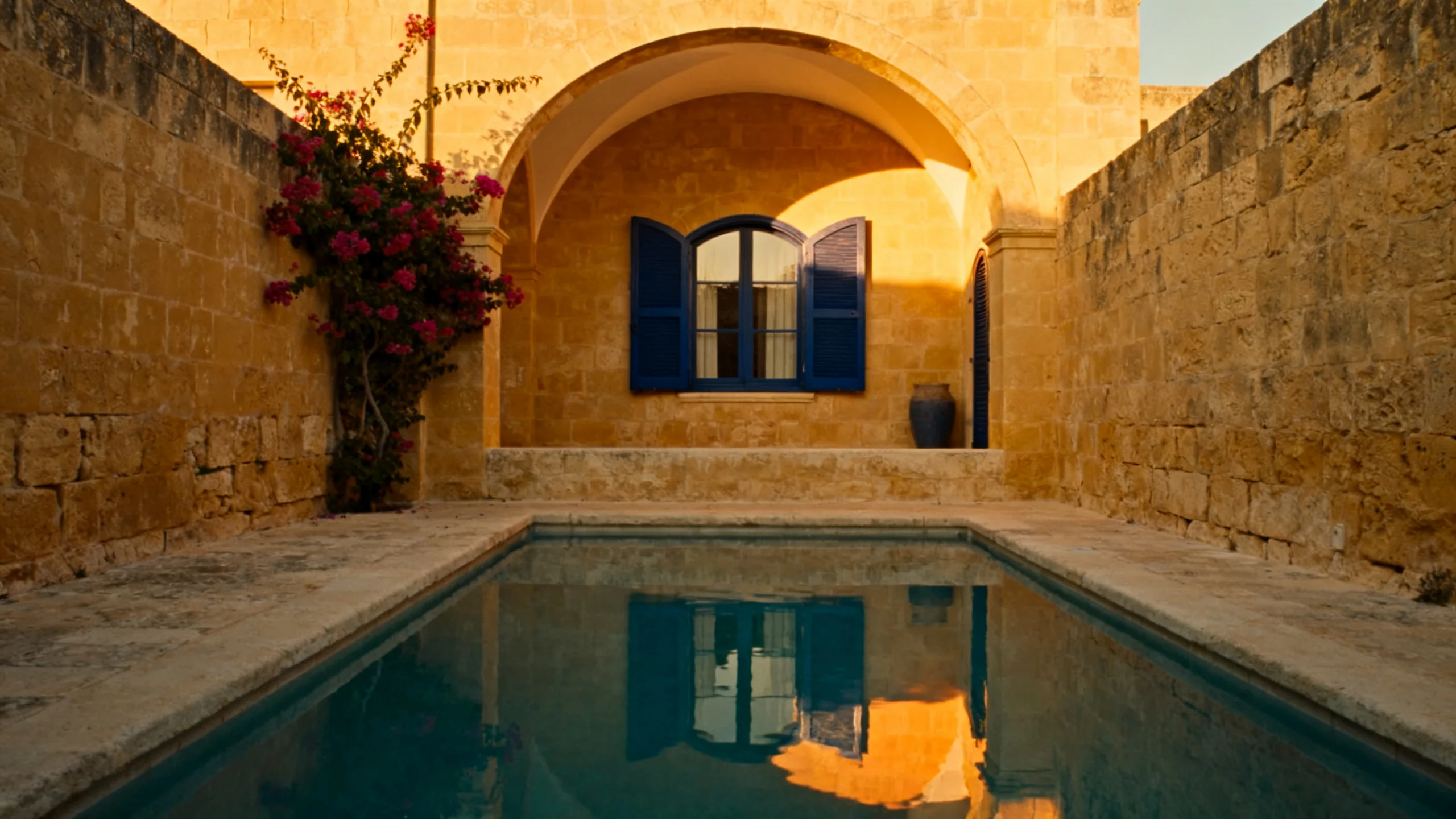
The signature Gozo accommodation. Restored 18th and 19th-century farmhouses with private pools in the inland villages. Booking platforms, pricing, what to verify.
The converted limestone farmhouse is the signature Gozo accommodation. Restored 18th- and 19th-century country houses with private pools, courtyard gardens, vaulted ceilings, and traditional features (gallarija balconies, wooden shutters, exposed limestone walls). The cluster is in the inland villages: San Lawrenz, Sannat, Għarb, Munxar, Xagħra outskirts. Around 200 farmhouses total operate as rentals, ranging from 2-bedroom couple’s properties to 6-bedroom family complexes.
This accommodation type does not exist in equivalent form on Malta (the Maltese inland villages are too densely built to support the pool-and-courtyard rural feel). The Gozitan version is the genuine slow-Mediterranean rural experience.
What you actually get
A typical Gozo farmhouse:
- Architecture: 18th or 19th-century stone-and-limestone country house with vaulted ceilings, exposed limestone walls in at least one room, traditional wooden shutters, a gallarija (enclosed balcony) on the upper floor.
- Pool: small, private, 3-5 metres long, set into a stone-walled courtyard. Heated in some properties, unheated in others.
- Bedrooms: 2-3 in the standard format. Some farmhouses sleep 4-6 across larger configurations.
- Kitchen: fully equipped for self-catering. Most have a gas hob, oven, fridge, washing machine, and basic kitchenware.
- Outdoor space: a courtyard or small garden for breakfast and dinner outside. Some have rooftop terraces with views over the surrounding agricultural landscape.
The aesthetic is slow-Mediterranean: not luxury in the polished-hotel sense, but characterful, comfortable, and rooted in the actual Gozo vernacular architecture.
Pricing
Two-bedroom farmhouses with private pool:
- Shoulder season (April-May, September-October): €140-280 a night.
- Peak summer (July-August): €200-450.
- Winter (November-March): €100-180.
Three- and four-bedroom larger properties (for families or small groups):
- €250-500 a night across the seasons.
Minimum stays: most farmhouses require 3-night minimum bookings in shoulder season and 7-night minimums in peak summer.
Cleaning and tourist tax: typically €40-80 cleaning fee plus €0.50 per person per night tourist tax.
Where to find them (booking platforms)
Specialist aggregators are the strong route for Gozo farmhouses:
- Gozofarmhouses.com is the long-standing dedicated platform, with the largest Gozo-specific inventory.
- MaltaHolidayHomes.com is the major Maltese rental aggregator, with strong Gozo coverage.
The major international platforms (Airbnb, Booking.com, Vrbo) list Gozo farmhouses but the selection is more variable. The specialist platforms have better-vetted inventory and the property descriptions are more accurate.
What to verify before booking
The farmhouse experience varies significantly between properties. Five things to check:
1. Private pool, not shared. Some listings say “pool” and the photo is of the property’s own pool; others say “pool” and mean a shared community pool used by 4-6 surrounding properties. Always confirm “private pool” in writing.
2. Interior photos of every room. Some listings cover up tired interiors with attractive exterior shots. Insist on interior photos of all bedrooms, kitchen, and bathrooms before booking.
3. Air conditioning in every bedroom. Gozo in July-August needs AC. Some older farmhouses have AC only in the living room or in the master bedroom; check that every bedroom is cooled.
4. The exact village. Some listings say “Gozo countryside” but the property is in the airport-adjacent suburbs of Mġarr (the ferry port). The character is different; insist on the village name.
5. Recent reviews. Read the last 6 months of reviews. Older positive reviews can mask recent maintenance issues. Look for mentions of pool cleaning, kitchen functioning, hot water reliability.
Best villages for the experience
San Lawrenz has the strongest concentration of well-maintained farmhouses. Quiet, beautifully restored, walking distance to Dwejra and Ta’ Pinu. About 15 minutes’ drive from Victoria.
Sannat sits above the Ta’ Ċenċ cliffs. Smaller village, mostly working-class Maltese homes interspersed with farmhouse rentals. Quiet evenings.
Munxar is a small inland village 10 minutes from Xlendi. Several restored farmhouses with strong courtyard-and-pool setups. Closer to the south coast than the other villages.
Għarb is the village of the Ta’ Pinu basilica. Quiet, traditional, with a few high-end farmhouse conversions.
Xagħra outskirts offer farmhouses near the Ġgantija temples. Closer to the north coast (Ramla Bay, Marsalforn) than the western villages.
Avoid:
- Mġarr-area rentals marketed as “farmhouses” but located in the airport-adjacent suburbs. The architecture is sometimes right; the rural feel is missing.
- Victoria-area rentals that share the village density without the courtyard-and-pool privacy.
The slow-Gozo rhythm
The farmhouse stay rewards a specific rhythm:
Mornings: slow breakfast on the terrace, walk to the village bakery for fresh bread (most Gozitan villages have a baker open from 06:00), coffee back at the farmhouse.
Late morning to early afternoon: cultural visit (Cittadella, Ġgantija) or beach (Ramla, Daħlet Qorrot).
Afternoon: return to the farmhouse, pool time, reading on the terrace.
Late afternoon to early evening: walking, a second cultural site, or sunset at Dwejra.
Dinner: at one of the village restaurants (Ta’ Frenc in Xagħra is the high-end pick; smaller village kitchens for casual meals) or self-catering at the farmhouse.
This is not a tourist itinerary; it is a holiday rhythm. For travellers who want the country at a slower pace, this is the strongest single Maltese accommodation experience.
How long to stay
Three nights is the floor. Less than that and the farmhouse rental fees per night make less sense, and you do not get the full rhythm benefit.
Five to seven nights is the sweet spot for a Gozo-focused trip. The farmhouse becomes the anchor; you visit the cultural sites at a relaxed pace; you have at least two genuine pool-and-terrace days.
Two weeks is reasonable for travellers committed to the slow-travel format and not pressing to see Malta as well.
A car is essential
The inland villages have minimal bus service. The Gozo bus network covers Victoria, Xagħra, Xlendi, Marsalforn, Dwejra, and Ramla Bay reasonably well. It does not cover San Lawrenz, Sannat or Munxar effectively. For a farmhouse stay, rent a car (€25-40 a day from Gozo agencies, or bring one from Malta).
When to book
July-August: 3-4 months ahead for the best farmhouses. The peak summer inventory thins out quickly.
April-May, September-October: 6-8 weeks ahead.
Winter (November-March): 3-4 weeks ahead. Several farmhouses close for the winter; verify before booking. The ones that stay open often have wood-burning fireplaces lit, which is the strongest single argument for off-season Gozo.
For the broader regional context, see the Gozo region where-to-stay page and the Gozo regional hub.
Related reading
- The case for Gozo: the argument for staying 3+ nights here.
- Ferry to Gozo: how to get the rental car across.
- 7-day Malta itinerary: the 4+3 split that anchors the farmhouse stay.
- Hiking the Gozo coast: what the slow base lets you reach.
- Limestone architecture: the same stone, restored at residential scale.