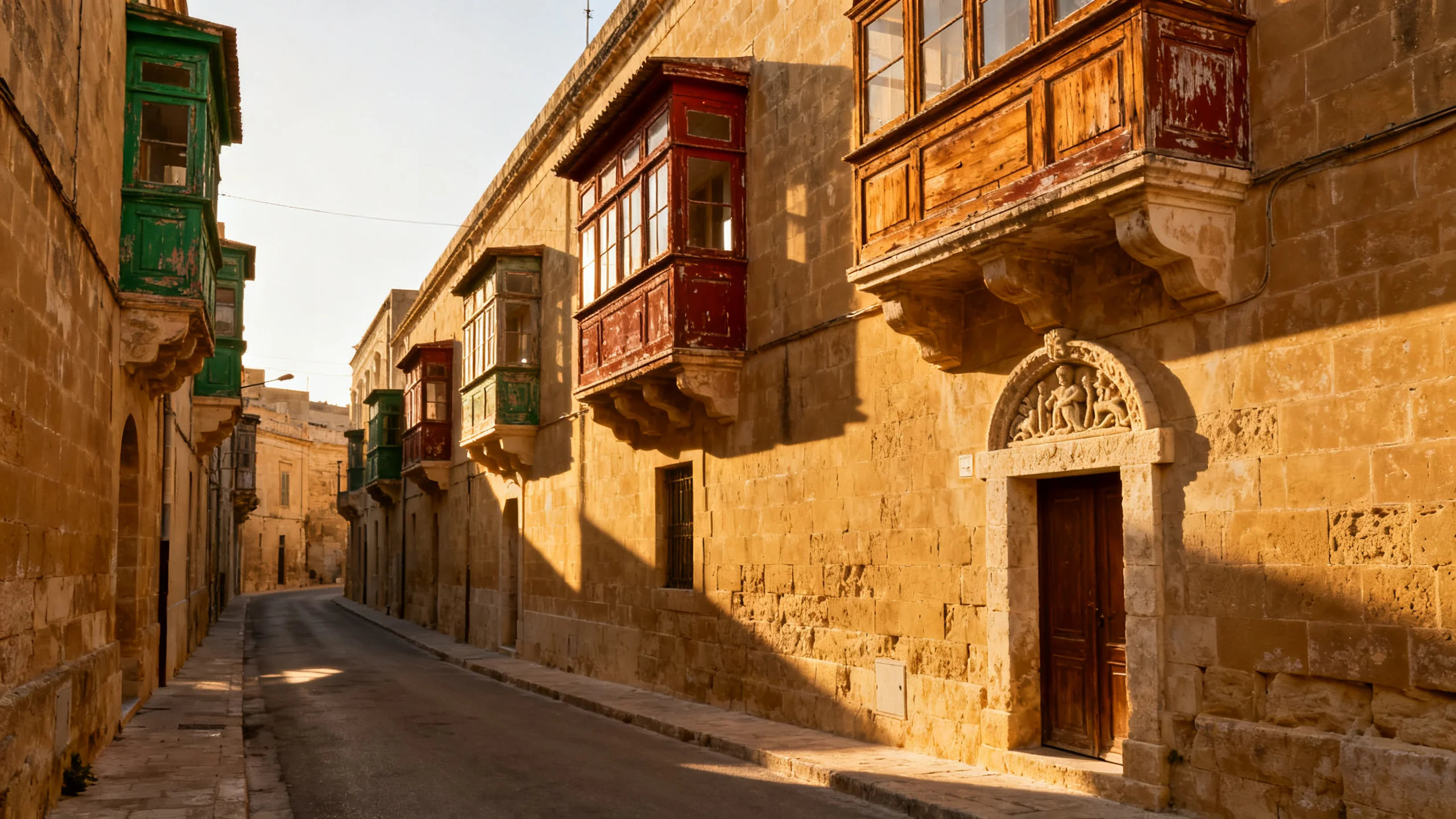
Why the entire country is built in honey-coloured limestone, the enclosed wooden balconies, the village dome competitions, and how to read the architectural code.
Walk through Mdina, Valletta, the Three Cities, any of the older central villages, or any town on Gozo, and the same fact dominates: every building, every wall, every paving slab, every church and every house is built in the same honey-coloured limestone. The colour varies slightly from cream-white on a fresh quarry to deep amber on weathered facades, but the material is constant.
This is globigerina limestone, the local sedimentary rock that has shaped Maltese architecture for at least five thousand years. The Megalithic temples were built from it. The Knights’ fortifications, the Valletta auberges, the Mdina palazzi, the village churches, the modern apartment blocks: all of them. Malta is one of the most architecturally monochromatic countries in Europe, and the colour is a soft warm yellow that takes the Mediterranean light better than almost any other building stone.
What is globigerina limestone
The geological story is simple. Malta sits on a limestone plateau formed roughly 20 to 30 million years ago in the Oligocene and Miocene epochs, when the area was a shallow tropical sea. The seabed sediment was rich in the calcium-carbonate shells of tiny microorganisms (foraminifera, particularly the genus Globigerina, which gave the rock its modern name). Compressed over millions of years, these shells became the soft, easy-to-cut limestone that surfaces across the islands today.
Three main strata are visible on Malta:
- Lower coralline limestone (the deepest): hard, dark, weather-resistant. Used in foundations and the most exposed coastal fortifications.
- Globigerina limestone (the middle layer, by far the thickest): soft when freshly quarried (it can be cut with a hand saw), hardens on exposure to air. This is the architectural stone of Malta.
- Upper coralline limestone (the topmost): hard again, used in some surface works and as gravel.
Globigerina is the wonder material. A skilled mason can cut blocks 60 × 30 × 30 cm in fifteen minutes with hand tools. The block hardens substantially in the first few weeks of exposure to air. The colour deepens from cream to amber over decades as the surface oxidises. The stone weathers gracefully, gaining patina rather than crumbling.
It does have downsides: it is porous (water can penetrate, which is why coastal buildings show salt damage), it stains easily, and it does not perform well in fires (the calcium carbonate breaks down at temperatures above 500°C, making restoration of fire-damaged stone difficult).
But for a small Mediterranean country with no metal ores, very little timber, and abundant soft sedimentary rock, limestone was always going to be the material. The Maltese have been building in it since the temple period.
The architectural code
Once you start looking, Maltese limestone architecture follows a recognisable code:
Rusticated lower courses: the ground-floor wall surfaces are often rough-cut, with deeper joints between blocks (rustication in the technical sense). This emphasises the building’s mass and protects the lower courses from impacts.
Smooth upper courses: above the ground floor, the wall surface is smooth, with fine joints. This is the canvas for any decorative carving.
Carved entrance portals: even modest village houses have a carved limestone surround at the front door, often with a date, family name, religious motto, or decorative motifs (laurel wreaths, scallops, crosses). The portal is the social signal of the house.
Coats of arms: wealthier houses display the family arms above the door or above the first-floor windows. The Mdina palazzi have the densest concentration of these.
The gallarija (enclosed wooden balcony): the single most distinctive Maltese architectural feature. A first-floor or second-floor wooden balcony, glazed and enclosed on all sides, projecting from the limestone facade. Originally introduced under Ottoman influence (similar balconies exist across the eastern Mediterranean), the gallarija developed locally into a distinctive form: rectangular, glazed, often in a single deep colour (faded green, rust red, soft blue, or natural varnished wood).
Gallariji are not purely decorative. They were originally functional: a private space for women to watch street life without being seen, a buffer between the limestone facade and the room behind, and a small additional living space in dense urban housing. They survive today on most older Valletta and Mdina facades and many central village streets.
Stone-carved drainage: limestone gargoyles, downspout endings, and rooftop drainage features. The Maltese understand that water management is the limestone building’s weak point and design around it.
Flat or low-pitched roofs: most Maltese houses have flat roofs (a Mediterranean response to low rainfall), often used as a secondary living space for hanging laundry, growing herbs, or storing water tanks. Some older buildings have low-pitched limestone-tile roofs; this is more common on Gozo.
The village dome rivalry
The most visible architectural competition in Maltese history has been between villages over who builds the biggest dome. This rivalry, beginning in the late 17th century and peaking in the 19th, produced some of the most distinctive village skylines in Europe.
The argument went roughly like this: a village’s economic and social standing was measured by the size and grandeur of its parish church. Within the parish church, the dome was the most expensive single element (it required complex engineering, more stone, and the highest visible structure in the village). A village that could afford a bigger dome than its neighbour was, by definition, a more important village.
The competition escalated. Naxxar built a dome in 1818. Mosta built a larger one between 1833 and 1860 (the famous Rotunda, claimed to be the third largest unsupported dome in Europe). Xewkija on Gozo built a competing dome in the 1970s (also claimed to be the third largest in Europe; the claims are not consistent). The Valletta Carmelite Church dome was rebuilt taller after WWII bomb damage. The dome of St Helen in Birkirkara is one of the largest pre-Mosta domes in the country.
The pattern continues into the 20th and 21st centuries with smaller-scale dome restorations and parish renewal projects. A walk through any central Maltese village will show at least one dome under repair or recently restored.
Reading a Maltese village
A few patterns worth knowing when you walk a Maltese town:
The square (pjazza) in front of the parish church: always present, often the village’s main public space, paved in limestone slabs, with benches and citrus trees. The patron-saint statue in a niche or column is usually in the square.
The auberge or palazzo: most villages have at least one substantial older house, often dating to the Knight era, with a carved portal and family arms. These are now usually private residences but the facades are publicly visible.
The wash-house (laħam, “the meeting” in Maltese-Arabic): many older villages have a stone-walled covered area near the village’s water source, used until the early 20th century for community washing. Some have been restored as small museums.
The wayside chapel: small limestone chapels at crossroads or on the village edges, often dating to the 16th or 17th century, with a single bell and a modest interior. These are walkable signatures of pre-industrial village religious practice.
The salt-and-pepper niches: small carved limestone niches set into house walls, often holding a small statue of the Virgin Mary or a patron saint. Some date to the 18th century; many are still maintained by the household.
Where to see it concentrated
For an architecture-focused walk:
Valletta: the densest concentration of carved baroque facades. The Strada Reale (Republic Street) is the obvious spine; the side streets are quieter and more revealing.
Mdina: the highest concentration of Knight-era palazzi. Triq Villegaignon is the showcase street.
Vittoriosa (Birgu): the Knights’ first base, with the Collachio quarter and the waterfront warehouses. Less restored than Mdina; more atmospheric.
Naxxar: the central village with the strongest 18th-century palazzo cluster. The walk between the parish church and Palazzo Parisio is particularly good.
Senglea: the small headland village with the Gardjola watchtower and the surviving 17th-century streetscape.
Xagħra (Gozo): the most architecturally intact Gozitan village, with limestone vernacular still dominant.
Gharb (Gozo): the village of Ta’ Pinu basilica, with traditional Gozitan farmhouse architecture in the surrounding countryside.
The modern context
Twentieth and twenty-first century Maltese architecture has largely abandoned the limestone vernacular in favour of concrete-block construction. The post-1960s suburbs of Birkirkara, Bugibba, Mosta and the package-tourism strip are not built in limestone; they use concrete blocks faced with limestone cladding when budget allows.
The new architecture is uglier than the old. Most travellers feel this on arrival without being able to articulate why; the answer is that the limestone density of the older townscape created a coherent visual environment that the post-1960s buildings substantially break.
The good news is that the older townscape is well-preserved. Valletta has been UNESCO-protected since 1980. Mdina is similarly preserved. The Three Cities are slowly being restored. Most of the central villages have at least one or two streets that are still entirely traditional. The contrast between the historic streetscape and the modern suburb is sharp, which makes the historic parts even more striking.
The honest paragraph
Limestone is the substance the country is made of, in a literal way that very few other places match. Walking through Valletta or Mdina or any of the older villages is a sustained encounter with a single material handled by skilled masons over five thousand years. The honey colour of the stone, the carved portals, the gallariji, the village domes: these are not generic Mediterranean architectural features but a specific local tradition with continuous transmission from the temple period to the 20th century. Once you start noticing the limestone, the country looks different.
Related reading
- Baroque Malta: the styles carved into the limestone interiors.
- Megalithic Malta: the same stone, 5,000 years earlier.
- Mdina and Rabat: the densest limestone townscape in the country.
- Valletta walking tour: UNESCO-protected facades, street by street.