From a Jerusalem hospital to a Mediterranean military order. Two centuries on Malta, the 1565 Great Siege, the construction of Valletta, and what they left behind.
Almost every cultural site on Malta connects back to one fact: from 1530 to 1798, the islands were ruled by the Sovereign Military Hospitaller Order of St John of Jerusalem, of Rhodes and of Malta. Two and a half centuries of an order of religious-military knights, originally founded to run a hospital in Jerusalem, ending up as a Mediterranean superpower headquartered on a tiny limestone archipelago south of Sicily.
This is the layer of history that produces most of what travellers come to see: Valletta as a city, St John’s Co-Cathedral, the Caravaggios, the Three Cities, the fortifications, the auberges, the wider street grid of the old harbour communities. Understanding the Knights is the prerequisite to understanding why Malta looks the way it does.
A short history
The order began in Jerusalem around 1099, founded by the merchants of Amalfi to run a hospital for pilgrims to the Holy Land. Within a century it had taken on a military function (escorting pilgrims, fighting alongside the Crusader states) and become one of the major Latin orders alongside the Templars and the Teutonic Knights.
When the Crusader states collapsed in 1291 with the fall of Acre, the order moved to Cyprus, then in 1310 to Rhodes, which they fortified and ruled for two centuries. The Knights ran a fleet of galleys from Rhodes that policed the eastern Mediterranean and harried Ottoman shipping; this made them a strategic target. In 1522, after a six-month siege, Sultan Suleiman the Magnificent took Rhodes and expelled them.
The Knights spent eight years homeless, looking for a new base. In 1530, Emperor Charles V granted them Malta, Gozo, and the small Tunisian outpost of Tripoli, in exchange for an annual rent of a single Maltese falcon (the gesture that gave the bird its English literary name, centuries later). The order arrived at Birgu, then a small fishing village, and started over.
For 35 years they fortified Birgu and the surrounding Three Cities. Then, in 1565, the Ottomans came again.
The Great Siege of 1565
The 1565 siege is the single most consequential event in Maltese history. A Turkish fleet of around 200 ships and 30,000 troops landed in May and besieged the Knights’ positions at Fort St Elmo (on the modern Valletta peninsula, then undeveloped) and the main fortifications at Birgu and Senglea.
Fort St Elmo fell after 28 days of bombardment, with all defenders killed; the Turkish casualties were so high (around 8,000) that the operation was already strategically failing. The main Knights’ fortifications at Birgu and Senglea held out through July and August, despite a tightening siege and the loss of about half the defenders.
The relief force arrived in early September: a Spanish-Sicilian army of about 8,000, landed at the north coast and marched south. The Turkish commanders, exhausted and short of supplies, lifted the siege and withdrew. The siege had lasted four months. Of the 8,500 original defenders, fewer than 600 were still able to fight. Of the original Turkish force, around 25,000 were killed or fled wounded.
The Knights had won. Suleiman the Magnificent died the next year. The Ottomans never attempted another major assault on the central Mediterranean. The 1565 victory turned the Knights, briefly, into the most famous order in Christendom.
Building Valletta (1566 to 1571)
The immediate response was to build a city that could not be taken again. The Knights chose the previously empty Mount Sceberras peninsula, between the two harbours, with the support of papal and royal donations from across Catholic Europe.
The architect, Francesco Laparelli, designed Valletta on a Renaissance grid plan, with broad straight streets, defensive bastions on all sides, regular building plots, and a clear separation of functions (auberges, churches, hospital, residences). The Italian engineer Bartolomeo Genga and the Maltese architect Girolamo Cassar (a Maltese-born Knight who designed most of the auberges and the early Co-Cathedral) executed the plan.
Construction was extraordinarily fast for the period. The first stone was laid on 28 March 1566. The Knights moved their headquarters into the new city in 1571, only five years later. The Co-Cathedral was built between 1572 and 1577. Most of the auberges followed in the 1570s and 1580s.
The result is what you walk today: a substantially intact 16th-century Renaissance grid city with baroque interiors added in the 17th century. Valletta has been continuously inhabited since 1571 and was UNESCO-listed in 1980.
The auberges and the langues
The Knights were organised into eight langues (literally “tongues”, language groups by national origin): Provence, Auvergne, France, Italy, Aragon, Castille-and-Portugal, Germany, and England. Each langue had its own auberge in Valletta, functioning as both lodging and gathering hall for its members. Seven of these survive (England’s was abolished after the Protestant Reformation):
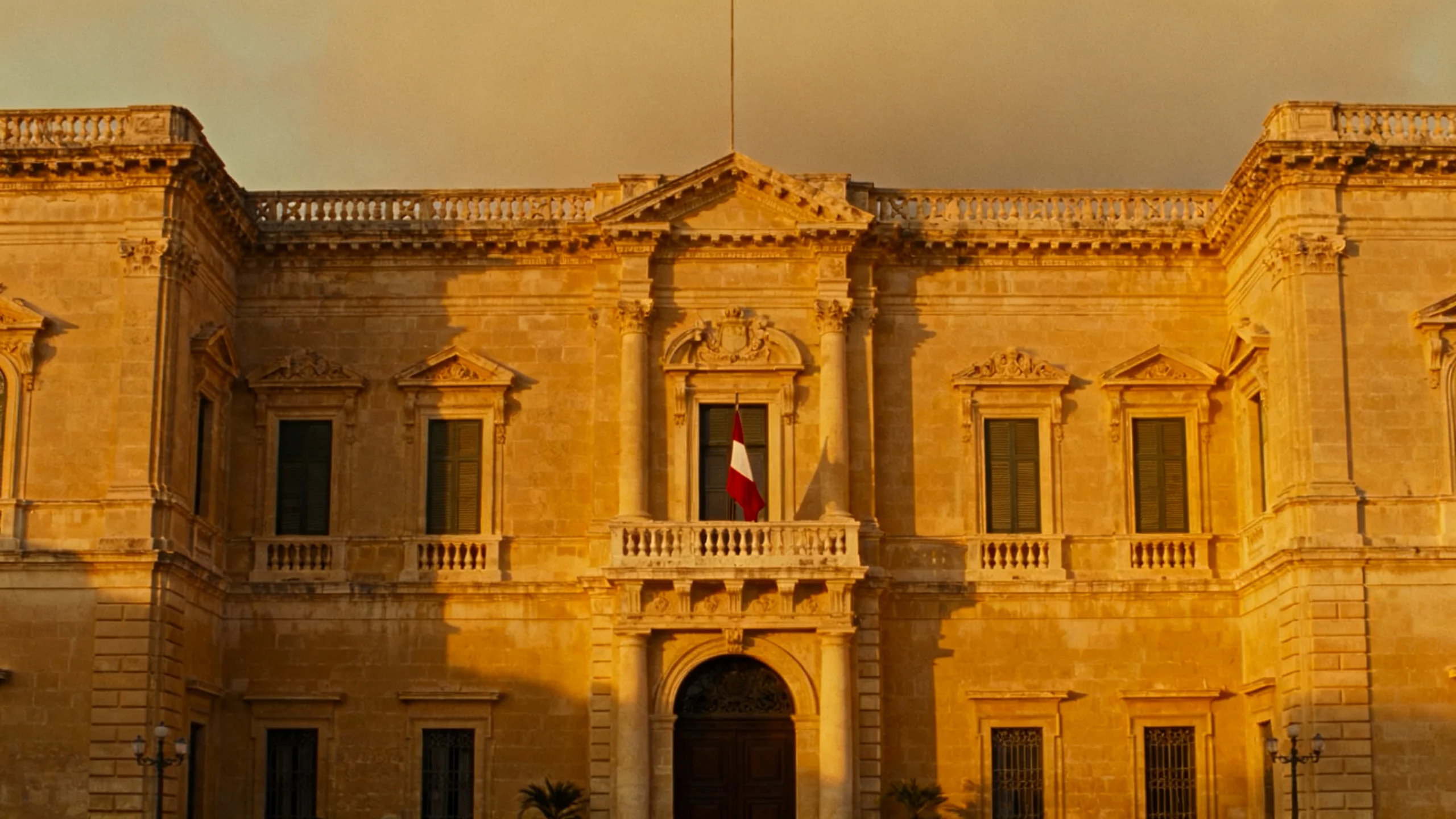
- Auberge de Castille (now the Prime Minister’s Office) on Triq Castille.
- Auberge d’Aragon on Triq il-Punent, now the office of the Deputy Prime Minister.
- Auberge de Provence on Triq ir-Repubblika, now the National Museum of Archaeology.
- Auberge d’Italie on Triq il-Merkanti, now the Malta National Community Art Museum.
- Auberge d’Auvergne survives in fragmentary form within the modern law courts complex.
- Auberge de France was demolished in the 19th century but a marker survives.
- Auberge d’Angleterre in Birgu (predates the Valletta auberges) survives as the Inquisitor’s Palace administrative wing.
These buildings are walkable in a 90-minute tour. They are the visual signature of Knight-era Valletta: low stone facades with carved entrance portals, modest decorative restraint compared to the cathedral interiors.
St John’s Co-Cathedral
The conventual church of the order, built between 1572 and 1577 as the Knights’ headquarters chapel and later upgraded to co-cathedral status (sharing the seat of the Maltese church with Mdina’s St Paul’s Cathedral). The exterior is austere, almost military, by the Knights’ own design: they wanted the cathedral to look like a fortress.
The interior is the most ornate baroque space in Malta. Mattia Preti’s vault frescoes (1661-1666) cover the entire ceiling with scenes from the life of John the Baptist. The marble inlaid tombstone floor is unique: every slab is the grave marker of a Knight, with the family arms, the Latin epitaph, and the personal device. The chapels along the side aisles are dedicated to the eight langues, each decorated in the style of the langue’s national art.
The Oratory off the nave holds the two Caravaggios: The Beheading of St John the Baptist (1608, the largest canvas Caravaggio ever painted and the only one he signed in full), and St Jerome Writing. Both originals.
Caravaggio came to Malta in 1607, fleeing a murder charge in Rome. The Grand Master Alof de Wignacourt admitted him as a Knight in gratitude for the Beheading and St Jerome. Within a year, Caravaggio had been imprisoned for assaulting another knight, escaped to Sicily, and his Knighthood was revoked. He died near Naples in 1610.
Decline and the French occupation
The 18th century was the Knights’ slow decline. The order’s military function was less relevant in a Europe of nation-state navies; its financial base (the European commanderies that funded the Maltese operation) shrank under successive secularisations.
The end came suddenly. On 9 June 1798, Napoleon Bonaparte arrived at Valletta with an army of 40,000 en route to Egypt. The order surrendered without a fight (the Knights were forbidden by their own constitution to bear arms against fellow Christians; many of the French Knights refused to defend Malta against the French army). Napoleon spent six days in Malta, looted the cathedral treasures and the order’s archives, abolished the order’s rule, and sailed for Alexandria.
The French occupation lasted two years. Local Maltese resistance, aided by a British naval blockade, ended it in 1800. The order was already disbanded. The British administered Malta as a protectorate from 1800 and as a crown colony from 1813 until independence in 1964.
The Knights survive today as the Sovereign Military Order of Malta, a small sovereign entity with embassies in many countries, running humanitarian operations worldwide. They no longer rule any territory but retain their UN observer status and their own postage stamps.
What to see
For a knight-themed Valletta day:
- St John’s Co-Cathedral (€15, 90 minutes). The Caravaggios.
- Auberge de Castille exterior walk (free, 10 minutes).
- National Museum of Archaeology (the auberge interior, €6, plus the temple artefacts).
- Casa Rocca Piccola (€9, 60 minutes). A surviving Knight-era palazzo, still occupied by descendants of one of the families.
- Fort St Elmo (€10, 2 hours). The 1565 defence site, plus the National War Museum.
For the Three Cities Knight context:
- Fort St Angelo in Birgu (€10, 75 minutes). The Knights’ first base before Valletta.
- Inquisitor’s Palace in Birgu (€6, 60 minutes). The Roman Inquisition’s Malta headquarters.
- The Collachio in Birgu, the walled quarter where the Knights lived.
For Mdina, the Knight context is lighter (Mdina was the existing pre-Knight capital; the Knights demoted it in favour of Valletta in 1571), but the Cathedral and Vilhena Palace are worth visits.
The honest paragraph
Most of what travellers find distinctive about Malta architecturally exists because of these 268 years. The Renaissance grid of Valletta, the baroque interiors, the auberges, the Three Cities fortifications, the cathedrals, the very fact that an island this small has so many world-class historic structures: all of it is the legacy of the Knights’ two and a half centuries of investment. To walk Valletta without knowing the basic outline of this history is to miss the layer that explains everything.
Related reading
- Baroque Malta: what the Knights paid for, room by room.
- Megalithic Malta: the prehistory that predates them by 5,000 years.
- Valletta walking tour: the 3-hour route through the Knights’ city.
- Three Cities harbour cruise: the original Knights’ base at Birgu.
- Valletta & the Three Cities: the region page for trip planning.