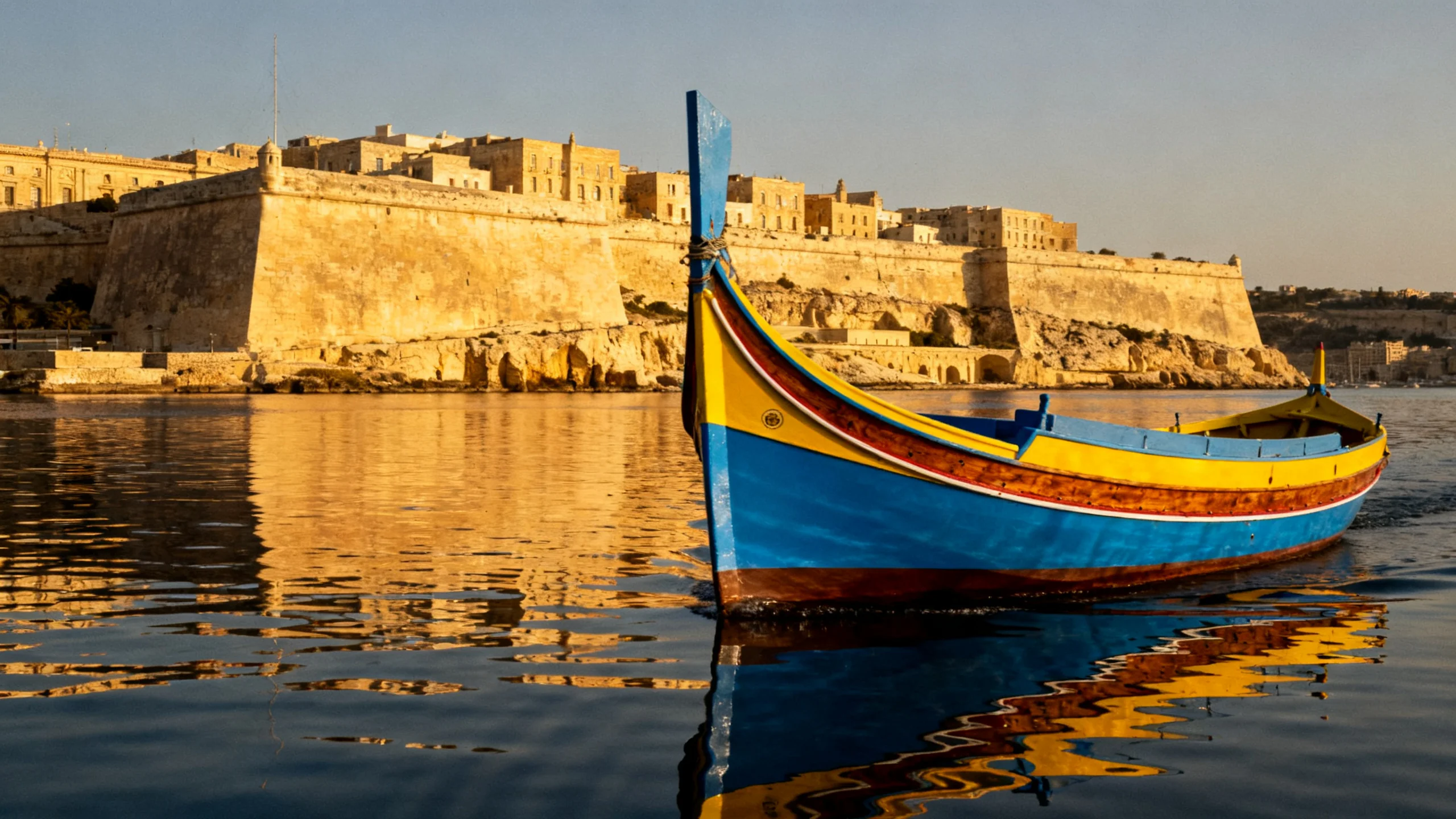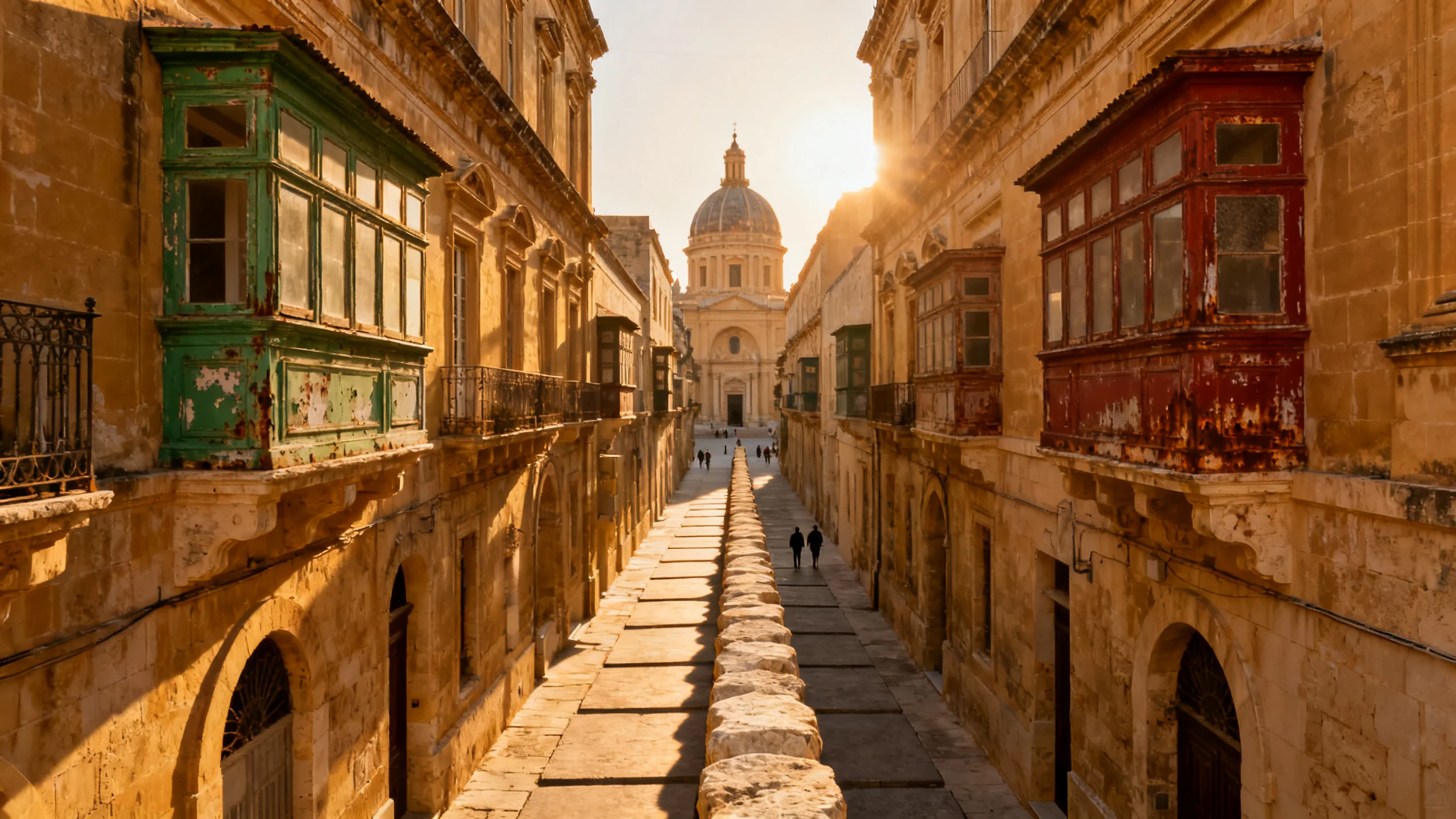
The honest walking route from the Triton Fountain to Fort St Elmo, with St John's Co-Cathedral, the Caravaggios and Upper Barrakka. Self-guided in 3 hours.
Valletta is small enough to see in one organised walking day. The peninsula is 900 metres long and 600 metres wide. The grid is regular, so getting lost is hard. The honest sequence below uses gravity in your favour, ends with sunset at the Grand Harbour, and covers the genuine highlights without padding. Three hours unhurried, four if you take the Co-Cathedral slowly.
The walking route, in order
Start at the Triton Fountain outside the city gate. The three bronze tritons holding a wide basin were sculpted by Vincent Apap in the 1950s and restored in 2017 for Valletta’s European Capital of Culture year. Take five minutes here and walk through the modern Renzo Piano city gate.
Republic Street is the pedestrianised spine. Walk it slowly. The first 200 metres pass the Auberge de Castille (now the Prime Minister’s office, exterior only), the National Library, and Republic Square with Queen Victoria’s statue at the centre. Look for the carved limestone portals on the side streets; they are the visual signature of the city.
St John’s Co-Cathedral, off Republic Street to the right. Built between 1572 and 1577, the conventual church of the Knights of St John. The interior is one of the most heavily ornamented baroque spaces in Europe: a painted vault ceiling by Mattia Preti (1661-1666), a marble inlaid tombstone floor where every slab is the grave of a Knight, and the Oratory containing the two Caravaggios. Allow 90 minutes minimum, two hours if you take the time on the paintings. Book the timed ticket online to skip the door queue. Dress code enforced (no shorts, no bare shoulders).
Casa Rocca Piccola on Triq San Pawl, 5 minutes from the cathedral. The still-occupied 16th-century palazzo of the Marquis de Piro, who personally gives the hourly tour. The wartime air-raid shelter cut into the limestone below the house is one of the strongest small-museum experiences in Malta. Allow 60 minutes.
St George’s Square (Pjazza San Ġorġ) further down Republic Street, with the Grandmaster’s Palace facade (state rooms closed for restoration through 2026), the Police Headquarters, and the National Library. Brief stop.
Upper Barrakka Gardens on the St Peter and St Paul bastion, with the view sweeping across Grand Harbour to the Three Cities. Time the Saluting Battery cannon at noon or 16:00 (€3 to descend to the battery level; free to watch from the gardens above).
Lower Barrakka Gardens at the south-east tip of the city for a quieter harbour view. The neoclassical memorial to the Great Siege of 1565 and the small chapel of Our Lady of Liesse are here.
Fort St Elmo at the tip of the peninsula. The 1565 siege defence site, rebuilt by the Knights in the 17th century, now housing the National War Museum. The 1942 material on the Siege of Malta is the strongest section; the George Cross awarded to the entire island is on display. €10, allow 2 hours.
Total time: 3 hours at a brisk pace skipping the slower museum visits, or 4-5 hours with full Cathedral and War Museum visits. The walk works in either direction; this is the gravity-friendly version.
Self-guided vs guided
The walking spine is easy to follow without a guide. The streets are signed, the major sites are well-marked, and you can read the audio guide at St John’s Co-Cathedral and the National War Museum for context. Self-guided is the strong default for travellers comfortable with their own map-reading.
A guided walking tour (around €25-35 per person, 3 hours) adds value if you want:
- A historical narrative tying the buildings together (the Knights of St John story).
- Insider stops you might miss (specific palazzi, the small auberges, the Strait Street back lane).
- A small-group atmosphere rather than reading information panels solo.
Book a small-group Valletta walking tour on GetYourGuide. Most tours include St John’s Co-Cathedral entry; check the inclusions before booking.
When to go
Best time of day: late afternoon (15:00 onwards) and evening. The cathedral and the Co-Cathedral are quieter, the limestone catches warm light, and the post-cruise hour from 17:00 onwards has the city largely to itself.
Worst time: between 10:00 and 14:00, when cruise excursions clog the central streets and the Co-Cathedral has 30-45 minute door queues.
Best season: Spring (April-June), autumn (September-October) and winter (November-March) are all excellent. Summer (July-August) is uncomfortably hot for sustained walking; restrict the walk to before 11:00 or after 17:00.
What to skip
- The horse-drawn karozzin carriages at the city gate. The streets are 900 metres end to end; walking is faster.
- The Valletta Tourist Train road circuit. The whole city is a 30-minute walk.
- Most of the souvenir shops on Republic Street. The limestone sculpture is mass-produced.
Practical notes
- Wear shoes with good grip; the limestone slabs can be slippery in wet weather.
- Public toilets inside the walls are scarce. The cathedral and the larger museums have them.
- Lunch options: small kitchens on Triq San Lucia or Triq Sant’Anna away from the Republic Street souvenir spine. Legligin Wine Bar or Rampila for a serious sit-down; pastizzi from a counter for €0.60 each.
For a longer Valletta program with the Three Cities crossing, see the Valletta region hub.
Related reading
- St John’s Co-Cathedral: the headline stop, in detail.
- Three Cities harbour cruise: the afternoon pairing.
- Baroque Malta: the painted vault and what produced it.
- The Knights of St John: the patrons who built the city.
- Valletta boutique hotels: sleeping inside the walls.