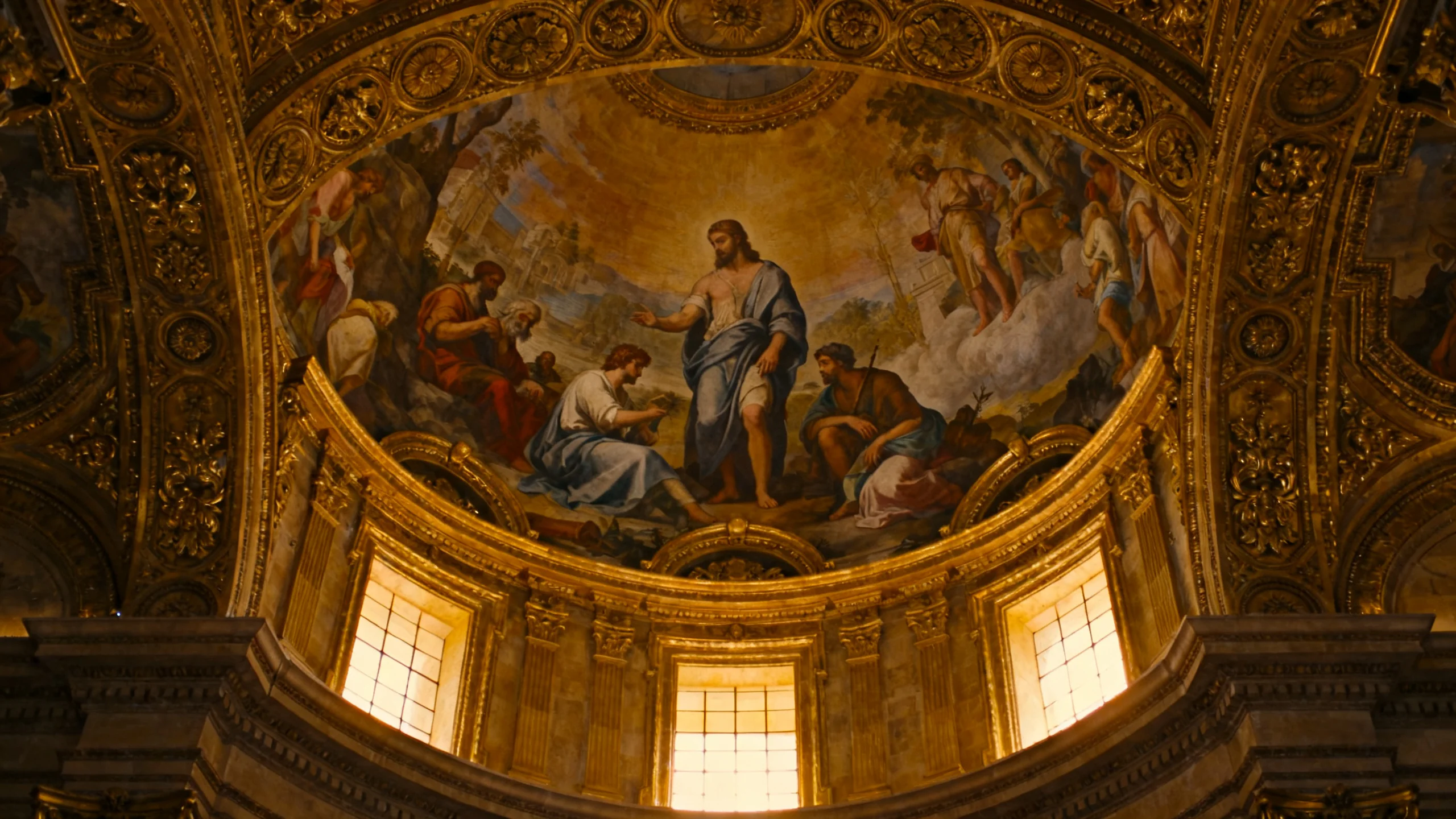
How the Knights of St John turned Valletta into a 17th-century baroque showcase, the Caravaggio years, and where to see it all today.
Walk into the nave of St John’s Co-Cathedral in Valletta. Look up. The vault above you is covered in painted scenes of the life of John the Baptist, executed between 1661 and 1666 by Mattia Preti, the Calabrese artist who spent most of his working life on Malta. The marble inlaid tombstones below your feet are the graves of Knights from across Europe, with full family arms and Latin epitaphs. The two Caravaggios in the Oratory off the nave include the only painting Caravaggio ever signed in full. The carved gilding on every interior column was executed by Maltese craftsmen between 1660 and 1730.
This is one room in one cathedral in one city in one of the smallest countries in Europe. The density and quality of baroque art and architecture in Malta is genuinely unusual; the explanation is straightforward and historical.
Why so much baroque
The Knights of St John ruled Malta from 1530 to 1798. They had access to:
- Money: revenues from the order’s commanderies across Catholic Europe (France, Spain, Italy, Germany) flowed into the Malta treasury.
- A patronage network: prominent Knight families had personal Italian and Spanish artistic patrons who could be borrowed for Malta projects.
- A specific religious-political agenda: after the 1565 Great Siege, the Knights needed to project the image of Christian victory over the Ottomans. Baroque art (large-scale, emotionally intense, religious) was the visual language of that project.
- A clean slate: Valletta was built from 1566 onward on previously empty land. Nothing had to be demolished; nothing had to be retrofitted. The entire city could be designed and decorated to baroque ideals.
The result is a concentration of baroque architecture and painting per square kilometre that exceeds even Rome (where baroque was added to existing Renaissance and medieval layers) and certainly exceeds Sicily, Lecce, or any other regional centre.
Mattia Preti: the Calabrese who stayed
Mattia Preti (1613-1699) was born in Taverna in Calabria. He trained in Rome with Caravaggesque painters in the 1630s, worked for the Barberini and Pamphili families, and produced major altar pieces in Naples in the 1650s.
In 1661, at the age of 48, he came to Malta on a commission and stayed for the rest of his life, 38 years. He died on Malta and is buried at St John’s Co-Cathedral.
His Malta output includes:
- The St John’s Co-Cathedral vault frescoes (1661-1666): the 18 scenes from the life of John the Baptist that cover the entire ceiling. Painted directly onto stone (not on plaster as in standard fresco), which is technically unusual.
- Numerous altarpieces in Maltese parish churches: the major ones at Naxxar, Mosta, Zurrieq, Zabbar.
- Easel paintings for private patrons, mostly Knights’ commissions.
- The St John’s Co-Cathedral chapel decorations for the langues (national groups of knights), executed by Preti’s workshop with his oversight.
Preti is the dominant Maltese baroque painter. Without him, the Valletta baroque interior would be substantially diminished. The 38 years he spent on Malta were the longest sustained residence of any major Italian baroque artist outside Italy.
The Caravaggio episode
Caravaggio’s Malta time is shorter (about 15 months in 1607-1608) but more famous because of his subsequent biography.
He arrived in Malta in July 1607, fleeing a murder charge in Rome (he had killed a man in a Roman tennis-court brawl in 1606 and the death sentence was outstanding). The Knight Grand Master Alof de Wignacourt admitted Caravaggio as a Knight of Obedience in July 1608, partly in exchange for the two cathedral paintings:
- The Beheading of St John the Baptist (1608): the largest canvas Caravaggio ever painted (over 5 metres by 3.5 metres), the only one he signed in full (“F. Michelang.o.f.”), and arguably his masterpiece. The painting hangs in the Oratory off the cathedral nave.
- St Jerome Writing (1608): a smaller painting in the same Oratory, the saint shown writing in his study with intense chiaroscuro.
Within weeks of becoming a Knight, Caravaggio was involved in another fight, this time wounding a senior Maltese knight. He was imprisoned at Fort St Angelo, escaped (the historical record is unclear how), fled to Sicily and then Naples, painted continuously, and died in 1610 near Naples at the age of 39. His Knighthood was revoked posthumously.
The two Caravaggios remain in their original location in the Oratory of St John’s Co-Cathedral. Both have been restored multiple times; the most recent major restoration of the Beheading (2003-2006) brought back the colour clarity that had been lost to centuries of candle smoke and varnishing.
Beyond Valletta: the parish churches
The baroque investment did not stop at the capital. From the late 17th century onward, the Maltese parish church became a major target of patronage. Local nobility, merchants returning rich from Mediterranean trade, and the various religious orders all commissioned increasingly elaborate church interiors.
The dome rivalry between Maltese villages is part of this story. Throughout the 18th and 19th centuries, neighbouring villages competed to build the biggest dome, the most elaborate facade, the most gilded interior. Mosta’s Rotunda of the Assumption (built 1833-1860, the third largest unsupported dome in Europe) is the late-baroque culmination of this rivalry.
Key parish-church baroque sites:
- Birgu Collegiate Church (St Lawrence): Mattia Preti altarpiece, restored 18th-century facade.
- Zabbar Sanctuary (Our Lady of Graces): Preti high altar, ex-voto collection.
- Naxxar Parish Church: Preti altarpieces, dome added in 1818.
- Zurrieq Parish Church: Preti altar, the rural baroque template.
- Senglea Collegiate (Maria Bambina): rebuilt after WWII bombing, baroque interior preserved.
- The Mdina Cathedral: rebuilt after the 1693 earthquake; Preti vault painting; the senior cathedral of Malta.
On Gozo:
- Ta’ Pinu Sanctuary (Gharb): early 20th-century neo-baroque, in a working baroque tradition.
- Cittadella Cathedral (Victoria): famous trompe-l’oeil flat ceiling by Antonio Manuele (1739) painted to imitate a dome.
- Xewkija Rotunda: claimed to be Europe’s third largest dome (the same claim as Mosta; Maltese pride and architectural reality occasionally disagree).
Architecture: Cassar, Laparelli, Tumas
The major architects of Maltese baroque:
- Girolamo Cassar (1520-1592): Maltese-born Knight, designed most of the original Valletta auberges and the early Co-Cathedral. His style is restrained: military-influenced facades, modest decoration.
- Francesco Laparelli (1521-1570): Italian, designed the Valletta city grid plan.
- Tumas Dingli (1591-1666): Maltese, designed many of the early 17th-century parish churches in the central villages.
- Lorenzo Gafà (1638-1703): Maltese, the most important late-17th-century church architect. The Cathedral of Mdina, the parish churches of Birgu, Vittoriosa, and Mosta (the earlier round church before the current Rotunda) are his.
Gafà’s domes are the visual signature of late-baroque Malta: tall, octagonal, with double-shell construction. The Mdina Cathedral dome is the masterpiece.
A baroque walking day
For a serious Maltese baroque visit:
Morning in Valletta:
- St John’s Co-Cathedral (€15, 2 hours including the Oratory time with the Caravaggios).
- The Manoel Theatre small baroque interior (€7, 30 minutes when no performance).
- A walk through the Knights’ auberges (Castille, Aragon, Provence, Italia, all 5 to 10 minutes apart).
Lunch at a Valletta restaurant in a baroque palazzo (Legligin Wine Bar, Rampila).
Afternoon in Mdina:
- St Paul’s Cathedral and Museum (€10, 90 minutes). Mattia Preti vault painting; the Latin-tomb floor; the cathedral treasury.
- A walk through the silent city looking for the carved palazzo entrances.
Optional Mosta stop before returning: the dome and the 1942 bomb story (free, 30 minutes).
The honest paragraph
Maltese baroque is not Roman baroque or Sicilian baroque scaled down; it is its own dense, locally produced version, with one major painter (Preti) who lived and worked here for almost four decades, two genuinely first-rank Caravaggios in the Oratory, and a parish-church culture that kept baroque architectural ambition alive into the late 19th century. The country is small enough that you can see most of the best of it in two unhurried days. For a traveller with even a casual interest in baroque art, the visit is one of the strongest concentrations available anywhere in southern Europe.
Related reading
- The Knights of St John: the patronage system that paid for all this.
- Limestone architecture: the local stone and how the baroque interiors were carved into it.
- Valletta walking tour: a 3-hour route that hits St John’s, the auberges and the Manoel Theatre.
- Mdina and Rabat: the second baroque centre.
- Valletta & the Three Cities: the region page for planning the baroque day.