Why the traditional dghajsa water taxi for €2 beats the harbour cruises at €35. The crossing, the Three Cities walk on the other side, and how to time it.
Grand Harbour is one of the great natural harbours in the Mediterranean. Three large bays cut into the limestone coastline, defended by massive 16th- and 17th-century bastions, with Valletta on the north shore and the Three Cities (Birgu, Senglea, Cospicua) opposite. The crossing between the two sides has been done since the 17th century by the traditional dghajsa, a wooden water taxi descended from Phoenician and Roman small-boat designs.
This crossing is the most underrated water experience in Malta. It costs €2 per person each way and takes 10 minutes including the loading. The tourist-cruise boats from Sliema and Bugibba that promise harbour tours charge €25-35 for a similar experience with extra commentary and music.
This is the case for the dghajsa.
What you actually get
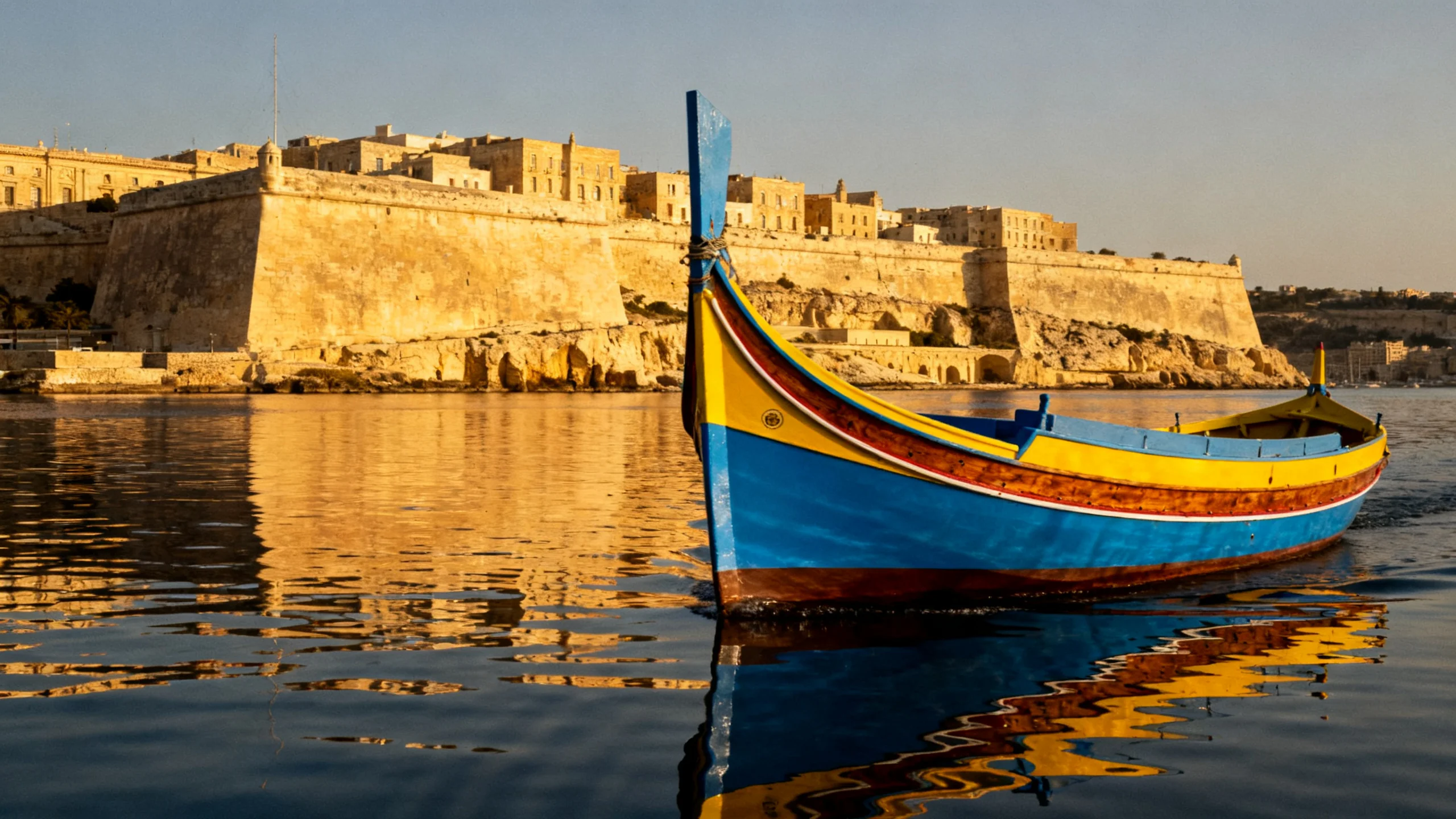
A traditional dghajsa tal-Pass is a low, beamy wooden rowing boat about 7-9 metres long, with a high prow and a low stern. Painted in deep blue, yellow, red and white. The boat carries 4-6 passengers comfortably (8 maximum). The operator rows standing, facing forward, with a single pair of long oars worked in the traditional Maltese style.
The crossing itself takes about 7-10 minutes. The route runs from Lascaris Wharf at the foot of Upper Barrakka Gardens (Valletta side) to the Birgu landing below the Inquisitor’s Palace. The boat passes:
- The bastion walls of Valletta on your left (the south-facing fortifications, the most photographed bastions in Malta).
- The Three Cities skyline as you approach: the parish church of Birgu (St Lawrence), Fort St Angelo at the tip of the Birgu peninsula, the Senglea bell tower.
- The working harbour, with cargo ships, the occasional cruise ship, and the smaller dghajsijiet ferrying other passengers.
The water in Grand Harbour is calm year-round (the harbour is enclosed on three sides) and the crossing is comfortable at any time of day.
Booking
No advance booking required. Walk to Lascaris Wharf, find a dghajsa with the public-rate sign displayed (€2 per person), and the operator will take you across as soon as the boat fills (or earlier if you pay for the full boat at €10-12).
Cash only. Bring small notes; the operators do not have change for €50 notes.
Return crossing: walk to the Birgu landing, find another dghajsa, pay €2 to come back. Or pre-arrange the return with your outbound operator if you want a fixed time.
The Three Cities walk on the other side
Once you arrive in Birgu, the walking sequence:
- Walk up from the landing into the Collachio, the walled quarter where the Knights’ auberges (lodgings by language group) were concentrated.
- Inquisitor’s Palace on Triq il-Mina l-Kbira (€6, 60 minutes). The Roman Inquisition’s Malta headquarters with intact dungeons and courtroom.
- Fort St Angelo at the tip of Birgu (€10, 75 minutes). The Knights’ first headquarters and the centre of the 1565 defence. The view from the rampart back at Valletta is arguably better than Upper Barrakka.
- Walk to Senglea (10 minutes along the harbour-front road) for Gardjola Gardens at the tip, with the famous limestone watchtower carved with an eye, an ear and a crane.
- Optional Cospicua walk along the inner harbour to see the working dockyards.
Total walking time on the Three Cities side: 3-4 hours unhurried.
Lunch in Birgu: Tal-Petut or Don Berto on the harbour-front for casual Maltese kitchens, Cugó Gran Macina Grand Harbour for the high-end option (boutique hotel restaurant; book ahead).
Return crossing: another dghajsa from the Birgu landing. The last dghajsijiet usually run until about 18:00 in winter and 21:00 in summer.
Alternatives if the dghajsa is closed
- Public commuter ferry from the same Lascaris Wharf: €1.50 one way, every 30 minutes, 5-minute crossing in a slightly larger boat. Use this if the dghajsa queue is long or if it is raining (the dghajsa is open-air).
- Walking via the Marsa peninsula: a 6 km detour around the head of the harbour. Bolt is €8-12 depending on traffic. Use this only with significant luggage or in heavy rain.
Book a Three Cities walking tour on GetYourGuide if you want a guided format that includes the dghajsa crossing plus the Birgu walk.
The tourist-cruise alternative
The Sliema and Bugibba waterfronts sell “Grand Harbour cruises” at €25-35 per person. These boats:
- Are larger (50-100 passengers).
- Cover the harbour from the water side without landing in the Three Cities.
- Add commentary (variable quality, often pre-recorded multilingual).
- Include music and a small bar.
- Last 60-90 minutes total.
These boats give you a different experience: a continuous loop tour of the harbour from the water without the option to disembark and walk. If you specifically want a sit-back harbour cruise without active walking, they are reasonable. If you want the genuine Three Cities visit, the dghajsa + walk pattern is substantially better.
When to go
Best time of day:
- Mid-morning (10:00-11:30): small queues, calm water, good light for photography.
- Late afternoon (15:00-17:00): warm light on the Birgu bastions; perfect for the Fort St Angelo rampart visit.
- Around sunset: the harbour at golden hour is the photograph of the trip.
Worst time: Friday and Saturday evening (locals also use the dghajsa to get to Birgu for dinner; queue can be 20-30 minutes).
Best season: year-round. Even winter is fine; the dghajsas have small canvas awnings for light rain. Strong winter storms (rare) shut the service for a day or two.
What to skip
- The dghajsa operators who quote €10-15 per person without showing the public-rate sign. The public rate is €2; insist on it or walk to the next operator.
- The “harbour speedboat tours” marketed alongside the cruises. These are loud, race past the bastions in 30 minutes, and use diesel exhaust as a feature.
- The harbour swim tours that pitch a quick dip near Fort St Angelo. The harbour water quality is fine for swimming but the activity is unnecessary; the village beaches are 20 minutes away by car.
Getting there
The dghajsa is at Lascaris Wharf below Upper Barrakka Gardens in Valletta. To get there:
- From Valletta city centre: walk down to Upper Barrakka Gardens (5 minutes from Republic Street), then descend by the Barrakka Lift (€1 each way) or by the steps (8 minutes downhill).
- From the Sliema ferry: walk south along the harbour-side path (15 minutes).
Accessibility
The dghajsa requires stepping down from the wharf into the boat (about a 50 cm drop). The operator helps but it is not wheelchair-accessible.
The Barrakka Lift between Upper Barrakka Gardens and Lascaris Wharf is wheelchair-accessible.
The public commuter ferry has level boarding and is wheelchair-accessible.
The Three Cities walking route involves uneven limestone streets and stairs; the Inquisitor’s Palace and Fort St Angelo have step-up entrances.
Why this crossing matters
The dghajsa is one of the few continuously practised pre-industrial transport traditions left in Europe. The hull shape, the rowing style, the painted decoration are all genuinely traditional and largely unchanged for centuries. The operators are descended from generations of Birgu fishermen who used the same boats for both commercial fishing and harbour transport.
For €2, you get a 10-minute boat ride and a small encounter with a working Mediterranean maritime tradition. The tourist cruise alternative gives you a sit-back loop tour without that connection. The choice between them is, in a sense, the choice between Maltese tourism’s marketing version and its working version.
For the broader Three Cities context, see the Valletta & the Three Cities regional hub.
Related reading
- Valletta walking tour: the morning before the harbour crossing.
- The Knights of St John: why Birgu and Fort St Angelo matter.
- Luzzu fishing boats: the dghajsa’s working sister.
- Long weekend itinerary: the day-2 crossing the trip builds around.
- Valletta boutique hotels: the late-evening base after the return crossing.