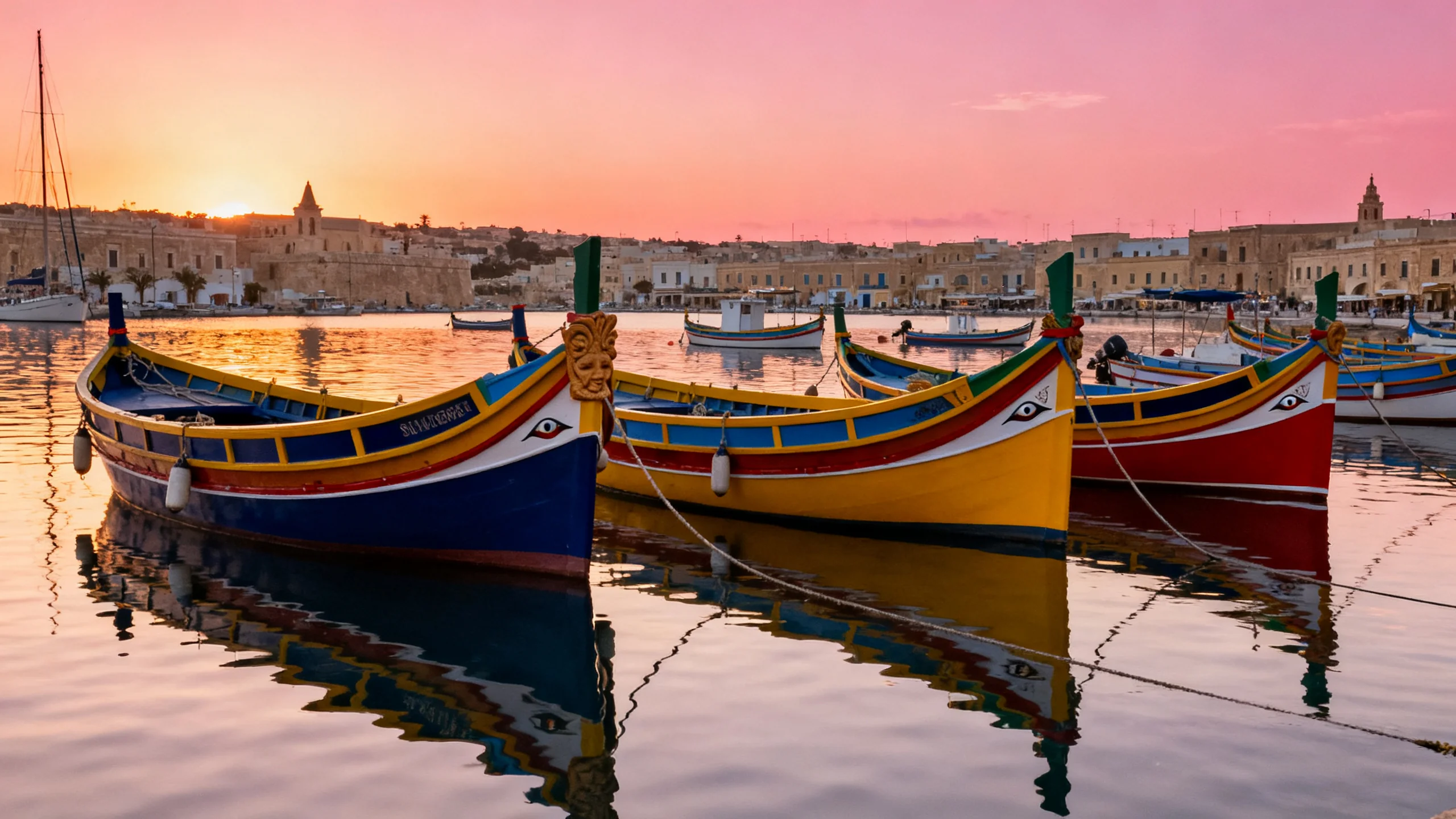
The painted Maltese fishing boats with the carved eyes on the prow. A Phoenician inheritance, the modern Marsaxlokk fleet, and what they actually catch.
Stand on the inner quay of Marsaxlokk at sunrise. The harbour fills with the most photographed working boat fleet in the central Mediterranean: low-slung wooden hulls painted in deep blue, sun-yellow, red, sometimes white, with a black band along the gunwale. On the prow of each boat, a pair of painted eyes stares forward.
This is the luzzu (plural luzzijiet), the traditional Maltese fishing boat. Roughly 200 of them still operate as a working fleet, mainly out of Marsaxlokk, Mġarr in Gozo, and a few smaller harbours. The painted eyes are not decorative in any modern advertising sense. They are a 2,800-year-old inheritance from Phoenician fishing tradition, and the boats that carry them are the visual signature of Maltese maritime culture.
What a luzzu is
A luzzu is a wooden boat, traditionally between 6 and 12 metres long, with a high prow, a relatively low stern, and a beamy hull designed for the chop of the central Mediterranean. The traditional construction uses planks of pine, oak, and (for the keel and frames) iroko or African mahogany, fastened with brass nails and copper strapping. Modern luzzijiet are sometimes built with fibreglass over wooden frames or fully in fibreglass, but the older wooden hulls are still common.
Propulsion is by inboard diesel engine. The traditional sail (a small lateen rig) is mostly gone from working boats; the inboard engine handles all propulsion. Some luzzijiet retain a mast for occasional sail use or for the steadying effect on a long fishing day.
The colours follow a loose convention: blue and yellow are the most common, often with white trim, occasionally with red bands. Each fishing family tends to paint its boats in a consistent palette over generations. The colours are repainted annually; a fresh luzzu just out of dry dock looks like a brand-new toy.
The eyes on the prow
The eyes carved or painted on the prow are the most distinctive feature. They are called għajn ta’ Osiris (“the eye of Osiris” in Maltese) or simply għajnejn (“eyes”), and they predate Christianity on Malta.
The Phoenician origin is straightforward to trace. Phoenician trading ships from at least 800 BC onwards carried painted eyes on their prows as protective magic. The eye was believed to ward off the evil eye (the malicious gaze that brings bad luck) and to help the boat find its way home through dangerous waters.
The Phoenicians traded extensively in Malta from the 8th century BC onward, eventually establishing the major settlement at Mdina and minor settlements across the coast. After the Phoenicians came the Carthaginians (closely related; same culture), then the Romans, then a thousand years of Latin-Christian rule. Through all of this, the small-boat fishing tradition on Malta continued to use the eye motif. By the time Christianity was the dominant religion (4th century AD onwards), the eye had become so embedded in the fishing tradition that it survived without question.
The Maltese clergy occasionally tried to reinterpret it as the Eye of God or the Eye of Providence (a similar single-eye Christian symbol common in 18th-century European church decoration). The fishermen mostly ignored these interpretations and continued treating the eye as protective magic without religious affiliation.
Today, the modern Maltese fishing fleet has dropped most other Phoenician practices. The eye on the prow is the longest-surviving piece of pre-Christian fishing tradition anywhere in the central Mediterranean and possibly anywhere on earth.
What they catch
The Maltese fishing fleet works the central Mediterranean year-round, with seasonal targeting of different species. The main fisheries:
- Lampuki (dolphinfish): the autumn fishery, late August to early November. Lampuki migrate through Maltese waters in schools, caught with floating fish-aggregating devices (kannizzati, palm-frond rafts that attract the schools). Lampuki pie is the seasonal Maltese dish; outside the season, fresh lampuki is unavailable.
- Tuna (tonn): large bluefin tuna are caught in spring (April-June) on offshore lines. The harvest is regulated by EU quota.
- Swordfish (pixxispad): longline fishery year-round, with peak landings in June and July.
- Squid (klamar) and octopus (qarnit): trapped on the limestone seabed, year-round.
- Smaller fish for the local market: sardines, anchovies, sea bream, sea bass, red mullet, all the standard Mediterranean inshore species.
The boats fish in two main patterns:
- Day fishing: out before dawn, back to harbour mid-morning with the night’s catch. This is the Marsaxlokk-quay fish market hour (08:00-11:00) when restaurant buyers come to negotiate.
- Longer trips: 2-4 day offshore trips for tuna or swordfish, ranging further into international waters between Malta, Sicily and the Libyan coast.
The Maltese fishing industry is small by international standards: around 1,000 registered fishermen, 200-250 active luzzijiet, total annual catch around 2,500 to 3,500 tonnes. Most of the catch goes to the domestic restaurant trade; exports are small.
The fishing year
For a traveller, the rhythm of the working fleet can be observed throughout the year:
Winter (December-February): reduced activity. Many boats are pulled up for winter maintenance (repainting, hull caulking, engine servicing). The dry-dock at Marsaxlokk fills with boats.
Spring (March-May): the tuna season starts. The bigger boats run multi-day offshore trips. The smaller boats work inshore.
Summer (June-August): swordfish season peaks. The fish market is active every morning; restaurants are full.
Autumn (September-November): the lampuki fishery. The peak weeks are mid-September to mid-October. Kannizzati appear in the harbour as fishermen prepare them; the floating palm-frond rafts are visible on early-morning runs out of Marsaxlokk.
Where to see them
Marsaxlokk is the main luzzu fleet base. The harbour holds 40-60 boats at any time. Sunday morning is the famous market; weekday mornings are the working version.
Mġarr (Gozo) is the second-largest fleet base. Around 25-30 luzzijiet operate from here. The harbour is also the Gozo ferry terminal, so the fishing boats share the space with passenger vessels.
Birgu (Vittoriosa): a smaller cluster of luzzijiet still moors in the Birgu waterfront. The boats here tend to be older and more traditionally maintained.
St Paul’s Bay: a small fleet of family-owned boats fishes from the bay, mostly working the inshore waters of the north coast.
Wied iz-Zurrieq: a tiny cluster of luzzijiet operates from the Blue Grotto inlet, running both fishing trips and tourist boat tours.
The boat-builders
A handful of traditional boat-builders still maintain the woodwork. The Marsaxlokk slipway at the back of the harbour has space for several boats at a time and one or two craftsmen who repair and occasionally build new luzzijiet from scratch. The cost of a new wooden luzzu (typical 8-metre size) is around €35,000-50,000, taking 6 to 12 months of part-time work. A fibreglass equivalent costs roughly half.
The traditional craft is slowly diminishing. The younger generation tends toward fibreglass for cost and maintenance reasons. A few of the older builders accept restoration commissions for collectors who want fully traditional wooden boats; these are increasingly rare.
How to engage with the fleet as a visitor
Three approaches:
As a buyer at the morning fish market. Walk the Marsaxlokk inner quay between 09:00 and 11:00 on any morning. The fishermen unload their catch directly to the buyers; you can watch the negotiations. Some sellers will sell directly to walk-up customers (small quantities, cash), but most operate through restaurant buyers.
As an audience for the painting work. Visit Marsaxlokk in February or March when the boats are out of the water for annual repainting. The fishermen and their families repaint by hand in the harbour and on the slipway.
As a boat trip passenger. A small number of working fishermen run summer half-day or full-day tourist boat trips on their luzzijiet. The trips usually involve a coastal cruise, optional swimming stops, and a lunch onboard. €60-90 per person; book through Marsaxlokk Tourist Information or directly at the harbour. This is the most direct way to actually sit on a working luzzu without buying one.
Skip
- The “luzzu cruise” boats marketed from Sliema and Bugibba that are actually modern motor boats painted in luzzu colours. The hull shape is wrong, the construction is fibreglass, the experience is a tourist-tier knock-off.
- The “traditional Maltese folklore evening” hotel shows that include luzzu imagery. Folklore-as-floor-show, not real fishing culture.
The honest paragraph
The luzzu fleet is one of the few continuously practised pre-Christian visual traditions left in Europe. The painted eye that the Marsaxlokk fishermen still paint on their boats every February is genuinely the same protective symbol that Phoenician sailors carved into their prows almost 3,000 years ago. The fleet is small (a few hundred boats), the working culture is precarious (younger generations are not always taking over the family boats), and the photogenic harbour-front aesthetic is doing a slow job of obscuring the working reality. For travellers who want to see actual maritime culture rather than the marketing version, the early morning at Marsaxlokk is the right hour.
Related reading
- Marsaxlokk fish market: how to time the Sunday market and the early-morning quay.
- Maltese cuisine: where the catch ends up on the plate.
- South Malta: the region the fishing fleet anchors in.
- Three Cities harbour cruise: the working harbour from a luzzu-style dghajsa.