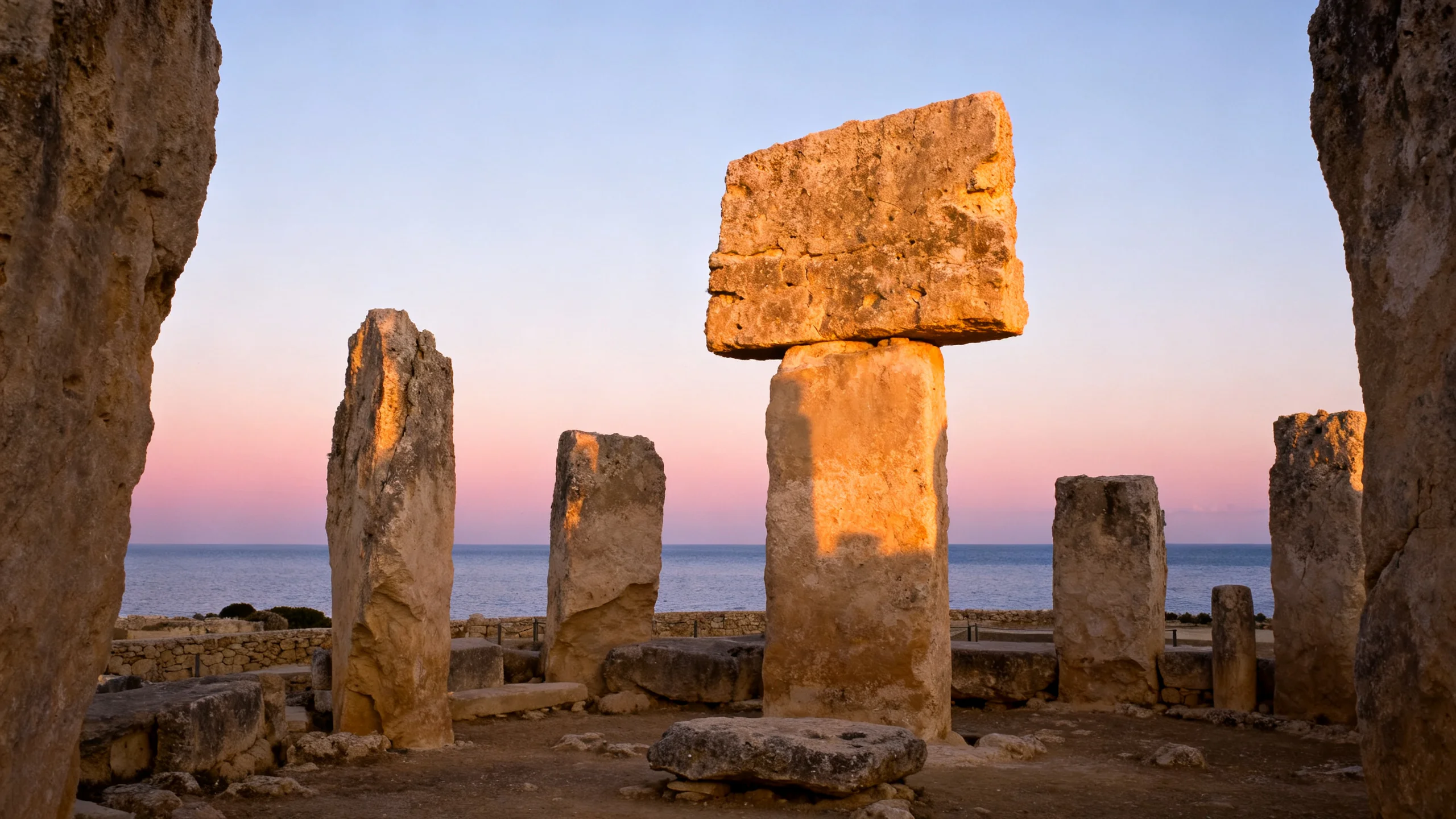
Six UNESCO temple sites built between 3800 and 2500 BC. The Hypogeum carved into the limestone. What the archaeology actually says about a civilisation we still cannot fully read.
The Egyptian pyramids were built between 2700 and 2200 BC. Stonehenge, in its earliest phase, around 3000 BC. The ziggurats of Mesopotamia, from about 2900 BC onward. And yet by the time the first stone of the Great Pyramid of Giza was cut, the Maltese temples had already been standing for close to a thousand years. Three of the seven sites are covered in detail in the Ggantija activity guide, the Megalithic temples south guide (Hagar Qim and Mnajdra), and the Hypogeum guide (which is technically a hypogeum, not a temple, but contemporary).
This is the headline fact most travellers learn on arrival, often from a tour guide, and dismiss as a minor archaeological curiosity. It is not. The Maltese temple period (roughly 3800 to 2500 BC) produced more standing megalithic architecture per square kilometre than anywhere else in the Mediterranean and possibly anywhere on earth. The structures that survive (seven UNESCO-listed temple complexes plus an underground necropolis carved into limestone) are the best-preserved monumental architecture of the Neolithic anywhere in Europe.
What was actually built
The temple plan is consistent across the sites and unlike anything else in prehistoric Europe. A trefoil or cinquefoil layout, with apses arranged around a central corridor, all enclosed by an external wall of upright limestone slabs (megaliths in the technical sense). The largest single stones weigh in excess of 50 tonnes. The technique for moving them remains debated.
The exterior walls were built with the largest stones placed vertically as orthostats, smaller stones laid horizontally above, and a binding rubble fill behind. The interior walls were faced with smoother coralline limestone, in some cases carved with spirals, animals or geometric patterns. Floors were paved with limestone slabs. Doorways used trilithon construction (two uprights plus a lintel) familiar from Stonehenge but in a domestic-scale form.
The temples are not domestic dwellings. There is no evidence of cooking fires, food preparation, or normal habitation. There are remains of animal bones (presumably sacrificial), libation holes carved into the floor, and ritual figurines (mostly female, often obese, the famous “Sleeping Lady” and “Fat Ladies” of the National Museum of Archaeology). The interpretation is that these were ceremonial structures: temples, in the modern sense, of an unknown religious system.
Where to see them
Seven UNESCO-listed temple complexes:
- Hagar Qim and Mnajdra on the southern cliffs of Malta. Paired, 500 m apart. The most commonly visited.
- Tarxien Temples in the modern town of Paola, central Malta. Four temples, tightly clustered, with the most carved decoration.
- The Hypogeum of Hal Saflieni in Paola, the underground necropolis with painted chambers (booking 2-3 months ahead required).
- Ġgantija in Xagħra on Gozo. Two temples, the older of the two on the archipelago.
- Ta’ Ħaġrat in Mġarr, north Malta. Smaller, less visited. See the magazine piece on lesser-known temples.
- Skorba also in north Malta. Even smaller; older than the temple period in its earliest phase.
- Borġ in-Nadur in Birżebbuġa, south Malta. Bronze Age phase added later.
Plus several minor sites (Buġibba, Xagħra Stone Circle) of more specialist interest.
What we know about the temple builders
The population that built these structures arrived on Malta around 5200 BC, probably from Sicily, in small farming groups. The temple period proper begins around 3800 BC with the construction of the first ceremonial structures at Ta’ Ħaġrat and Ġgantija. Building continued, with evolving styles, for about 1,300 years.
Then, around 2500 BC, the temple culture collapses. This is documented archaeologically: temple maintenance stops, no new temples are built, and a different material culture (Bronze Age, with pottery styles linked to Sicily) appears in the same locations. The cause remains debated. Hypotheses include:
- Environmental collapse: rapid deforestation visible in pollen records, possibly leading to soil erosion and agricultural failure.
- Disease: a pandemic of unknown origin sweeping the small population.
- Internal social collapse: religious or political crisis ending temple-building elite power.
- External invasion: a population replacement by Bronze Age arrivals.
The most likely answer is a combination of the first three. The fourth is not supported by genetic evidence.
What we cannot read
The temple builders had no writing system. We have:
- No deities named or depicted in a recognisable iconography.
- No religious texts.
- No explanation of the spiral motifs, the female figurines, or the temple alignments.
- No clear understanding of the social hierarchy.
- No documented temple festival or calendar (though Mnajdra’s equinox alignment suggests astronomy was important).
What we do have, indirectly, is the temple plan itself: identical across multiple sites built centuries apart, by people who must have been transmitting architectural and ceremonial knowledge across generations without writing. The temples are, in a sense, the documents.
The Hypogeum: the underground complement
The Hypogeum of Hal Saflieni is the necropolis that sits underground in modern Paola, cut into the soft limestone over about 800 years (roughly 3300 to 2500 BC). It is the only Neolithic underground structure in the world, and the only known prehistoric site where the architecture of the temple was carried below ground.
Three levels, painted ceilings (red ochre spirals), trilithon doorways carved out of solid rock to imitate the surface temples, and burial remains of around 7,000 individuals. The Hypogeum visit is the strongest single archaeological experience available on Malta, limited to 80 visitors per day for conservation. Booking opens 6 to 12 weeks ahead for shoulder season, 2-3 months for July-September.
Why the temples matter beyond Malta
For most of the 20th century, the megalithic Malta sites were classified as a regional curiosity. The fact that they predate the Egyptian pyramids was treated as an interesting footnote rather than as a major archaeological finding.
The current consensus has shifted. The Maltese temples are now understood as one of the earliest sustained traditions of monumental architecture anywhere on earth. They are also one of the earliest documented cases of a complex society building shared ceremonial space without state-level political organisation (the population was probably 6,000 to 10,000 at the temple-building peak; well below typical thresholds for state formation).
This matters because it shows that monumental architecture, ritual complexity, and long-distance trade (the temples used some imported stones and decorative items) can emerge without central authority. The Maltese temple culture is, in this sense, one of the few large-scale prehistoric counter-examples to the “complexity requires the state” model that dominates the Mesopotamian and Egyptian narrative.
How to visit
For a serious archaeological day:
- Morning: Ġgantija on Gozo (€10 combined ticket), the oldest of the temples.
- Lunch: Xagħra village.
- Afternoon: ferry to Malta, drive to Hagar Qim and Mnajdra (€10 combined ticket) on the southern cliffs.
For a shorter visit, choose Hagar Qim and Mnajdra (which are paired and atmospheric) plus the Tarxien Temples (which have the most carved decoration). Allow 2 to 3 hours per site for an unrushed visit.
For travellers who got Hypogeum tickets, work the visit into the day before or after the Tarxien Temples (they are 600 m apart in Paola).
Further reading
The standard general work is The Temples of Malta by David Trump (Floriana, 2002). The National Museum of Archaeology in Valletta has the original artefacts and a thorough audio-guide; allow 90 minutes if you have been to any of the temple sites.
The temples are not visually spectacular in the modern sense. They reward patience and the willingness to imagine yourself in front of a doorway built in 3600 BC by a society that did not yet have metal tools. The reward is the closest sustained encounter Europe offers with deep prehistoric time.
Related reading
- Ggantija temples on Gozo: the oldest of the seven sites.
- Megalithic temples south: Hagar Qim and Mnajdra in the same morning.
- The Hypogeum: the contemporary subterranean necropolis (timed-ticket only).
- Temples nobody visits: the four sites outside the main circuit.
- Limestone architecture: the same stone, refined over 5,000 years.