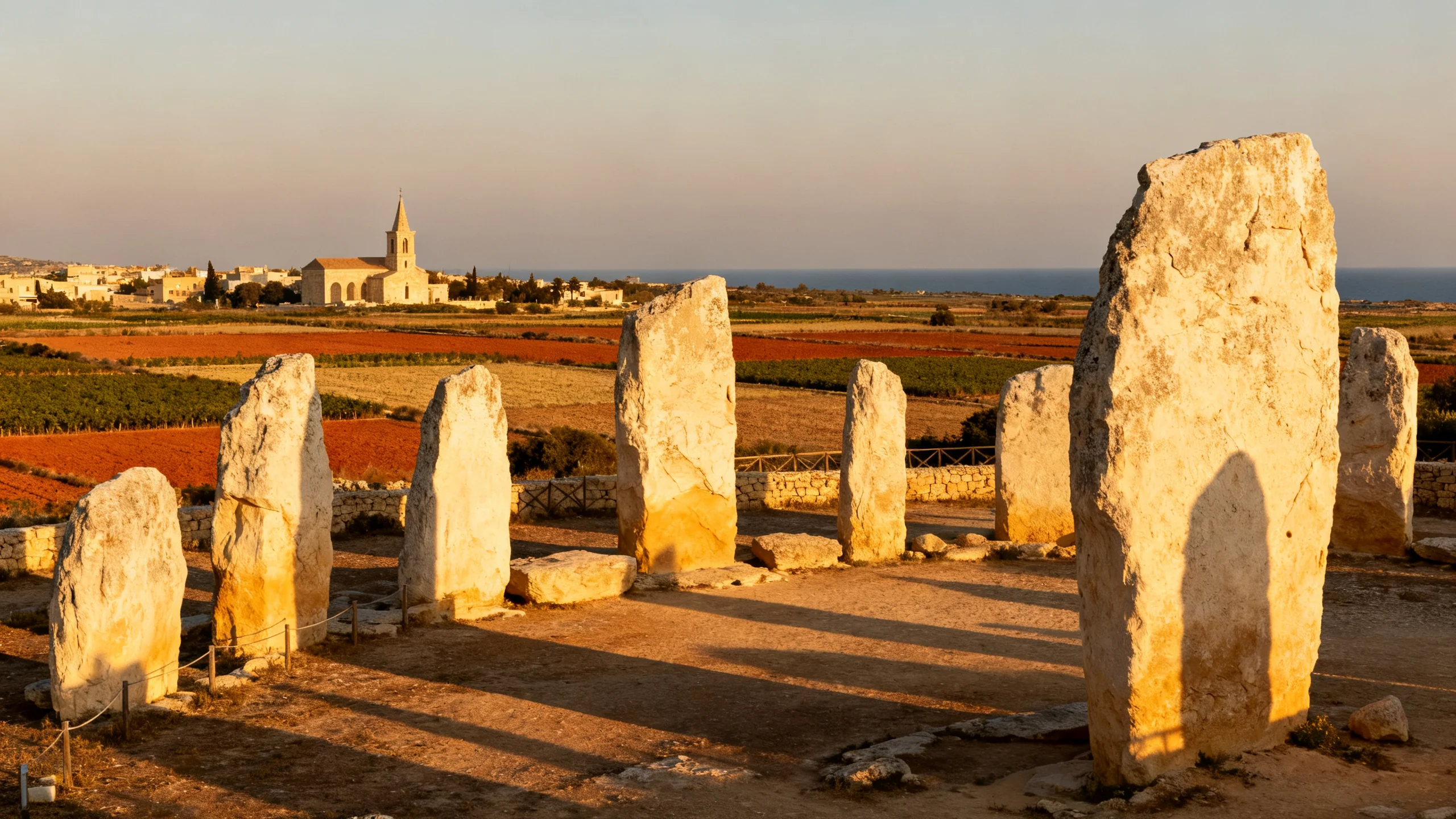
The three lesser-known megalithic sites that most travellers skip. The case for going, what to see, and what the archaeology adds beyond Hagar Qim and Ggantija.
Every Malta visitor with even a casual interest in archaeology hears about Hagar Qim, Mnajdra, Ggantija, and the Hypogeum. These are the four major Neolithic sites, all UNESCO-listed, all with visitor centres and audioguides and €6 to €40 admission charges. They are also four out of seven temple sites that have UNESCO status. The broader Megalithic Malta piece sets the chronological context.
The other three (Ta’ Ħaġrat, Skorba, and Borġ in-Nadur) are visited by maybe five percent of the travellers who see the four famous ones. They are smaller, less prepared for tourism, and substantially less impressive at first sight. But each adds something that the four famous sites do not, and a serious archaeology-focused Malta trip benefits from including at least one of them.
This is what they are, where to find them, and what to expect.
Ta’ Ħaġrat (Mġarr, north Malta)
A small temple complex on the western outskirts of Mġarr village in north Malta, dating to the early Mġarr phase of the Maltese Neolithic (roughly 3600-3200 BC). Two adjoining temples, the larger to the north, the smaller to the south, both built in the standard trefoil plan that the later major temples (Hagar Qim, Mnajdra, Tarxien) would refine.
What makes Ta’ Ħaġrat interesting is that it is one of the earliest sites that shows the full developed temple plan. The trefoil layout, the entrance trilithon, the carved limestone slabs, the internal niches: all of these elements are present in their basic form. The later major temples are more refined versions of what was already worked out at Ta’ Ħaġrat.
The site is small (roughly 30 metres long and 20 metres wide). The visit takes 30 to 45 minutes. There is a small visitor centre with a brief introductory display, but no audioguide. €3 admission. Opening hours are reduced (typically 09:00-16:00, closed Mondays), and the site is sometimes unattended even during posted hours; the gates are unlocked but nobody is on site.
How to get there: Drive to Mġarr village in north Malta (not to be confused with Mġarr port on Gozo). The temple is signed from the main road through the village. Bus #44 from Valletta to Mġarr, then a 10-minute walk.
What it adds: a sense of the temple plan in its early-developmental form. If you have already seen Hagar Qim and Mnajdra, Ta’ Ħaġrat is the chronologically earlier version that makes them more comprehensible.
Skorba (Żebbiegħ, north Malta)
A complex site 2 km west of Ta’ Ħaġrat, with two phases of occupation that span more than 3,000 years. The earlier phase (around 4500-4100 BC) predates the temple period proper and includes one of the oldest stratified Neolithic settlements in the central Mediterranean. The later phase (around 3400-3000 BC) added two temples on top of the earlier village remains.
The combination is unique. At Skorba you can see the same site used as a domestic village in the early Neolithic, then redeveloped as a ceremonial centre in the temple period, then partly reused in the Bronze Age. The stratigraphy is the clearest single example anywhere of how the temple culture grew out of an earlier farming-village culture.
The remains themselves are less visually striking than Ta’ Ħaġrat (the temple architecture at Skorba is partly destroyed; the village remains are foundation lines rather than standing stones). But the archaeological narrative is the strongest of any Maltese site.
The site is small, signed, and has a minimal information board on-site. There is no manned visitor centre. €3 admission, often unattended; the gates are accessible during reasonable hours.
How to get there: drive to Żebbiegħ village, then a short walk along Triq Skorba. Bus #44 to Mġarr, then 20 minutes on foot from the village.
What it adds: the strongest visible link between the temple culture and what came before. For anyone who has seen the more polished temple sites, Skorba is the explanation of how the temple plan emerged from earlier farming practice.
Borġ in-Nadur (Birżebbuġa, south Malta)
A late-temple-phase site on the south coast, in the modern town of Birżebbuġa near the freight port. The Neolithic temple here was built around 2700 BC, in the final phase of temple construction across the archipelago.
What makes Borġ in-Nadur distinctive is the Bronze Age occupation that followed. After the temple culture collapsed around 2500 BC, a Bronze Age village was established on the same site, with a defensive wall built around the old temple. The Bronze Age pottery styles (from elsewhere in the Mediterranean) appear immediately above the temple-period layers.
This is the clearest single site for understanding the transition from the temple culture to the Bronze Age. The temple was the last major construction of a culture that was about to disappear; the village above it was a different people moving in (or the same population shifting to a different cultural pattern; the genetic and material evidence is mixed).
The remains are partially excavated and visible. The temple foundation is clear in plan; the Bronze Age village wall is identifiable but less complete. The site is open but unattended; there is a small unstaffed information panel.
How to get there: drive to Birżebbuġa. The site is signed from the town centre. Bus #82 or #210 to Birżebbuġa, then a 15-minute walk through the town.
What it adds: the only Maltese site where the post-temple Bronze Age is visible. For travellers interested in the question “what happened after the temple culture”, this is the place to see the physical answer.
Why these are worth the visit
None of these three sites is impressive in a tourism-marketing sense. They are smaller, less prepared, and require more imagination than the four famous sites. For most travellers, they are skippable.
But for travellers genuinely interested in the Maltese Neolithic, each adds a layer that the four famous sites do not:
- Ta’ Ħaġrat adds the early-development phase of the temple plan.
- Skorba adds the pre-temple farming-village culture.
- Borġ in-Nadur adds the post-temple Bronze Age transition.
Together, the seven UNESCO sites tell the full archaeological narrative of the Maltese Neolithic and Bronze Age. The four famous sites are the visual peaks; the three lesser-known sites are the connective tissue.
A practical archaeology-day itinerary
For a serious archaeology-focused Malta visit (one or two days), the order to consider:
One-day intensive:
- 09:00-10:00: Skorba (the earliest layer).
- 10:30-11:30: Ta’ Ħaġrat (the early temple).
- 12:00-13:30: lunch in Mġarr village.
- 14:00-16:00: Hagar Qim and Mnajdra (the major late temples).
- 16:30-17:30: Tarxien Temples (the most carved late temples).
- 18:00-19:00: National Museum of Archaeology in Valletta (the artefacts).
This is a serious 9-hour archaeology day. You see the development of the temple plan chronologically (Skorba → Ta’ Ħaġrat → Hagar Qim/Mnajdra → Tarxien) plus the original artefacts in Valletta. The Hypogeum is excluded because tickets are too hard to fit into a same-day plan; book separately if possible.
Two-day version adds:
- Day 1: Skorba, Ta’ Ħaġrat, Ggantija on Gozo (ferry across).
- Day 2: Hagar Qim and Mnajdra, Borġ in-Nadur, Tarxien, the Hypogeum (if tickets), the museum.
The honest paragraph
Most Malta visitors should not bother with the three lesser-known temple sites. The four famous ones are enough for a general impression. But for travellers with a genuine archaeological interest (and there are more of these than the average tour-operator pitch assumes), adding at least one of the lesser sites is the move that turns a tourist visit into a serious one. The reward is not visual; it is conceptual. You leave the country understanding the Maltese Neolithic as a culture that grew, peaked, and disappeared over 2,500 years, with a clear chronological and material record. That understanding is genuinely rare among European prehistory destinations, and Malta is the place to acquire it.
Related reading
- Megalithic Malta: the long context piece.
- Hagar Qim and Mnajdra: the headline southern sites.
- Ggantija on Gozo: the oldest of the seven.
- Hypogeum Ħal Saflieni: the contemporary subterranean site.
- North Malta region: the home of Ta’ Ħaġrat and Skorba.