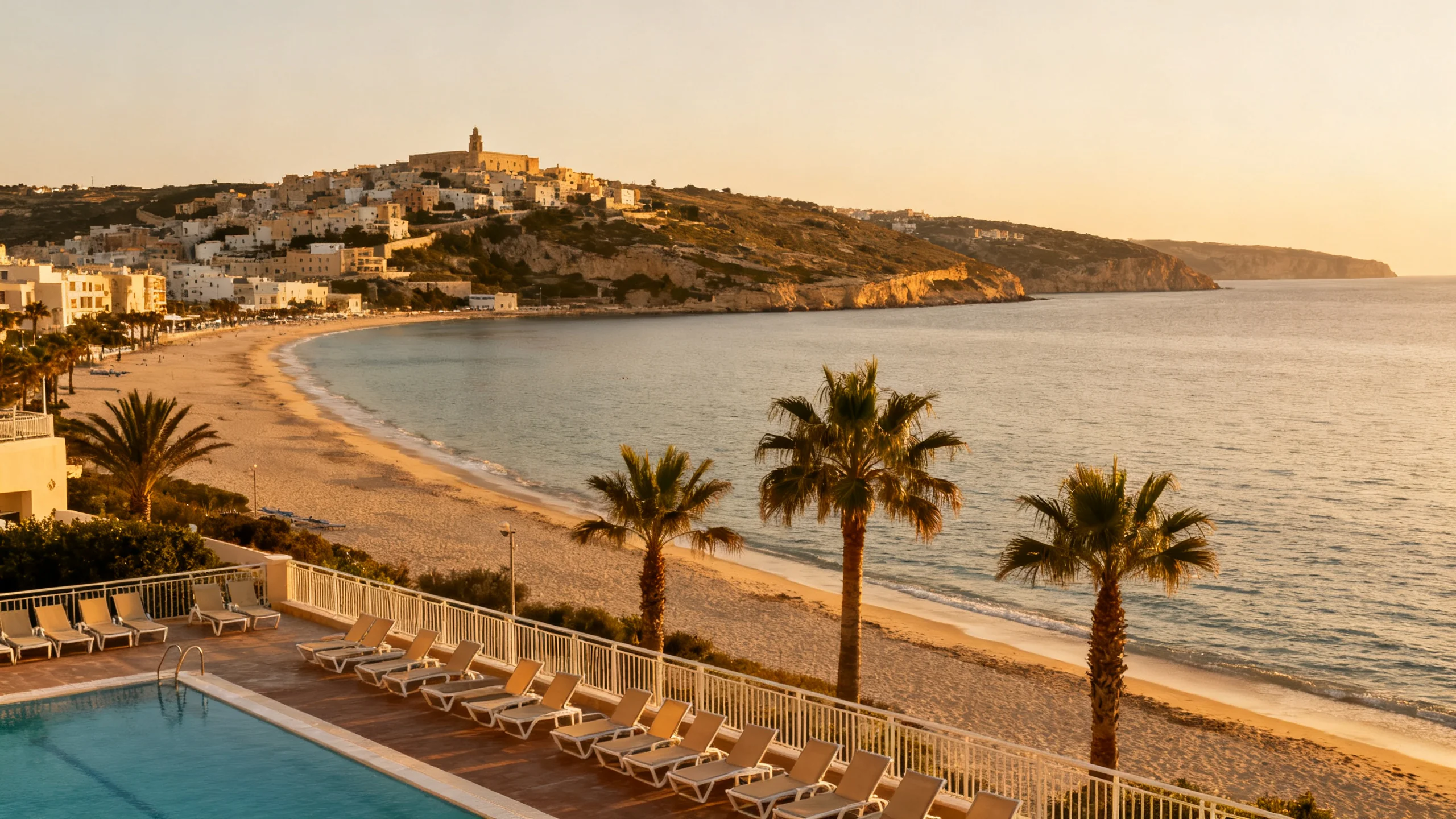
North Malta is where the country's sandy beaches actually are. Most of the rest of the island is rocky shoreline, and travellers who come for sand discover this on day two. Mellieha Bay alone holds more linear metres of sand than the south, east, and Sliema combined. The north is also where you catch the ferry to Gozo, where the package-tourism strip thins out into farmland, and where the road system finally stops feeling like a city grid. The honest take is that this region has two strong reasons to come (beaches, Gozo crossing) and a handful of weak ones (resort hotels, family conveniences, a windswept ridge walk). What it lacks is the limestone, the cathedrals, and the small-town character that makes the rest of Malta interesting. Choose your base accordingly.
Geography first. The north of Malta is a long peninsula that narrows toward Cirkewwa and the ferry port, with two big bays cut into the west coast (Mellieha Bay and the Golden Bay / Ghajn Tuffieha pair) and a quieter east-coast strip around Mistra Bay and Xemxija. The whole peninsula is about 12 km from south to north, and the road that runs along its spine (Triq il-Marfa) connects almost everything you might want to visit. A rental car is the obvious choice. The bus network exists but it punishes anyone who tries to use it for more than a single segment.
Functionally the region splits into three different kinds of place, and conflating them is the most common booking mistake.
Mellieha is the hilltop village at the top of the central plateau. Pleasant, walkable, anchored by the Mellieha parish church and its medieval sanctuary, with small boutique hotels and apartments. It is the only northern village that feels like an actual village rather than a tourist annex. Wakeful by 08:00, quiet by 23:00, the bakery on Triq il-Kbira sells the best pastizzi north of Birkirkara.
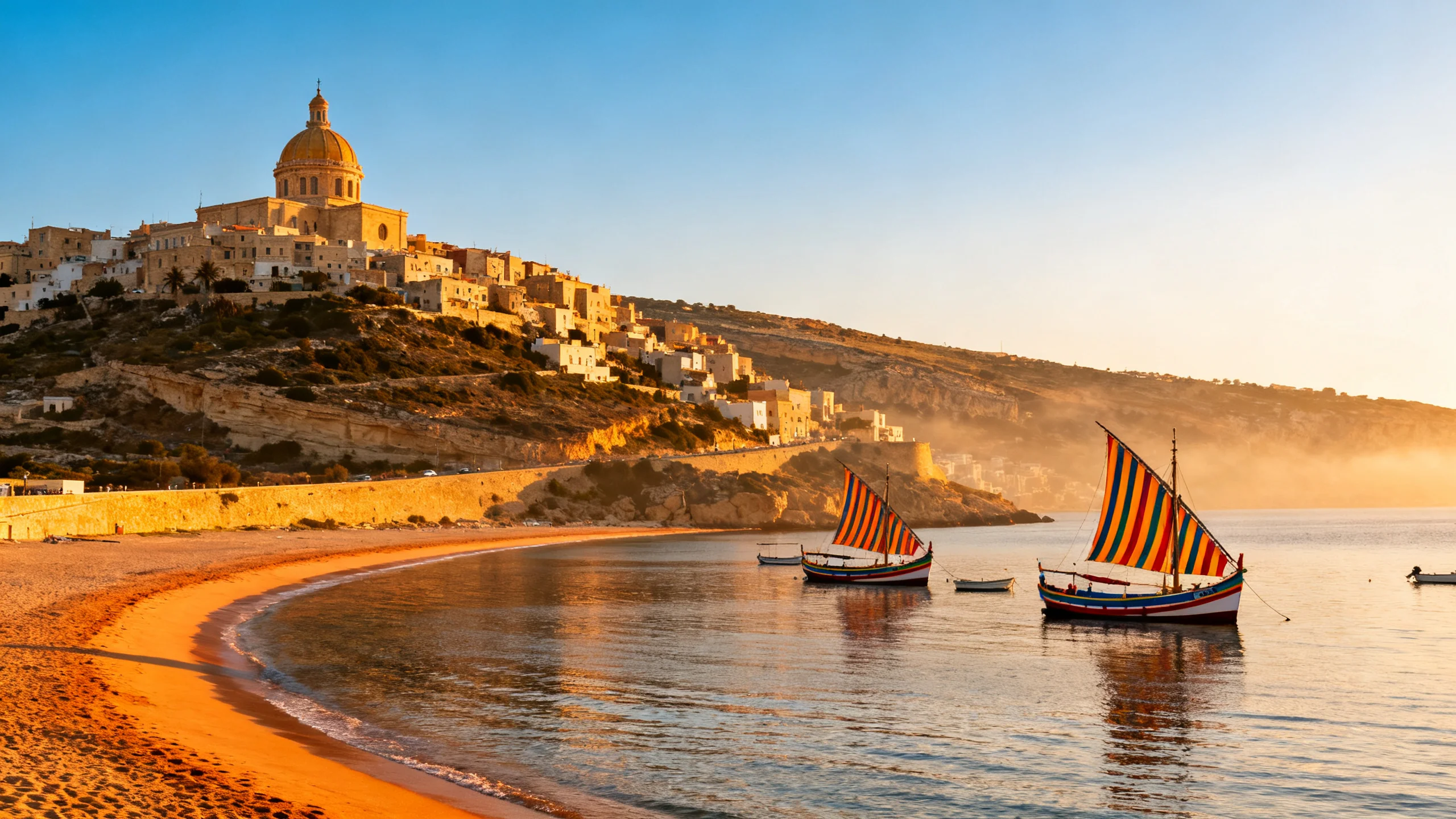
Mellieha Bay (Ghadira) is the long sandy beach at the foot of the village. Roughly 800 m of sand, shallow water out for thirty metres, beach hotels along the back of it. This is where Maltese families go on Sundays and where most package-tour hotels point their pool decks. In July and August the beach is uncomfortably full; in May, June, September and October it is the genuine highlight of north Malta.
St Paul’s Bay / Bugibba / Qawra is the package-tourism strip along the east coast, three towns that bleed into each other along a continuous seafront. This is the cheapest accommodation cluster in Malta, but it is also the least Maltese-feeling part of the country. Concrete apartment blocks, English-pub-themed bars, mini-markets, tour-bus pick-up points. If a hotel listing says “north Malta” at under €80 a night, this is where it is. Sleep here only if budget is the binding constraint or if you specifically want the British-package atmosphere.
The beaches in order
Mellieha Bay (Ghadira) is the default. Sand, shallow, lifeguarded in season, plentiful parking (with a fee in summer), kiosks and beach-club rentals along the back. Family-friendly for the depth gradient. Buses #41, #42 and #221 from Valletta all stop here. Arrive by 09:30 in July or August or expect to walk 800 m from a roadside spot.
Golden Bay (Ramla tal-Mixquqa) is the next bay west, less developed because there is only one resort hotel on it (the Radisson) and a much smaller car park. The sand is reddish-gold, the cliffs at either end frame it neatly, and the swimming is good. The wind is more honest here than at Mellieha; days with strong westerlies turn the water rough.
Ghajn Tuffieha (Riviera Beach) is a fifteen-minute walk over the headland from Golden Bay, down 200 steps and back up the other side. Smaller, quieter, the same red-gold sand, no hotel above it, and the best of the three for a serious beach day if you do not have small children. Take water; there is one snack van and nothing else.
Anchor Bay (Popeye Village) is the cove next door to Golden Bay, dominated by the 1980 Robert Altman film set turned into a paid attraction. Avoid the village itself (kitsch, family-park atmosphere, €18 admission for what is essentially a wooden mock-up). The cove next to it is fine for a swim.
Paradise Bay sits at the very tip of the peninsula, ten minutes south of Cirkewwa. Small, sheltered, a limestone-cut steps descent to a tiny strip of sand and a deeper rocky platform. Best if you are catching a Gozo ferry and want one swim before or after.
Skip the manmade “beach” along the Bugibba waterfront. It is a 50 m strip of imported sand on a concrete shelf, with the Bugibba aquarium and pizza chains immediately behind. There is no reason to choose it over the real beaches twenty minutes north.
Cirkewwa and the Gozo ferry
The Gozo ferry crosses from Cirkewwa terminal at the very north of the peninsula to Mgarr on Gozo. It is operated by Gozo Channel, runs every 30 to 45 minutes from roughly 06:00 to 23:00 (less frequent overnight), and takes about 25 minutes from quayside to quayside.
What to know:
- Booking is not required for foot passengers. Walk on, walk off.
- Car ticket is bought on the Gozo side coming back, not on arrival. So you drive on at Cirkewwa, drive off at Mgarr, do your Gozo day, then queue and pay (around €15 return for car + driver) at the Mgarr terminal on the way home. This is the part most first-time visitors find confusing.
- No advance reservation for the regular Gozo ferry. There is a separate fast passenger ferry from Valletta to Mgarr that does take bookings.
- Summer queues for cars can be 30 to 90 minutes between roughly 09:00 and 11:00 on weekends. Cross early or cross around 13:00.
The same area handles the Comino ferry. Several private operators run small boats from Cirkewwa to the Blue Lagoon, typically €15 to €25 return, departures from around 09:00. They drop you at the Blue Lagoon for a fixed window (usually 3 to 4 hours) before bringing you back.
What else to see in the north
Once you have ticked off beaches and the ferry, the rest of the region is short.
The Red Tower (St Agatha’s Tower) on the headland above Mellieha is the most photogenic of the surviving Knights-era coastal watchtowers, built in 1649 to signal the approach of Ottoman ships. €2 admission, fifteen minutes inside, the view from the roof covers Mellieha Bay, Gozo and Comino. Combine with a Mellieha visit at sunset.
Mellieha Sanctuary of Our Lady is the small medieval church carved into the rock at the foot of the village, with a fresco of the Virgin attributed by tradition to St Luke. The story is theological; the cave-church atmosphere is genuine. Free, open daily.
Marfa Ridge and L-Ahrax peninsula is the walk that no guidebook covers because there is nothing built on it. From the small village of L-Ahrax tal-Mellieha, a network of unmarked paths follows the limestone cliffs east and north toward Ahrax Point. Wild thyme, fennel, the occasional shepherd, no shade. Best in spring (March–May) or autumn. Avoid in July afternoons.
Salina Bay at the southern edge of the region preserves the old Knights-era salt pans. The Salina Nature Reserve next to them is a small wetland with migrating shorebirds in spring and autumn. Free, fifteen minutes of interest unless you are a birder.
Getting in and out
The northern peninsula is one of the few parts of Malta where the bus network is genuinely inconvenient. Plan for a car, or accept that bus journeys will eat half your day.
- From Valletta to Mellieha: bus #41 or #42, around 70 to 80 minutes (depending on traffic), €2.50. Or drive in 35 to 50 minutes off-peak.
- From Sliema to Cirkewwa: bus #X1 express, around 90 minutes. By car: 40 minutes off-peak, much longer in Friday afternoon traffic.
- From the airport to Mellieha: bus #X1 changes at the airport interchange, total around 90 minutes. Bolt is €30 to €40 depending on demand.
- Within the north: a single bus (#101 or #221) along the spine road covers Mellieha to Cirkewwa, but it runs hourly. Walk or drive instead.
Where to sleep
The base depends entirely on why you are here.
Mellieha village is the best mix of character and convenience. Boutique conversions of old townhouses run €110 to €180 a night. Walk to the bay in 20 minutes, easy bus or car to anywhere in the north, restaurants open year-round.
Mellieha Bay beachfront is for the resort experience. The half-dozen hotels along the back of the bay run €160 to €350 a night in summer (often half-board or all-inclusive). Convenient for non-swimmers and families who want the pool / beach / dinner triangle.
Bugibba / Qawra is the budget option. €60 to €110 a night for clean enough apartment hotels, ten minutes to a Bus #X1 stop, walkable seafront. Make peace with the fact that you are not really seeing Malta during the day-to-day, just sleeping near it.
Detailed picks on the where-to-stay page for this region.
How long to stay
A single day visit is enough if you are based elsewhere and want one beach day plus a Red Tower drive-by. Two nights is the sweet spot if you also want a relaxed Gozo daytrip from this side. Three nights is reasonable if you are travelling with small children, basing yourself at Mellieha Bay, and using the location for a mix of beach, Gozo crossing, and one cultural day to Mdina or Valletta.
Four or more nights here and you are essentially on a beach holiday that happens to be in Malta. Some travellers want exactly that. If you are one of them, this region delivers; the rest of the country can come on a future trip.
The honest paragraph
The north is the most polarising region in Malta. The beaches are genuinely good, the Gozo ferry is genuinely convenient, and the rest is a mixed bag of resort architecture, package-tour infrastructure, and short detours. Sleep in Mellieha village for character. Sleep on the beach for convenience. Sleep in Bugibba only for price. And do not let the brochures convince you that Mellieha Bay is anything like the south of France in August: it is fuller, smaller, and finer-grained than that. Pre-noon or after 17:00 is when it shows its best side.