Inland Sea Tunnel, Blue Hole, Santa Marija Cave, P29 wreck: the headline dive sites and where to base. Plus PADI certification on Gozo.
Gozo is the diving destination of choice in the central Mediterranean, with most major sites accessible from shore (no boat needed), visibility of 25 to 40 metres in summer, and a network of well-established dive schools. The Malta side adds a few significant wrecks and the Cirkewwa-area sites. Together, the two islands offer one of the strongest concentrations of accessible Mediterranean diving available anywhere in Europe.
This piece covers the headline sites, where to base, and the certification options.
The headline dive sites
Gozo (the main cluster)
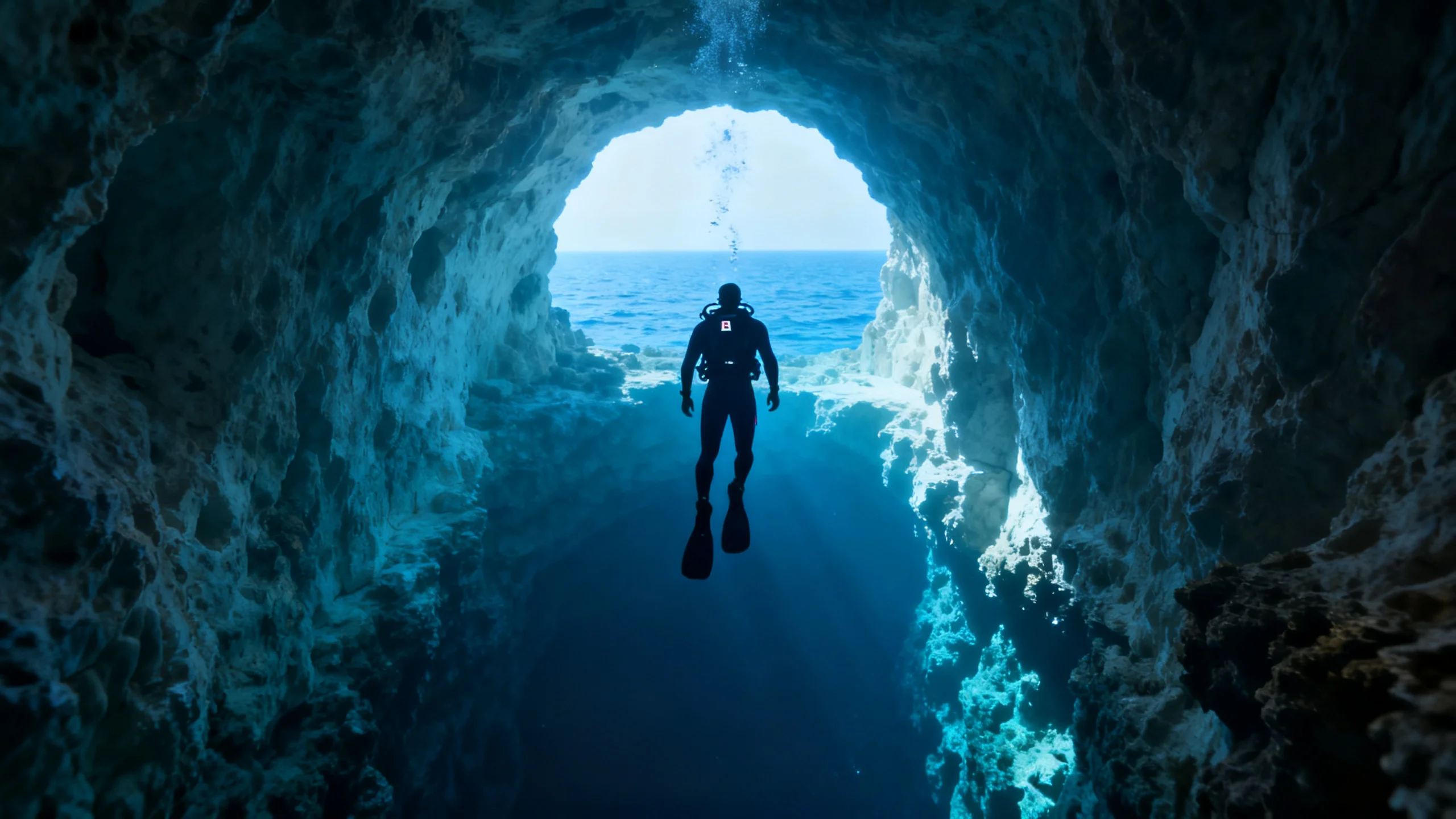
Inland Sea Tunnel at Dwejra. An 80-metre cave passage through the cliffs connecting the inland sea (a shallow lagoon) to the open Mediterranean. The tunnel narrows to about 5 metres wide at its tightest point, with limestone walls dropping 20-25 metres below. Light streams through from both ends; the swim through is photographed everywhere in dive marketing. Depth: 5-25m. Visibility: 20-30m. Difficulty: Open Water level, but the tunnel can be intimidating for new divers.
Blue Hole at Dwejra. A 10-metre-wide vertical shaft connecting the surface (a small natural well) to the open sea via a horizontal cave at 15 metres. Divers descend into the hole, swim through the cave, and exit into the open Mediterranean. Depth: 5-20m. Visibility: 20-30m. Difficulty: Open Water+.
Reqqa Point on the north coast of Gozo. A series of caves at 15-25 metres depth with consistent schools of barracuda and grouper. Depth: 10-30m. Visibility: 25-35m. Difficulty: Advanced Open Water for the deeper sections; Open Water for the shallow areas.
Xlendi Cave at the head of Xlendi bay. A large cave at 10-15 metres depth, often used as a first night dive on Open Water courses. Depth: 5-15m. Visibility: 15-25m. Difficulty: Open Water.
Mġarr ix-Xini in the south. A deep narrow inlet with a sheltered shore dive entry. Good for beginners and a popular night dive site. Depth: 5-25m. Visibility: 20-30m. Difficulty: Open Water.
Comino
Santa Marija Cave at the north-eastern tip of Comino. A large cavern at 15-20 metres depth with schools of barracuda and the occasional moray. Depth: 10-25m. Visibility: 25-35m. Difficulty: Open Water.
Lantern Point on the western edge of Comino. Caves at 18-25 metres, with drift-dive options when the current allows. Depth: 15-30m. Visibility: 25-35m. Difficulty: Advanced Open Water.
Malta side (the wrecks)
P29 patrol boat off Cirkewwa. A 52-metre Maltese government patrol boat scuttled in 2007 as an artificial reef. Sits upright at 36 metres on a sand bottom. Difficulty: Advanced Open Water with Deep certification.
Tugboat Rozi also off Cirkewwa. A 40-metre tugboat scuttled in 1992. Sits at 36 metres. Difficulty: Advanced Open Water with Deep certification.
Madonna Statue shore dive at L-Ahrax (north Malta). A statue of the Madonna placed on the seabed at 18 metres as a memorial. Depth: 8-18m. Visibility: 20-30m. Difficulty: Open Water.
Where to base
Xlendi (Gozo) is the largest dive-school cluster. Several PADI 5-star schools (Atlantis Gozo, Gozo Aqua Sports, Scuba Kings), plus smaller operators. Walkable to Xlendi Cave and a 15-minute drive from Dwejra. Best for divers who want a single base for both Gozo and Comino sites.
Marsalforn (Gozo) is the second cluster, with similar school stock. Slightly closer to the Reqqa Point area on the north coast.
Cirkewwa (Malta) has 3-4 dive schools focused primarily on the Cirkewwa-area sites (the P29 and Rozi wrecks) and the Comino dive sites. Useful if you are basing in Mellieha and want to dive both islands without a daily ferry.
Sliema and St Julian’s have school presence but the dive sites in their immediate area are limited; expect transfer time to the better sites.
Prices
- Single shore dive with rented kit: €60-80.
- Boat dive (single tank): €75-95.
- Two-tank boat day: €110-130.
- Night dive: €70-90.
- Full week dive package (10 dives): €450-600.
Book a Gozo dive day on GetYourGuide for guided dives at the headline sites with a small group.
Certification
PADI Open Water is the entry-level course: 3-4 days of classroom + pool + 4 open-water dives. €440-520 with most Gozo schools. The exam includes theory + skills + open-water assessment.
PADI Advanced Open Water is the next step: 5 specialty dives over 2-3 days. €280-340. Recommended for the Blue Hole and the deeper Gozo wrecks.
Specialty courses (Deep, Wreck, Cave, Night, Nitrox): €120-180 each.
If you are coming specifically to certify, allocate at least 4 dive days in your trip plus 1-2 buffer days. The active 7-day itinerary is too compressed for full certification; plan a 10-day trip if certification is the main goal. See the active 7-day itinerary for the certified-diver pattern.
When to dive
Best months: April-May and September-November. Water 18-23°C, visibility 25-35m, no jellyfish.
Summer (June-August): water 24-27°C (the warmest), visibility still good but slightly more particulate. Some seasonal jellyfish (Pelagia noctiluca) appear, mostly stingless to divers.
Winter (December-March): water 15-17°C. 7mm wetsuit or drysuit needed. Visibility often exceptional (35m+) on calm days. Fewer divers, smaller groups, lower prices.
What to bring
Most dive schools rent full kit (BCD, regulator, wetsuit, fins, mask, computer) for €15-25 per dive day. If you have your own gear, bring it:
- Mask, snorkel, fins.
- Computer (saves €5-10/day on rental).
- Wetsuit: 5mm for shoulder season, 7mm or drysuit for winter, shorty for summer.
- Boots and gloves if you have them.
Bring:
- Certification card (physical or digital).
- Recent dive log (within 6-12 months, or you may be asked to do a refresher dive).
- Insurance (DAN membership or equivalent strongly recommended for deeper wreck dives).
Practical notes
- Hyperbaric chamber: the Malta-Gozo area has a recompression chamber at Mater Dei Hospital on Malta. Most schools include emergency evacuation procedures in their briefings.
- No-dive day before flying: the standard 18-24 hour rule applies. Build a no-dive last day into your trip.
- Group sizes: most Gozo schools cap groups at 4-6 divers per instructor.
- Language: all major schools operate in English; many also offer Italian, German, French.
What to skip
- Resort hotel-affiliated dive desks that charge double the school rate for the same dive. Book direct with a PADI 5-star school.
- “Discover Scuba” half-day pitches at Comino Blue Lagoon: these are introductory dives in 3 metres of water with poor visibility from the boat traffic. Save your money for a real first dive with a Gozo school.
- Diving in late afternoon on busy summer days at Dwejra: the Inland Sea Tunnel and Blue Hole are popular and the small dive boats queue. Morning dives are quieter.
For the broader active-trip context, see the active 7-day itinerary and the Gozo regional hub.
Related reading
- Active 7-day itinerary: how the dive days slot in.
- Hiking the Gozo coast: the surface-interval alternative.
- Gozo region hub: where most of the dive sites are.
- Health and safety: the brief that matters for diving more than any other activity.
- Gozo farmhouses: the standard stay-base for a dive week.