Practical health and safety information for travellers: tap water (yes, drink it), pharmacy hours, the European health card, and the genuine risks worth knowing about.
Malta is one of the safest countries in Europe by most measures. Violent crime against tourists is rare, the healthcare system is competent, and the public infrastructure works reliably. The genuine risks are small and mostly preventable: dehydration, sunburn, occasional petty theft in crowded tourist areas, and the road traffic. The notes below cover what to actually be careful about and what to ignore.
Tap water
Tap water in Malta is safe to drink and meets EU drinking-water standards. The supply is mostly desalinated seawater (reverse osmosis) blended with limited groundwater extraction. The taste is slightly mineral and slightly metallic, which is why many Maltese still buy bottled water out of habit.
Restaurants will offer bottled water by default; ask for tap water if you prefer (jugs are usually free or carry a small €0.50-1 charge for the carafe and lemon).
There is no parasitic, bacterial or chemical risk from Maltese tap water for normal travel use. Brush your teeth with it, fill your water bottle from it, drink it cold from the tap.
Healthcare
Malta has a public health system (Mater Dei Hospital is the main facility, on the south side of the central conurbation) and a private one (St James Hospital in Sliema, St Thomas Hospital in St Anne). Both are accessible to visitors.
For EU/EEA citizens, the European Health Insurance Card (EHIC) or GHIC (UK Global Health Insurance Card) entitles you to the same care as Maltese residents at the public hospital, free at the point of use for emergencies. Bring the physical card or the digital equivalent.
For non-EU visitors (US, Canadian, Australian, etc.), travel insurance is the practical way to cover unexpected medical costs. The public hospital will treat you in emergencies and bill afterwards; the private hospitals expect upfront payment or insurance authorisation.
Standard pricing at the private hospitals for visitors without insurance:
- GP consultation: €50-80
- Emergency room visit: €100-150 plus tests
- Hospital stay: €300-500 per night plus treatments
- Pharmacy prescription medications: typically EU-standard prices, often 30-50% lower than US prices
Pharmacies
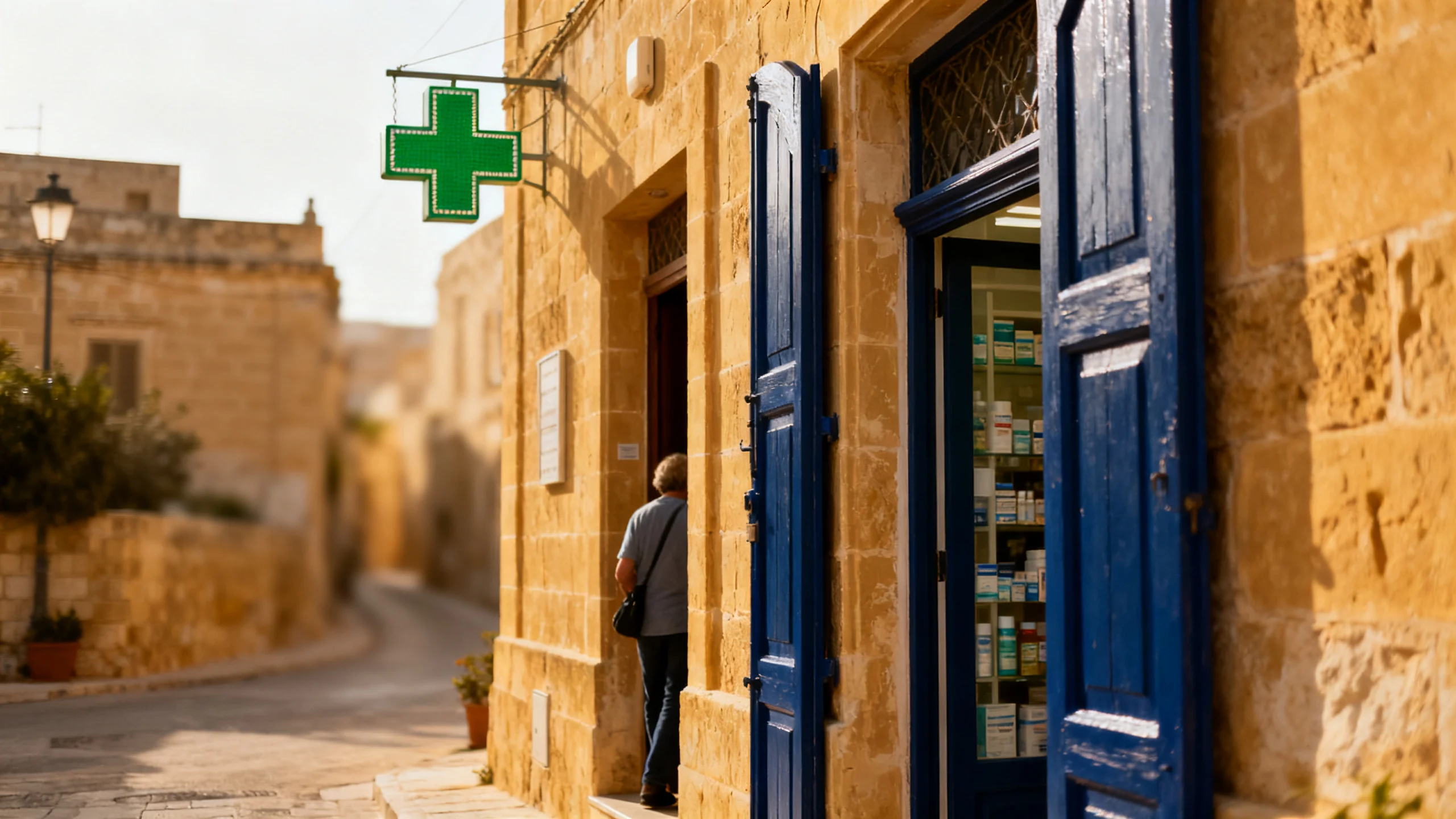
Pharmacies (farmacija) operate widely. Opening hours:
- Standard hours: Monday-Friday 09:00-19:00 with a long lunch break (typically 13:00-16:00), Saturday morning.
- Sunday rotating duty system: each Maltese town has one or two pharmacies open on Sunday, on a rotating schedule. The schedule is posted on the door of every pharmacy and in the daily newspapers.
- 24-hour pharmacies: limited to one or two locations. Check the rotating list.
Most over-the-counter medications (paracetamol, ibuprofen, antihistamines, basic antibiotics for skin scrapes, anti-diarrhoeals) are available without prescription at prices similar to or lower than the rest of Europe. Pharmacists speak English and can recommend solutions for minor ailments.
Prescription medications: if you take regular medication, bring a written prescription from your home doctor and a 1-week buffer supply. If you need a refill mid-trip, the Maltese system can issue a prescription via a private GP consultation (€50-80 for the visit plus the cost of the medication).
Emergency numbers
- 112: the European emergency line. Routes to police, ambulance or fire as needed.
- 191: Maltese police direct.
- 196: Maltese ambulance direct.
Both numbers work from any phone (mobile, hotel landline, public phone). English-speaking operators are available 24/7.
Sun and dehydration
The single most common health issue for visitors. Malta gets 300 days of sun a year, the UV index reaches 10-11 in summer (very high), and the limestone reflects strongly.
Practical:
- Sunscreen 30+ SPF minimum, reapplied every 2 hours when active outdoors.
- Hat with a brim for walking in Mdina, Valletta or any cliff walk.
- Water bottle on you at all times in summer; drink before you feel thirsty.
- Avoid the 11:00-16:00 sun for sustained outdoor activity in July-August.
- Reef-safe sunscreen at the Blue Lagoon and Crystal Lagoon; the lagoon ecosystem is fragile.
Heatstroke symptoms (dizziness, headache, nausea, dry skin) deserve immediate response: get indoors, drink water with electrolytes, cool down with damp towels. If symptoms persist after 30 minutes, get medical attention.
Crime and personal safety
Malta is statistically one of the safest European countries. Violent crime rates are below the EU average. For travellers:
- Pickpocketing: limited but present in crowded tourist areas (Marsaxlokk Sunday market, the X1 bus to Cirkewwa in summer, the Sliema-Valletta ferry deck at peak times). Standard precautions apply: bag on the front, no wallet in back pocket.
- Hotel safes: use them for passports, cash and valuables when out for the day.
- Beach theft: rare but real at the major beaches (Mellieha Bay, Golden Bay). Take only what you can swim with; leave the laptop at the hotel.
- Car break-ins: very rare. Lock the car, do not leave visible valuables on seats.
- Solo female travel: generally safe at all hours in tourist areas. Standard caution in Paceville on weekend nights (where the issue is drunken misbehaviour more than malicious crime).
What does NOT happen frequently in Malta:
- Mugging by knife or weapon
- Scam taxis (the licensed system is regulated)
- Restaurant overcharging (menu prices are honoured; check the bill, of course)
- Currency scams at exchange counters (use ATMs)
Road safety
The genuine risk. Maltese roads have a higher accident rate than the EU average. Aggressive driving, narrow streets, mixed pedestrian-vehicle spaces, and a small number of distracted drivers on phones.
For pedestrians:
- Look the wrong way first: traffic comes from the right when crossing on the left-hand-drive system. The instinct from continental Europe or the US is to look the opposite way; train yourself to look both ways.
- Pedestrian crossings: zebra crossings exist but local drivers often do not stop. Make eye contact with the driver before stepping out.
- Crossing in Paceville at night: be especially careful with drunken pedestrians and drivers; the crossings near the club strip see frequent close calls.
For drivers, see the driving in Malta page.
Sea safety
The Mediterranean here is generally calm and warm. Practical:
- Swimming after eating: traditional Maltese advice is to wait an hour. Modern medicine says this is overcautious for healthy adults; common sense applies.
- Strong currents: rare on the south and east coasts; occasional at the north-west sites (Anchor Bay, parts of Golden Bay) when westerlies blow.
- Jellyfish (Pelagia noctiluca) appear seasonally, usually in July-August. Stings are painful but not dangerous. The Marine Conservation Authority publishes a daily map of sightings (visitmalta.com/jellyfish-watch).
- Sea urchins: present on rocky shores. Wear aqua shoes when entering from limestone platforms.
- Boats and swimmers: the Blue Lagoon and other busy swimming spots have boat traffic; stay close to shore.
Mosquitos and biting insects
Mosquitos appear in summer evenings, mostly in coastal wetland areas (Salina, the Birzebbuga lagoons) and near rural water features. Standard insect repellent works. No malaria, no dengue.
Sandflies appear in late summer on rural cliff paths and inland village outskirts; bites are itchy for a few days but harmless.
The carob caterpillar (processionary caterpillar) appears on pine trees in spring, mostly in Buskett Gardens area; do not touch, the hairs cause skin irritation.
What is NOT a problem
To dispel a few common worries:
- No dangerous wildlife: no snakes that are aggressive, no scorpions in places you visit, no spiders that harm. The Mediterranean gecko on your hotel ceiling is harmless and friendly.
- No water-borne disease risk beyond standard food hygiene.
- No vaccines required for entry from EU, UK, US, Canada, Australia, NZ or most other major-source markets. Standard EU vaccination recommendations apply (tetanus up to date, MMR, etc.).
- No notable air quality issues outside the dense central conurbation in summer.
Travel insurance
Even with EHIC/GHIC, a basic travel insurance policy is recommended for:
- Medical evacuation in case of serious injury (not covered by EHIC).
- Trip cancellation or delay coverage.
- Lost or stolen baggage.
- Liability coverage if you damage rental property or third-party property.
Annual multi-trip policies for European residents typically cost €40-80; single-trip for non-EU residents €30-60 for a week.
In summary
Malta is a low-risk destination. Drink the tap water, wear sunscreen, look right-then-left before crossing, and the trip will be uneventful in any of the ways that worry travellers.
Related reading
- When to visit: July-August heat and what it means for sites.
- Driving in Malta: the road safety brief for left-hand traffic.
- SIM card and internet: emergency-call connectivity.
- Diving in Malta and Gozo: the one activity where the safety brief matters most.