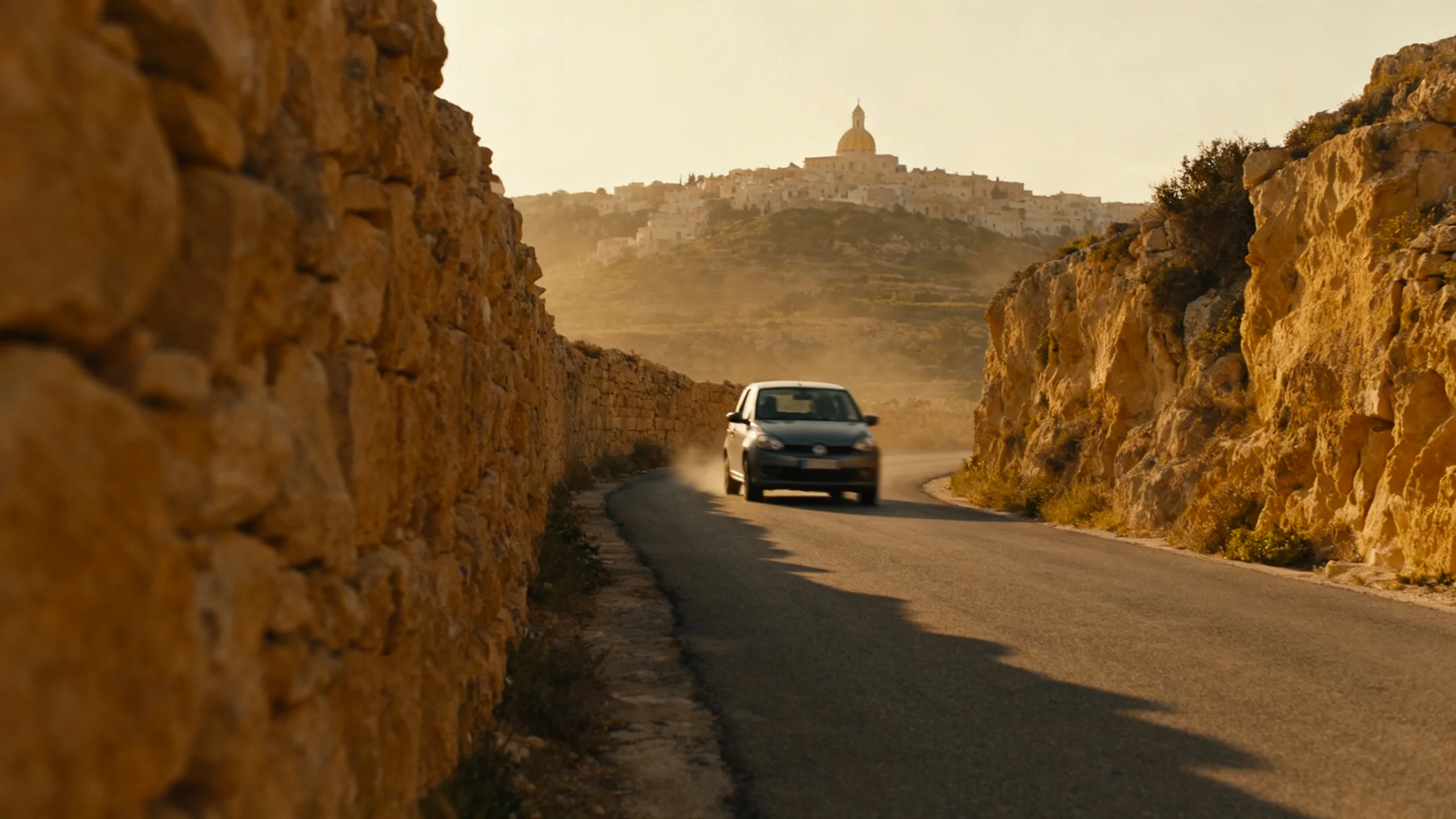
What to know before you drive: left-hand traffic, narrow roads, parking economics, fuel, the stop-sign convention, and where the locals are not joking about the traffic.
Malta drives on the left. This is the single most important practical fact for any visitor planning to hire a car. The other facts are about the size of the roads, the volume of cars on a small road network, and a few local conventions that catch first-time drivers off guard. Once you have absorbed these, driving here is no harder than driving on a busy European Sunday afternoon.
Left-hand traffic
Malta inherited the British road system. Cars drive on the left, the driver sits on the right, the gearshift is on the left of the driver. Roundabouts circulate clockwise. Most road signs follow UK conventions (white background, red borders for warnings, black-on-white for distances).
For drivers used to right-hand traffic (continental Europe, the Americas, most of Asia), the adjustment takes about 30 minutes of slow driving. The first roundabout is the moment most people remember; the second one is unconscious.
Practical advice for the first hour:
- Drive a small economy car, not a large rental. Maltese roads are narrow.
- Drive in daylight for the first session. Night-time and unfamiliar left-driving combine awkwardly.
- Start outside Sliema and Valletta. The first 20 minutes should be on the open road, not in city traffic.
- The car’s left side is closer to the kerb than you instinct expects. Mirror checks help.
The road network
Malta has about 2,200 km of paved road on a 27 × 14 km island. The density is high. The main roads (the Birkirkara-Mosta corridor, the coast roads) are recently rebuilt with proper lane markings; the smaller village roads are limestone-cobbled or older asphalt with no markings.
Indicative speeds and conditions:
- Motorways: there are none. The fastest sustained driving is on the airport-Mosta road or the M2 to Cirkewwa, where 80 km/h is achievable.
- Main roads through villages: 50 km/h limit, often slower in practice due to parked cars narrowing the lanes.
- Side streets in villages: 30 km/h or below, often single-lane shared.
- Rural roads in the south or near Dingli: well-paved but narrow; expect 40-50 km/h.
The state of the surface is variable. Recent road-rebuilds (the EU-funded works of 2018-2024) have improved the main arteries substantially. Older village streets are uneven, with the occasional pothole; a small economy car handles them fine.
Parking
The biggest practical hassle. Malta has approximately one car per resident, the highest car-ownership rate in the EU, on a small island. Parking is genuinely difficult in:
- Valletta: no on-street parking inside the walls; pay €15/day at the MCP underground in Floriana.
- Sliema: free street parking exists but circling 20-30 minutes to find it is common. MCP Sliema Strand is €15/day for guaranteed parking.
- St Julian’s and Paceville: similar pattern to Sliema. The MCP Spinola is €15/day.
- Mdina: parking only outside the walls (free Mdina Parking or Howard Gardens lots).
- Marsaxlokk on Sunday: full by 09:30; walk 800 m from a roadside spot.
Parking is easier in:
- Mellieha (free street parking widely available).
- Marsaskala and the south coast villages (free street parking).
- Most of Gozo (free in villages, paid only at Ramla Bay in summer).
- The inland-village centres outside busy hours.
The “stop sign is a suggestion” convention
Local drivers treat stop signs as yield signs, especially at minor junctions where visibility is clear. This is unsafe to do as a visitor (because you do not know the local right-of-way convention at each junction) but you should expect other drivers to roll through stop signs without stopping fully. Defensive driving applies.
Roundabouts work conventionally: yield to the right (clockwise) traffic already in the roundabout. The bigger issue is that Maltese drivers often do not signal when exiting, so you need to wait until you see a car clearly slowing to exit before pulling in.
Speed cameras and fines
Fixed speed cameras are installed on most major roads (the Mosta-Birkirkara corridor, the airport approaches, the M2 to Cirkewwa). Fines are €75 to €240 depending on the over-speed amount. Hire-car agencies will charge the fine to your card plus an administration fee (often €30-50) if you receive a citation.
Mobile speed traps appear occasionally on rural roads. The locals know where; the visitors do not. The simple advice: drive at the posted limit.
Drink driving
Malta has a strict 0.05% blood-alcohol limit and active enforcement. Police checkpoints are common on Friday and Saturday nights, especially around Sliema, Paceville and St Julian’s. The fine is €1,200+ and immediate licence confiscation. Just take a Bolt.
Fuel
Petrol stations are everywhere. Most are open 06:00 to 22:00 with self-service. A few 24-hour stations exist along the main arteries.
- Unleaded 95: around €1.40/litre.
- Diesel: around €1.30/litre.
- LPG: limited availability; check with your rental agency if your car is dual-fuel.
Card payment is universal. Most stations also accept cash.
Pedestrians, cyclists, and the unusual
- Pedestrian crossings: zebra crossings exist but local drivers often do not stop for pedestrians waiting at them. Make eye contact before stepping out.
- Cyclists on the main roads: rare and brave. If you see one, give them substantially more space than you would in northern Europe.
- Horse-drawn karozzin in Valletta and Mdina: they have right of way on certain streets. Drive slowly behind them.
- The occasional flock of sheep on rural inland roads: yield, smile.
Insurance and your rental contract
Standard rental insurance in Malta covers third-party liability and collision damage with a high deductible (typically €1,200-2,500). The waivers offered at the desk to reduce the deductible to zero cost €15-25 per day; consider whether your credit card or travel insurance covers this already.
The damage that most often catches visitors out: kerb scuffs on the rear-left wheel arch (because you parked too close to the kerb due to the left-hand driving) and minor scratches from narrow streets. Photograph the car on pickup at every angle.
When NOT to drive
Some moments where driving is more burden than help:
- The Valletta and Sliema central streets during Friday-evening or Saturday-night peaks.
- The Cirkewwa road on Sunday afternoon (traffic toward the ferry).
- The Mellieha approach in July-August (traffic to the bay).
- Mdina at any time of day: park outside and walk in.
- The drive from the airport to Valletta during a Friday evening flight arrival: bus or Bolt is faster.
For trips that primarily mean Valletta + Sliema + a Gozo daytrip, the getting around Malta guide describes a no-car pattern that often works better.
Related reading
- Getting around Malta: bus + ferry + Bolt as the no-car alternative.
- Ferry to Gozo: bringing the car across the channel.
- Getting to Malta: airport car-hire pick-up logistics.
- 5-day itinerary: the trip where a car becomes the right call from day 3.
- South Malta region: the region where a car genuinely changes what’s possible.