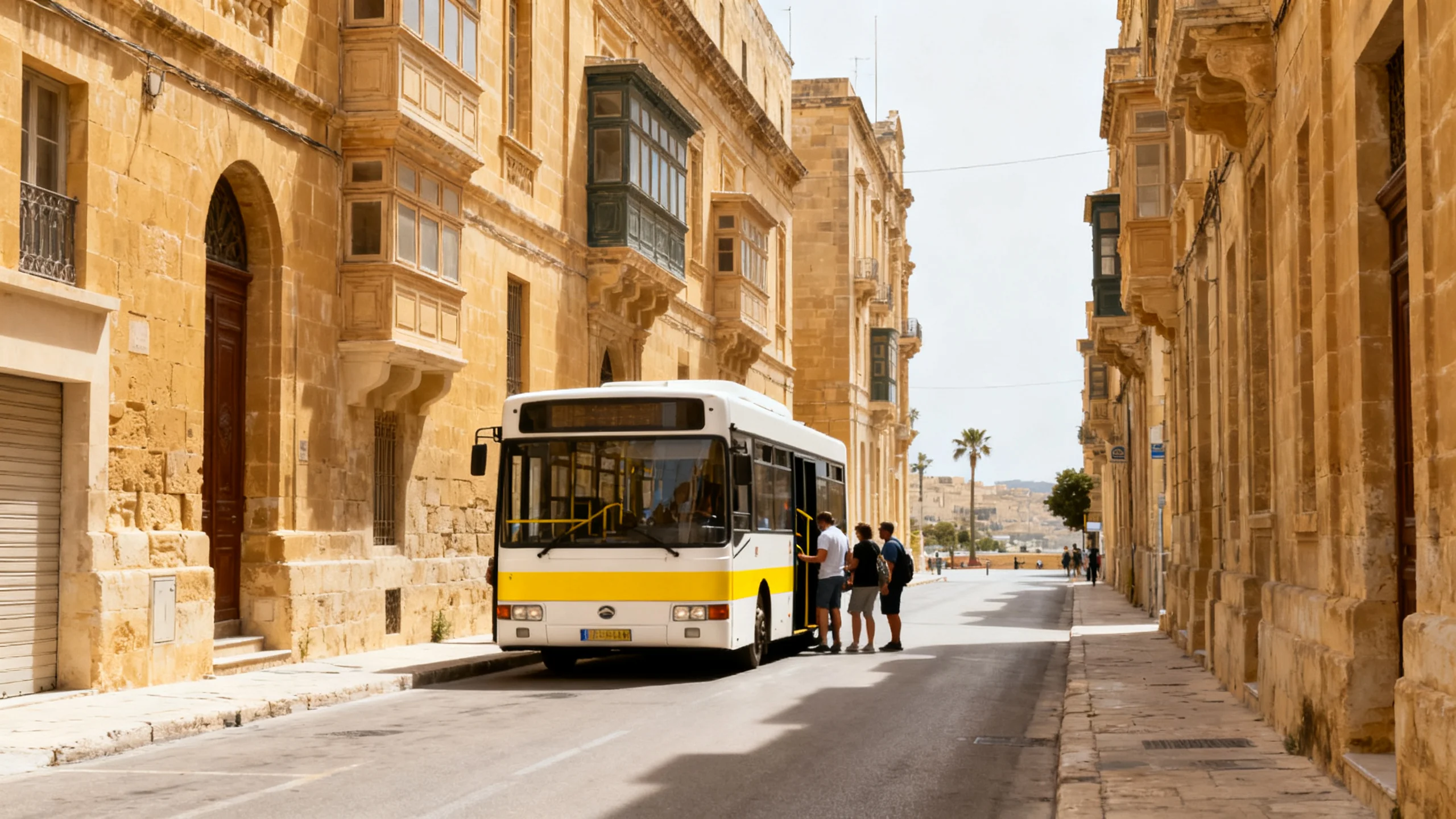
Honest comparison of the four ways to move around: the €2.50 bus network, Bolt ride-hailing, traditional taxis, and the hire-car option.
Malta is small (the main island is 27 km long and 14 km wide) and the four transport options cover most needs at different price-and-convenience points. The honest pattern that works for most visitors: bus or Bolt for short hops in the urban areas, hire a car for any day that includes Mellieha, Marsaxlokk, Dingli or the inland villages.
The bus network
Operated by Malta Public Transport (Tallinja), the bus network is the cheapest and most thorough option. Coverage:
- Around 90 routes across Malta plus 15 on Gozo.
- Flat fare of €2.50 cash per journey (€1.50 in winter), valid for 2 hours including transfers.
- Tallinja card brings the per-journey cost down to €0.75 (single-use Concession card €15) or €21 for 7 days unlimited.
- Cash or contactless card payment at the driver. No paper tickets.
Where the network works:
- The Valletta City Gate terminus in Floriana is the central hub. Almost every route starts or ends here.
- The X-lines (X1, X2, X3, X4) are the express routes that skip stops to cover long-distance journeys (airport, north coast, Sliema, Mosta).
- The regular numbered lines cover urban Malta in dense detail. Most journeys are 30 to 60 minutes from Valletta to anywhere on the main island.
Where the network struggles:
- Cross-Malta transfers: getting from the north to the south without going through Valletta often takes longer than the actual distance suggests.
- The smaller inland villages: hourly service, sometimes less.
- The southern coast between Marsaxlokk and Dingli: no continuous line.
- Summer crowds: the X1 to Cirkewwa and the routes to Mellieha and Golden Bay get standing-room only between 09:30 and 11:30 on summer weekends.
Schedules are reliable but the bus shows up “when it shows up” with a 5 to 10 minute window either side of the timetable in practice.
Bolt
The dominant ride-hailing app in Malta. Operates 24/7 across the country with the exception of Comino (no roads).
- App-based booking and payment: download Bolt before you arrive, set up payment with a card.
- Typical fares:
- Within Valletta or Sliema: €5-9.
- Sliema to Valletta: €8-12.
- Airport to Valletta/Sliema: €15-25.
- Sliema to Mdina: €15-22.
- Valletta to Marsaxlokk: €15-22.
- Sliema to Cirkewwa: €30-45.
- Surge pricing: 1.3× to 2× the base rate at peak times (Friday evening, Saturday night, summer weekend mornings).
- Driver tipping: not expected but appreciated, 10% is generous.
Bolt is the right choice for:
- Late-night journeys when the bus has stopped.
- Group travel (2-4 passengers split the cost).
- Time-sensitive transfers (airport, ferry connections).
- Carrying luggage.
The alternatives: Uber operates a small fleet but with fewer drivers; eCabs is the Maltese taxi-dispatch service with similar pricing. Both work but Bolt has the largest driver base.
Traditional taxis
The white taxis with the Maltese government licence on the side operate from designated taxi ranks at the airport, in Valletta, in Sliema and at major hotels. Fixed prices by zone at the airport rank (€25 to Valletta or Sliema, €40 to Mellieha). Metered fares for other journeys; ask for the meter to be activated before you depart.
Traditional taxis are typically 30-50% more expensive than Bolt for the same journey. Use them only when no Bolt is available or when you specifically want a metered receipt.
The traditional white-and-orange taxis
The classic black-and-orange Maltese taxi cabs (often older Mercedes from the 1990s) operate in a less regulated tradition, mostly from hotel ranks. Negotiate the fare before boarding. These are more expensive than the modern white taxis and aimed primarily at hotel guests.
Hiring a car
The right choice for travellers who want to see beyond the Valletta-Sliema axis. The full picture is on the driving in Malta page (left-hand traffic, parking realities, the road conditions). Summary:
- Cost: €25-40 a day for a small economy car in shoulder season; up to €60 in July-August.
- Where to rent: airport desks for the main agencies; smaller Maltese operators (Mayjo, Wize) offer pickup at your accommodation.
- Parking: free in most villages and beach areas; paid (€1.40/hour to €15/day) in central Valletta, Sliema and Mdina-adjacent.
- Fuel: petrol around €1.40/litre. Cars are usually returned with a full tank.
The case for a car: any itinerary that includes 2+ of the following (Marsaxlokk, Hagar Qim, Dingli Cliffs, Mellieha, Golden Bay, inland villages, multiple Gozo days).
The case against: pure Valletta + Sliema + airport stays. Parking is genuinely difficult in both areas and the bus network covers what you need.
Bicycles and scooters
Cycling on Malta is possible but not pleasant. The main island has narrow roads, aggressive driving, no continuous bike infrastructure, and a generally hostile attitude toward cyclists. Cycle on Gozo instead, where the roads are quieter and the distances are short.
Scooter rental is available in Sliema, St Julian’s and Mellieha; €25-40 a day. Same warning as bicycles: the traffic is unforgiving. Scooters on Gozo are recommended; scooters on Malta are best avoided unless you have significant experience riding in dense urban traffic.
The honest stack for a typical week
For a 7-day trip based half in Valletta or Sliema and half in Gozo, the practical stack:
- Days 1-3 in Valletta/Sliema: use the Sliema-Valletta ferry (€1.50) and the bus network. Skip the car entirely.
- Day 4: hire a car at Sliema, drive Mdina + the south coast + Dingli sunset, return the car.
- Days 5-7 on Gozo: pick up another car from Gozo agencies on arrival, drive the island.
This pattern minimises parking hassles and uses each transport mode where it works best. A single 7-day rental that sits parked for half the trip is more expensive and more annoying than two 1-3 day rentals split around the actual driving days.
Related reading
- Driving in Malta: the left-hand-side driving brief and road-network reality.
- Ferry to Gozo: the second-mode-of-transport explainer.
- Getting to Malta: the airport-arrival logistics that frame day 1.
- Sliema & St Julian’s: the central coast where the Valletta ferry and bus hub converge.
- North Malta region: the half of the island where a car shifts what is feasible.