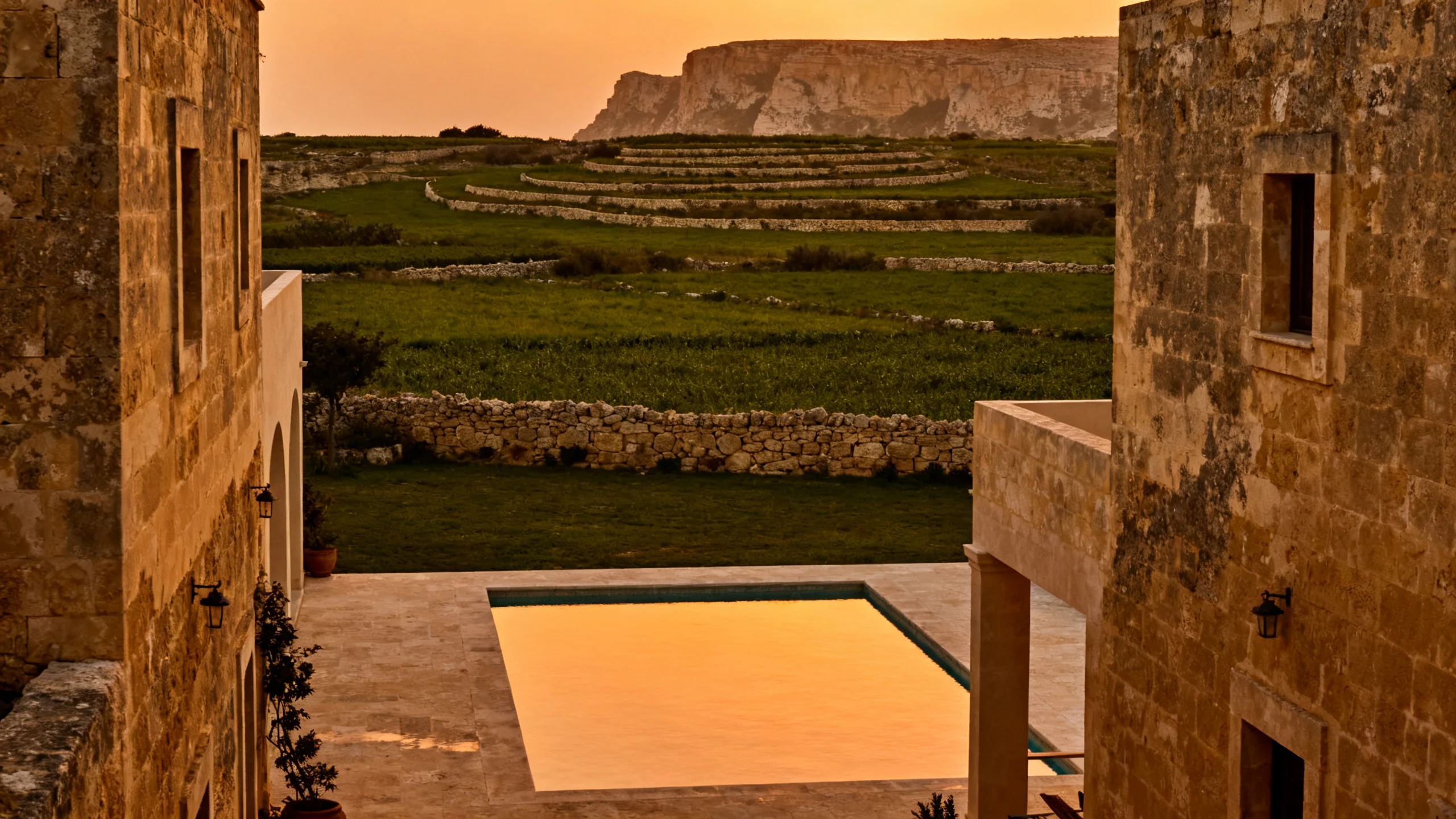
The single most common Malta-trip mistake is treating Gozo as a daytrip. The argument for three nights on the smaller island, with the farmhouse stay, the slower clock and the second cultural layer.
The standard Malta itinerary suggests one Gozo day. Wake up early, take the Cirkewwa ferry, see the Cittadella, see Ggantija, eat a quick lunch, see Dwejra, take the evening ferry back. Six hours of Gozo, plus four hours of getting there and back, plus the cost of a Malta-side day. Many travellers come away thinking Gozo was nice and they got the basics; few of them come away thinking they actually visited Gozo.
This piece is the argument against that approach. The case for spending three nights on Gozo (and possibly more) instead of one day. The case for splitting your Malta trip 50/50 between the two main islands, not 80/20 in favour of Malta.
What you cannot do in one Gozo day
The compressed daytrip pattern fits in:
- The Cittadella in Victoria (90 minutes, rushed).
- Ggantija temples in Xagħra (90 minutes).
- A quick lunch.
- Dwejra (90 minutes).
- The drive between these places (45 minutes total).
- Return ferry.
Six and a half hours of activity. What it leaves out:
- Ramla Bay, the red-sand beach. Not visited.
- Mġarr ix-Xini swimming and the Rew Rew restaurant. Not visited.
- The coastal walks at Sannat-Ta’ Ċenċ or San Lawrenz-Gharb. Not done.
- Any of the diving sites (Inland Sea Tunnel, Blue Hole, Reqqa Point, Santa Marija Cave). Not done.
- The salt pans walk at Marsalforn. Not done.
- Ta’ Pinu sanctuary in Gharb. Probably skipped.
- Any actual evening on the island: no sunset at Dwejra, no village restaurant dinner, no Cittadella by night.
- The farmhouse pool: not booked, not used, not even seen.
The single-day pattern visits Gozo’s three or four obvious sites in their daytime version. It misses everything that requires staying overnight: the slower pace, the village atmosphere after the day-trippers leave, the early-morning solitude at Ramla, the post-dinner Cittadella walk.
What three nights actually adds
Three Gozo nights with a converted farmhouse base (the strong recommendation) produces a different trip:
Day 1 evening (arrival): ferry across, settle into the farmhouse. Lunch at a village restaurant. Cittadella in the afternoon. Dinner at Ta’ Frenc or a local kitchen. The first evening sets the tempo: slower than Malta, less programmed, with the parish church bells dividing the day.
Day 2 (the active day): Ggantija + Ta’ Kola windmill in the morning. Lunch in Xagħra. Dwejra and the Inland Sea boat in the afternoon. Xlendi for dinner. Eight or nine hours of activity, but spread across the whole day rather than compressed into six.
Day 3 (the slow day): morning swim at Ramla, walk up to Calypso’s Cave, lunch at the farmhouse pool, afternoon coastal walk along the Sannat cliffs, dinner at a small village place. The pace drops; the trip becomes a holiday rather than a tour.
Day 4 morning (departure): a final swim at Mġarr ix-Xini or a slow coffee in Victoria, ferry back to Cirkewwa, drive to the airport or continue with the rest of the Malta trip.
The total Gozo time: roughly 72 hours instead of 6.5 hours. The marginal time is twelve times the single-day amount, and what you do with it (one swimming day, one cultural day, two evening atmospheres) is not available without the overnight stays.
What changes about the visit psychologically
The shorter Gozo visit is, structurally, a tour. You arrive somewhere, see the headline sights, move on. The pace is similar to a museum visit. You can describe what you saw afterwards but you do not develop any personal sense of the place.
Three nights is enough to start having a personal sense of Gozo. You start recognising the man at the village bakery. You find a favourite swimming spot. You notice the second-cousin relationships in the village (everybody is related). You hear the parish church bells often enough to know when 17:00 is. You walk to dinner instead of driving. You sit on the farmhouse terrace at 22:00 with a glass of Gozitan red wine and the stars are unobstructed because the village has 600 residents and no light pollution.
This is a real shift, not a sentimental one. The Gozo three-night visit creates the kind of memory that survives years later; the day-trip visit produces a list of seen sights that fades within months.
The farmhouse stay as the signature
The single most distinctive Gozo accommodation is the converted limestone farmhouse: restored 18th- and 19th-century country houses with private pools, courtyard gardens, vaulted ceilings, and original architectural features. The cluster is in the inland villages (San Lawrenz, Sannat, Munxar, Gharb), away from the more touristy Xlendi and Marsalforn coasts.
This is the accommodation that does not exist on Malta in any meaningful form. The Maltese inland villages have very few similar restored farmhouses; the country is too densely built. The Gozitan version, with its quiet villages and access to actual rural countryside, is a genuinely different experience.
A typical farmhouse: two or three bedrooms, a private small pool (3-5 metres long), a stone-walled garden, a kitchen, a small living room with a wood-burning stove for winter. Booking is through aggregators like Gozofarmhouses.com or the standard platforms. Prices range from €140 to €280 per night in shoulder season for a two-bedroom unit.
The pitch is straightforward: you have your own quiet place to come back to between Gozo days. The farmhouse becomes the second character of the trip, alongside the island itself. By night three you are reluctant to leave.
The geography that makes this work
Gozo is a small island (67 km², roughly a third the size of Malta). The road network is compact; nothing is more than 25 minutes by car from anywhere else. This means the farmhouse base works for visiting the whole island:
- 10 minutes to Victoria.
- 15 minutes to Xlendi or Marsalforn.
- 15 minutes to Ramla Bay.
- 12 minutes to Dwejra.
- 20 minutes to Mġarr (and the ferry).
- 25 minutes to anywhere on the eastern coast.
You can structure days however you want without backtracking penalties. Morning culture, afternoon swim, evening dinner, all from the same base.
This is the opposite of Malta, where the geography forces base-changes. Sleeping in Sliema means a daily ferry commute to Valletta. Sleeping in Mellieha means a drive to anywhere south. Gozo’s compactness simplifies the trip; Malta’s density complicates it.
What the 50/50 split looks like
For a 7-day trip, the recommended pattern is:
Days 1-3 in Malta: Valletta (2 nights inside the walls, day 1 evening + 2 day visits), Mdina (1 day), southern coast (1 day).
Days 4-7 on Gozo: ferry across on day 4 morning, 3 nights at a farmhouse, days for Cittadella + Ggantija (day 4), Dwejra + Xlendi (day 5), Ramla + coastal walk + farmhouse pool (day 6), departure morning (day 7).
This is 3 Malta nights and 3 Gozo nights, with day 4 being the transition. Six full days plus one travel day on each end.
For a 5-day trip, the same logic with 2 Malta nights + 2 Gozo nights. Tighter but still workable.
For 10 days, 5 Malta + 5 Gozo opens up the slow-Gozo experience properly. See the 10-day itinerary for the detail.
The objection: but the temples and Valletta are bigger
The standard objection to splitting 50/50 is that Malta has more major cultural sites than Gozo. This is true in a list sense: Valletta + the Three Cities + Mdina + the southern temples + Tarxien + the Hypogeum + the central villages collectively are more named sights than the Cittadella + Ggantija + Dwejra + Ramla on Gozo.
But the list-counting argument misses the point. The Malta sites can each be visited in a single morning or afternoon. The Gozo experience is not about a list of sights; it is about the island as a whole. Time on Gozo is rewarded in a way that time on Malta beyond the cultural minimum is not.
For most travellers, after about three or four days of Malta cultural visits, the marginal returns drop substantially. The fifth and sixth Malta days, if they are spent on minor parish churches and secondary villages, are diminishing returns. Those same days on Gozo are increasing returns: each extra day on Gozo gives you more of the actual Gozo experience.
The honest paragraph
The Gozo daytrip is a trap. It feels efficient (you can say you saw Gozo) but it produces the weakest version of the trip available. The 50/50 split (three nights on each main island for a week, four for ten days) is the format that produces the strong version. The farmhouse stay is the signature accommodation. The slower pace is the signature mood. For most first-time Malta visitors, the marginal cost of converting a Gozo daytrip into a Gozo three-night stay is small (the ferry is the same, the time is reorganised), and the upside is large. The country deserves more than its smaller half gets in the standard tourist arithmetic.
Related reading
- Gozo region hub: the trip-planning page.
- Gozo farmhouses: the signature accommodation.
- 7-day Malta itinerary: the 4+3 split that builds the Gozo nights in.
- 10-day Malta itinerary: the 5+5 split for the full version.
- Gozo day trip: the compressed version, if a daytrip is genuinely all you have.