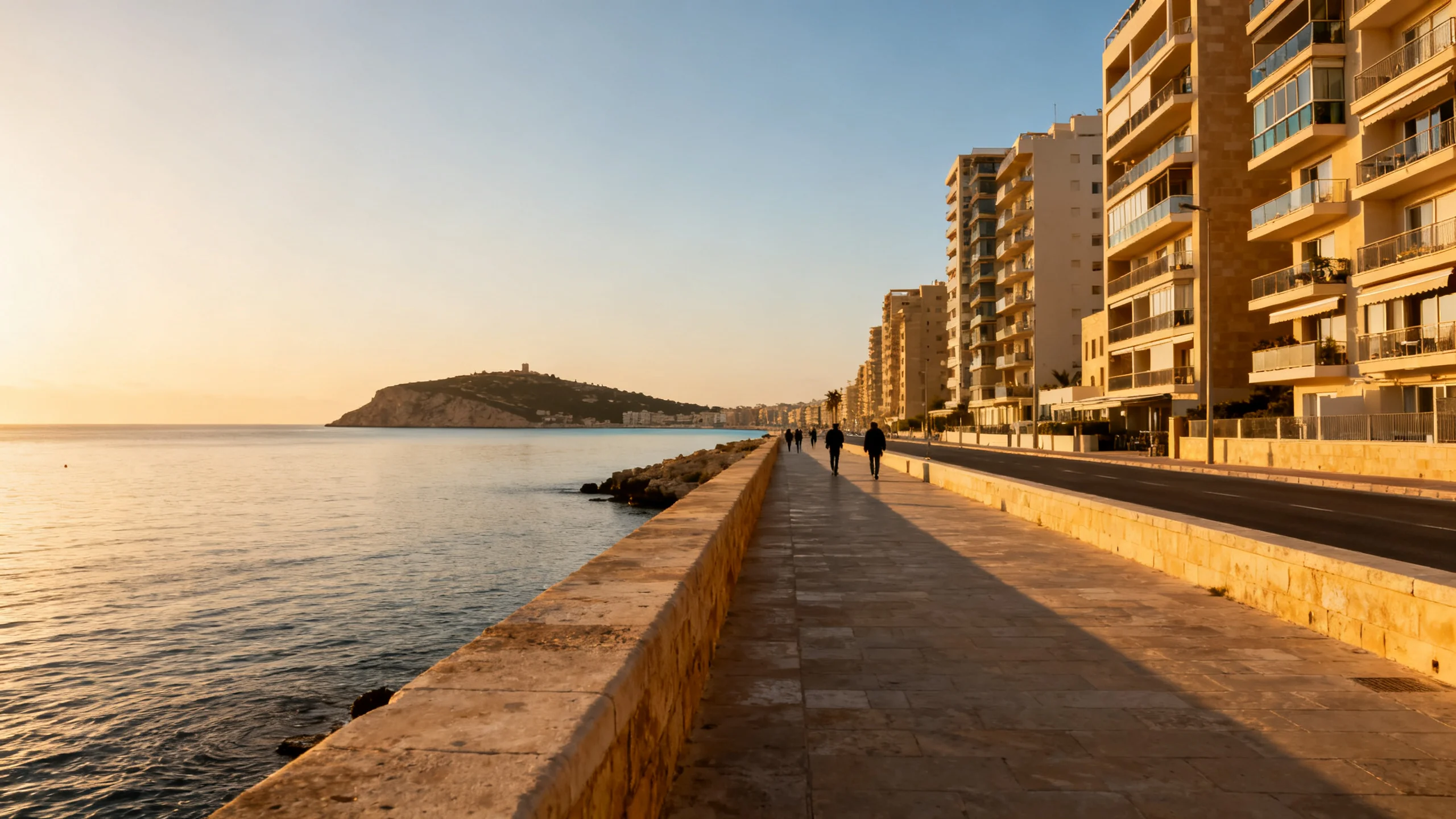
Two adjacent towns, two different atmospheres. Sliema is residential and walkable; St Julian's is restaurant-heavy and louder. Which to pick by trip type.
Sliema and St Julian’s run into each other along a continuous seafront on the east coast of Malta. From a map, they look like a single tourist strip. From the ground, they have meaningfully different atmospheres and accommodation patterns, and choosing between them matters for the kind of trip you have.
This is the honest comparison.
Sliema in one paragraph
Residential, walkable, family-friendly. Quieter in the evenings. Older Maltese demographics. More apartment-hotel stock than boutique. Has the Sliema-Valletta ferry as its standout asset.
The town is essentially a long mid-rise residential strip along Tower Road and the inland streets. The buildings are mostly 1990s-2000s; older properties exist around the Carmelite chapel and Tigne Point but most of the seafront is modern. The seafront promenade is wide, flat, paved, and step-free for 3 km, ending at the Spinola Bay boundary with St Julian’s.
The evening atmosphere is locals walking the promenade, families eating at the small kitchens behind the seafront, the occasional restaurant terrace. Things wind down by 22:30 on weeknights, 23:30 on Friday and Saturday.
St Julian’s in one paragraph
More restaurants, more bars, more nightlife, especially at the Paceville end. Younger demographic. More boutique hotel stock than Sliema. Spinola Bay is the photogenic centre.
The town is denser than Sliema, with more concentrated commercial activity. The Spinola Bay area has the genuine restaurant scene (Tarragon, Zest); the Portomaso marina has the luxury hotels; Paceville at the northern end has the clubs and stag-party infrastructure.
The evening atmosphere depends on which part of St Julian’s you are in: Spinola Bay is similar to Sliema (quiet by 23:30), but Paceville is loud until 04:00 on Friday and Saturday nights.
Sliema strengths
Sleep quality: quieter at night than St Julian’s. Tower Road apartments on the upper floors (3+) get minimal street noise.
The Valletta ferry at Strand Wharf: 5 minutes to Valletta, €1.50, every 30 minutes. The fastest Valletta access from anywhere in the country.
Family-friendly seafront: 3 km of flat paved promenade, suitable for strollers, wheelchairs, evening walks.
Supermarkets: more grocery options (Lidl in Gzira, Welbee’s, Park Towers) than the St Julian’s side.
Slightly cheaper: €90-140 mid-range apartment vs €120-180 in St Julian’s for equivalent quality.
Sliema weaknesses
Less restaurant variety: the kitchens are competent but fewer in number than St Julian’s. The standout Maltese restaurants (Ta’ Kris, Capo Crudo) exist but are scattered.
Limited boutique hotel stock: the few boutiques (Plaza Premium, Hotel Juliani at the St Julian’s border) are mid-range; the genuine boutique experience is in Valletta.
Less character: the streetscape is mid-rise modern; the limestone vernacular is mostly absent.
St Julian’s strengths
Restaurant density: more places to eat, more variety, especially around Spinola Bay (Tarragon, Zest, MED, ION Harbour at the Portomaso Hilton).
The Spinola Bay walk: photogenic harbour with luzzu boats, restaurants along the curve, the Love sculpture, the small chapel of St Julian.
More boutique stock: Hotel Juliani, the Iniala property, the Hilton and Westin at Portomaso.
Closer to the airport: 35-40 minutes by bus or 15-20 minutes by car (vs 45-50 from Sliema).
St Julian’s weaknesses
Paceville noise: anything within 200 metres of the club strip is loud on weekend nights.
Stag and hen party density: the Bay Street complex and the surrounding bars attract group tourism that some travellers find off-putting.
Less stroller-friendly: the streets behind the seafront are steeper and more car-clogged than Sliema’s.
Bus connections to Valletta are slower: the X2 from St Julian’s is 45 minutes vs the 5-minute ferry from Sliema.
Which to pick by trip type
Family with kids under 10: Sliema. The seafront promenade is the strongest single asset for stroller-and-children travel in Malta. The supermarkets handle daily logistics. The Valletta ferry makes the cultural daytrips simple.
Couples on a short cultural trip: Valletta if budget allows; otherwise Sliema (cheaper, with the ferry).
Younger couples or groups wanting evening atmosphere: St Julian’s (Spinola Bay area, NOT Paceville-adjacent). The restaurant variety is the draw.
Business travellers: St Julian’s (the corporate hotels at Portomaso) or Sliema depending on meeting location.
Stag or hen weekends: Paceville, knowing what you are booking.
Budget travel of €60-100 a night: Sliema or St Julian’s inland streets (Gzira, San Ġwann); the genuine budget stock is on the Sliema side.
Streets to favour
In Sliema:
- Tower Road between Triq Stella Maris and Triq il-Torri. Seafront, family-friendly.
- Triq Manuel Dimech and Triq Tigne. Behind the seafront, quieter.
In St Julian’s:
- Triq Spinola and the bay-front streets. Restaurant density without Paceville noise.
- Portomaso marina area for the high-end stays.
Streets to avoid
In Sliema:
- Bisazza Street (the chain-restaurant pedestrian spine). Functional but loud during dinner hours.
- Triq Manwel Dimech inland in the Gzira section. Marketed as “Sliema area” but actually in Gzira.
In St Julian’s:
- Anything within 200 metres of the Bay Street Complex or Paceville Avenue. Bass noise from clubs until 04:00.
- Triq Santa Rita, Triq San Ġorġ, Triq Wilga. Paceville heart.
A short note on noise
The Maltese tourism industry has not historically prioritised sleep quality. Listings on the major platforms often understate the noise risk. Two practical rules:
- Anything labelled “Paceville” or “Paceville-adjacent” is loud at night. Period.
- Anything below the 3rd floor on a seafront-facing street picks up evening foot traffic.
Use the booking platforms’ map view to verify the exact location before booking. The 200-metre buffer matters.
For the broader regional context, see the Sliema where-to-stay page and the where-to-stay overview.
Related reading
- Sliema & St Julian’s region hub: the trip-planning context.
- Valletta boutique hotels: the across-the-harbour comparison.
- Self-catering apartments: the format that dominates Tower Road.
- Getting around Malta: the Sliema-Valletta ferry is the daily commute.
- 3-day Malta itinerary: the trip where the Sliema base often wins.