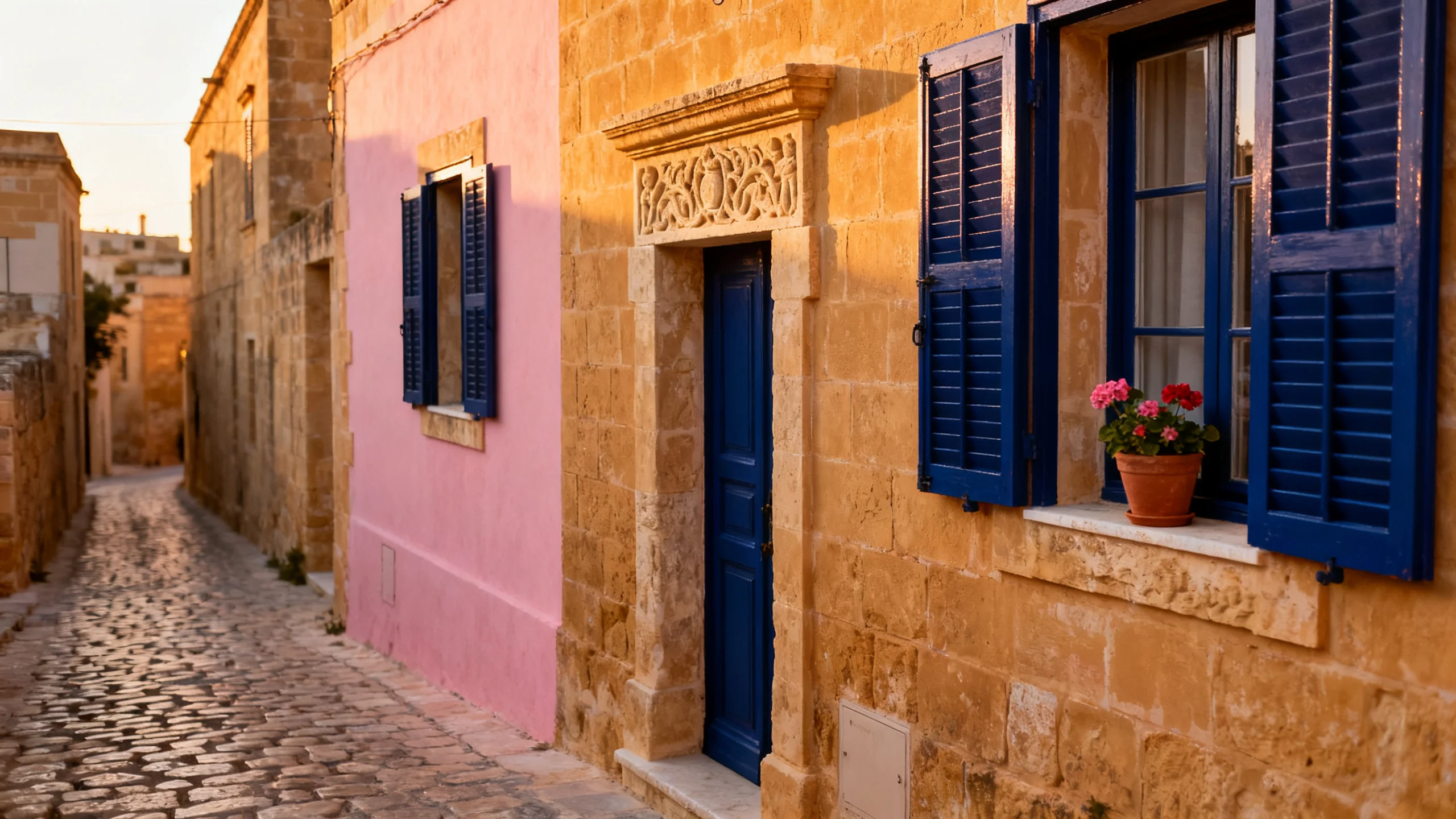
The quieter half of Malta has limited but interesting accommodation. Marsaskala for the small-town base, inland farmhouses for slow travel, what to avoid.
The south of Malta has the smallest accommodation supply of any region except Comino (which has none). This is partly a function of how undeveloped the southern coast is, partly a deliberate planning choice by successive Maltese governments to keep the southern villages from following the Bugibba pattern. The result is limited but interesting stock for travellers willing to base outside the main tourist clusters.
Three main bases, plus some farmhouse alternatives.
Marsaskala (the main base)
The town in the south-east corner, east of Marsaxlokk. Residential, with a 1.5 km seafront promenade and a working fishing dock at one end. The accommodation is mostly self-catering apartments and small guesthouses along the seafront, with a handful of restored townhouses inland.
What you find here:
- Seafront apartments: €80-130 a night for a one-bedroom unit in shoulder season. Some buildings have shared pools.
- Marsaskala Townhouse Conversions: small boutique 4- to 8-room properties at €120-200 a night.
- B&Bs scattered through the residential streets, €70-110.
Best for: travellers who want a quiet base, a daily walk along the promenade, and a 10-minute drive to Marsaxlokk or Hagar Qim. No noteworthy nightlife, a half-dozen good local restaurants, an authentic small-town atmosphere.
Pitfalls: not central for anything; the bus connection to Valletta is 35-45 minutes; no Maltese hotel-chain presence (which can be an advantage if you wanted to avoid that).
Marsaxlokk (the fishing-village base)
Sleeping in the famous fishing village itself. A handful of guesthouses inside Marsaxlokk, mostly small-scale, in restored seafront or near-seafront properties.
What you find here:
- Murella Living is the larger boutique, 8 rooms in a restored seafront building. €130-200 a night.
- Smaller guesthouses at €90-150 a night for a double room with breakfast.
- Self-catering apartments (a few) at €80-140.
Best for: one or two nights to experience the fishing-village atmosphere; travellers interested in the working harbour rhythm; photographers who want sunrise on the luzzu fleet.
Pitfalls: limited dining options outside the seafront restaurants; the Sunday market noise (08:00-13:00) is genuine if you are sleeping on the harbour side; few longer-term-stay amenities.
Tip: choose a property on the church-side streets rather than the harbour-side to avoid the Sunday market noise.
Inland villages (the farmhouse alternative)
The south has restored farmhouse rentals scattered through the inland villages (Zurrieq, Qrendi, Siggiewi, Mqabba, Safi). The architecture is similar to the Gozo farmhouse, but the rural feel is less pronounced because the southern Maltese villages are denser than their Gozitan equivalents.
What you find here:
- Two-bedroom farmhouses with small pool at €130-220 a night in shoulder season (€200-350 in July-August).
- Smaller restored townhouses without pool at €90-150.
Best for: travellers with a car who want a slow-travel rural pattern; couples wanting privacy; small families who appreciate the limestone vernacular at an accessible price.
Pitfalls: the inland villages have small populations and few amenities; eating out means driving to Marsaxlokk or Marsaskala; the rural-with-pool experience is genuinely better on Gozo.
Tip: if you want the farmhouse experience specifically, Gozo is the stronger choice. The southern Malta farmhouses are a reasonable backup, not the primary destination for that accommodation type.
What to avoid in the south
-
Birzebbuga apartments: the freight port immediately behind the town beach gives the location an industrial character. The accommodation is functional but the atmosphere does not deliver what southern Malta is for.
-
Paola apartments: the town is densely built, with limited Maltese character despite the proximity to the Hypogeum and Tarxien Temples. Sleep elsewhere and daytrip to the temples.
-
“South Malta luxury resort” hotels marketed online: there are none of these in the genuine south. Listings that suggest otherwise are usually in the airport-area suburbs or in the central conurbation north of the southern villages.
A note on car requirement
A car is essential in the south. The bus network covers Marsaxlokk, Marsaskala and the major temple sites but with hourly frequencies that punish multi-stop days. Rent a car (€25-40 a day) for the duration of your southern stay, even if you do not need it elsewhere in your Malta trip.
Parking is uniformly easy in the south: free street parking in most villages, a few paid spots in Marsaxlokk centre on Sunday mornings, free at all the temple sites.
How long to stay
Two nights is the natural floor for the south. Enough for the temples, Marsaxlokk, Dingli Cliffs and one swim.
Three to four nights for a slower visit including the Hypogeum if you have tickets, an inland village walking day, and time for two evenings at a Marsaskala or Marsaxlokk restaurant.
Five or more nights is for travellers committed to slow travel. The south rewards staying put more than the north does, but the inventory of distinctive places to visit is finite.
How the south works in a broader Malta itinerary
The strongest pattern for travellers who want some south Malta exposure:
Daytrip from a Valletta or Sliema base: hire a car for one day, drive Hagar Qim + Marsaxlokk + Dingli + return. No overnight needed. Covered in the 3-day and 5-day itineraries.
Two-night southern stay as part of a longer trip: useful in the 10-day itinerary, where the slow pace becomes the third register of the trip after Valletta intensity and Gozo rhythm.
Southern-only base for the full trip: only for travellers who specifically want the underdeveloped half of the country as the dominant experience. Not the recommendation for first-time visitors.
When to book
July-August: 6-8 weeks ahead. The southern stock is small enough that peak summer fills out earlier than the platforms suggest.
Shoulder season: 3-4 weeks ahead.
Winter: 1-2 weeks ahead, often with last-minute availability.
For the broader regional context, see the South Malta region where-to-stay page and the where-to-stay overview.
Related reading
- South Malta region hub: the regional context.
- Marsaxlokk fish market: the working harbour you can wake up to.
- Megalithic temples south: Hagar Qim and Mnajdra, 20 minutes from the inland farmhouses.
- Dingli Cliffs sunset: the natural late-afternoon walk from a southern base.
- 10-day Malta itinerary: the trip that builds in a southern base.