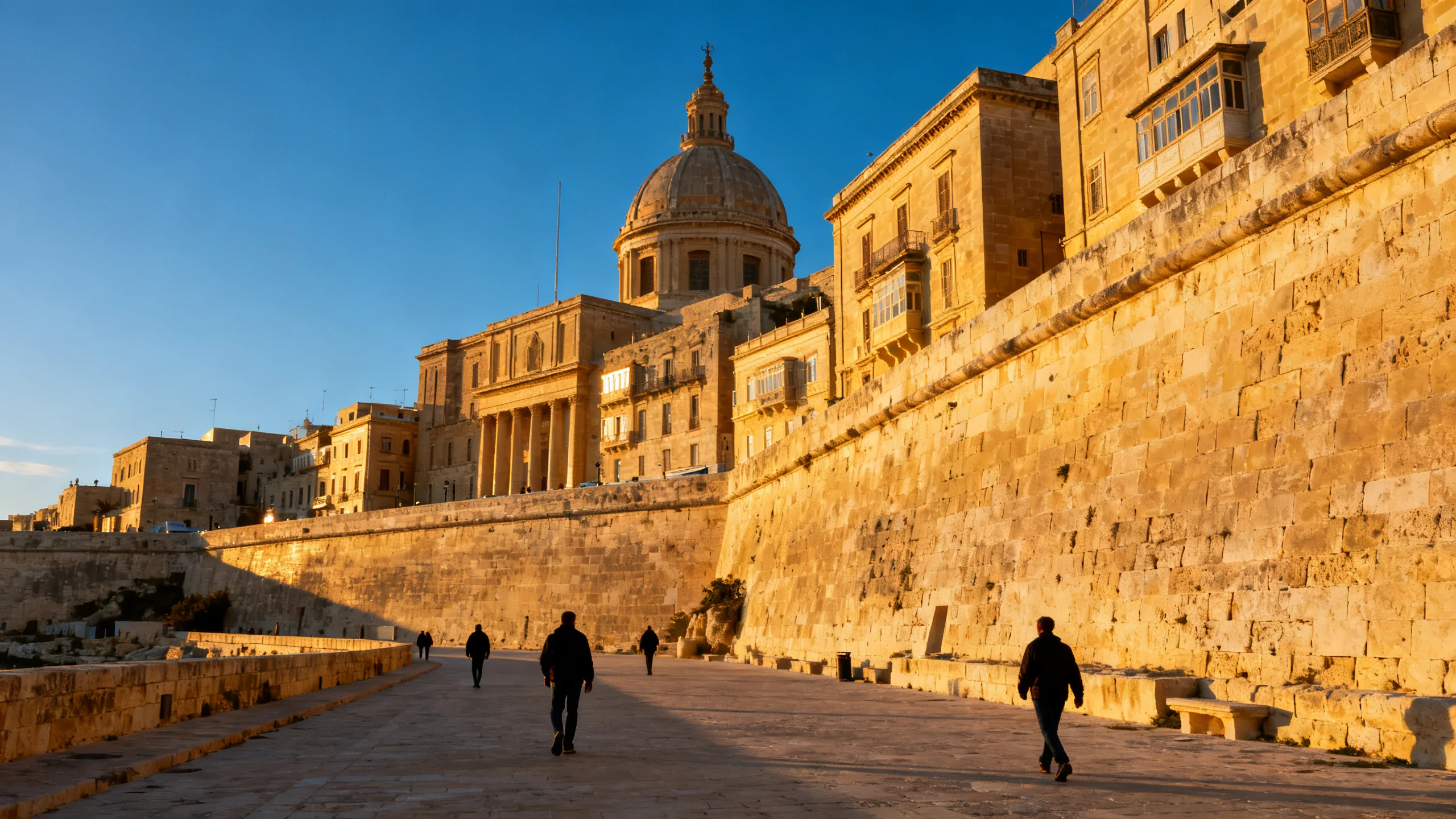
Why November to March is the underrated way to see the archipelago. Cool walking weather, empty cathedrals, half the prices, and a country running to its own clock.
Most of what gets written about Malta talks about it as a summer destination. The beach hotels, the package brochures, the cruise stops, the sunny-Mediterranean stock photography all aim at the same six months between May and October. This is reasonable; summer is when the swimming is best and the days are longest. It is also the version of Malta most visible to international audiences.
But the country has another version, and the case for visiting in winter (specifically November through March) is stronger than the marketing suggests. This is the case. The shorter, more decision-focused brief sits at When to visit Malta if you just want the month-by-month verdict.
The weather, honestly
Maltese winters are mild by European standards. Average January temperatures are 12-15°C during the day, dropping to 8-10°C overnight. The wettest month is January with about 90 mm of rainfall, but it falls in short heavy bursts followed by clear bright periods rather than the sustained grey skies of Northern Europe.
What this means in practice:
- Daytime walking weather is excellent. Mid-teens with bright sun is comfortable for a long Valletta walk, a Mdina visit, or a coastal hike at Dingli Cliffs. You will need a light jumper, not a winter coat.
- Sea swimming is off the menu. The sea temperature drops to 15-17°C by January. Some hardy Maltese still swim year-round; most travellers will not.
- Storms produce dramatic photography. The southern cliffs in a winter swell produce the strongest seascape conditions of the year.
- Sunset times are early: around 17:00 in December and January. Plan around it.
The honest summary: Maltese winters are like English late springs but with much more sun. The dominant emotional difference is the light, which is consistently bright and clean even on cool days.
What is open
Maltese tourism infrastructure operates year-round in the urban areas. What does close:
- Beach kiosks at Mellieha Bay, Golden Bay, Ramla, Comino: closed from late October to mid-May.
- Some Marsaxlokk seafood restaurants close for 2-3 weeks of winter for the owner’s holiday.
- Some Xlendi and Marsalforn resort hotels on Gozo close for January.
- The Sliema-Valletta ferry runs reduced winter schedule with occasional cancellations in storms.
- The Gozo fast ferry runs 3-4 crossings per day instead of hourly.
What stays open:
- Almost every cultural site: St John’s Co-Cathedral, the National Museum of Archaeology, all the temple sites, the Hypogeum, the Mdina Cathedral, the Cittadella on Gozo.
- Almost every restaurant in Valletta, Mdina, Sliema, and the central towns.
- All the hotels in the historic centres and the central conurbation.
- The bus network runs year-round.
- The Cirkewwa-Mgarr car ferry runs year-round with very rare weather cancellations.
The headline: the cultural Malta is fully accessible in winter; the beach Malta is closed.
The crowds (and the lack of them)
This is the strongest argument for off-season Malta. The cruise ships still come (smaller numbers, mostly Italian and German lines doing winter Mediterranean rotations), but the volume is a fraction of summer. The Hypogeum, which sells out 2-3 months in advance for summer slots, can be booked 3-4 weeks ahead in January. The St John’s Co-Cathedral has 30-45 minute queues in August; in January, you walk in. Mdina at noon in summer is gridlocked with coaches; in January it is so empty you can hear the limestone footsteps.
The atmosphere matters. The cathedrals were designed for an empty unhurried experience. They are better visited empty.
The prices
Off-season hotel rates are 30-50% below summer peaks. A Valletta boutique hotel that costs €280/night in July costs €160 in January. A converted Gozo farmhouse drops from €240 to €130. The Iniala Harbour House in Valletta, the most expensive property in Malta, has off-season rates 40% below its summer peaks.
Flights are similarly cheaper. A Ryanair London-Malta return that costs £180 in August costs £55 in January. Air Malta business-class fares are often half the summer rate.
The total saving on a one-week trip is in the order of €400-700 per person at the mid-range level. This is enough to upgrade the hotel category, eat at one Michelin-starred restaurant (De Mondion at the Xara Palace), and still come out ahead of the summer cost.
The Carnival and the winter cultural calendar
Winter Malta has its own events:
- Carnival: the Friday-to-Tuesday before Lent, dates vary each year (usually February). Floats, parades, costume competitions, mostly in Floriana and Valletta. Smaller than Tenerife or Rio but a real local event with five days of celebration.
- The Feast of St Paul’s Shipwreck (10 February): a major Valletta procession with a small fireworks display, commemorating the apostle’s shipwreck on Malta in AD 60.
- The Mdina Cultural Festival (typically June, but the winter run of similar smaller events at Mdina happens through the year).
- Christmas in Valletta (mid-December onwards): the Christmas crib trail through the city, with displays in many churches and shops.
- The pre-Lenten “Imbarka” tradition (early February in the inland villages): small village feasts that mark the start of the carnival season.
None of these are the equivalent of the summer festas. But they are real local events with genuine atmosphere, and the absence of summer tourists means you experience them as participants rather than spectators.
What it actually feels like
A typical winter Valletta evening: the streetlights come on at 17:00, the city is wet from a brief afternoon shower, the limestone facades shimmer under the lamps, the cathedral bells ring at 18:00 from St John’s and St Paul’s Shipwreck. The cafés on Strait Street are half-full with locals and a handful of visitors. The kitchens are warm. Dinner at Noni or Rampila costs €40 per person instead of €60. The walk back to the hotel through the empty Republic Street feels like the city you read about and rarely experience.
This is the version that the brochures do not advertise but the country genuinely offers between November and March.
When NOT to come in winter
Some travellers should still skip winter:
- Beach holiday seekers: the swimming is not happening.
- Divers who want certification: the Gozo dive schools run year-round but with reduced staffing; certification courses are more variable.
- Outdoor wedding planners: the rain risk during January and February is real.
- Anyone who specifically wants the festa atmosphere: those are summer-only.
For everyone else (cultural travellers, city-break visitors, slow travellers, repeat visitors), the off-season case is strong.
The travel pattern
The strongest winter Malta itinerary is similar to the summer one with two adjustments:
- Bring layers. The temperature swings between 8°C overnight and 16°C midday are larger than the summer equivalents.
- Plan around shorter daylight. Sunsets at 17:00 in December mean the late-afternoon cultural visits start at 14:00, not 16:00.
The 5-day or 7-day itineraries work equally well in November-March. The southern temples and Dingli Cliffs are arguably better in winter (the light is clearer, the temperatures are right for the longer walks, the crowds are absent).
For travellers committed to Gozo, the off-season pattern is: 2-3 Malta nights + 3-4 Gozo nights at a farmhouse with the wood-burning fireplace going. This is one of the most underrated European winter breaks available.
The honest paragraph
The summer Malta is the version of Malta the world is supposed to want. The winter Malta is the version the country still mostly keeps for itself. The cultural sites are the same; the streets are quieter; the prices are lower; the light is better. For travellers who are not specifically chasing beach weather, the November-to-March window is the right one. The country will be there in August. It will be cheaper and emptier and more comfortable in February.
Related reading
- When to visit Malta: month-by-month decision guide.
- Public holidays and festas: the winter feast-day calendar.
- Village festas: the parish-square evenings that happen year-round.
- Long weekend in Malta: a 3-day winter itinerary that genuinely works.
- Budget and costs: the shoulder-season discount, quantified.