National holidays that close shops and museums, the festa calendar from June to September, and the small religious feasts spread through the year.
Malta has 14 public holidays per year, more than most European countries. Some are nationwide closures (banks, government offices, many restaurants); others are recognised but most things stay open. Layered on top of these are the village festas, dozens of patron-saint celebrations spread mostly across the summer months, plus a handful of smaller religious feasts. The two categories combine into a calendar that is busy from mid-June to early September and quieter the rest of the year.
National public holidays
14 dates set by law, with five national days (Sette Giugno, the Republic Day, etc.) and nine religious feasts.
Fixed dates (every year):
- 1 January: New Year’s Day
- 10 February: Feast of St Paul’s Shipwreck (commemorates the apostle’s shipwreck off Malta in AD 60)
- 19 March: Feast of St Joseph
- 31 March: Freedom Day (the 1979 departure of British forces)
- 1 May: Workers’ Day
- 7 June: Sette Giugno (commemorates the 1919 riots against British rule)
- 29 June: Feast of Saints Peter and Paul (the “Imnarja” festival)
- 15 August: Feast of the Assumption (the most observed Marian feast; the Mosta festa is the largest of the year)
- 8 September: Feast of Our Lady of Victories (the 1565 lifting of the Ottoman siege)
- 21 September: Independence Day (from Britain, 1964)
- 8 December: Feast of the Immaculate Conception
- 13 December: Republic Day (the 1974 declaration of Malta as a republic)
- 25 December: Christmas Day
Movable date:
- Good Friday: the Friday before Easter Sunday. Major national observance; many restaurants close.
What is closed on public holidays:
- Banks and government offices: closed.
- Public museums and most attractions: closed (Heritage Malta sites including the Hypogeum, Hagar Qim, Tarxien, Ggantija, the Cittadella complex).
- Bus services: reduced Sunday schedule.
- Many restaurants: closed on Good Friday, Christmas Day, and 1 January. Most stay open on the other public holidays, especially the religious feasts where the festa happens.
- Supermarkets: mostly open on holidays except 1 January, Good Friday and Christmas Day.
Plan around the closures: do not schedule a Hypogeum or Tarxien visit on a public holiday because they will be closed. The major town centres (Valletta, Sliema) remain pleasant for walking even when museums are shut.
The festa calendar
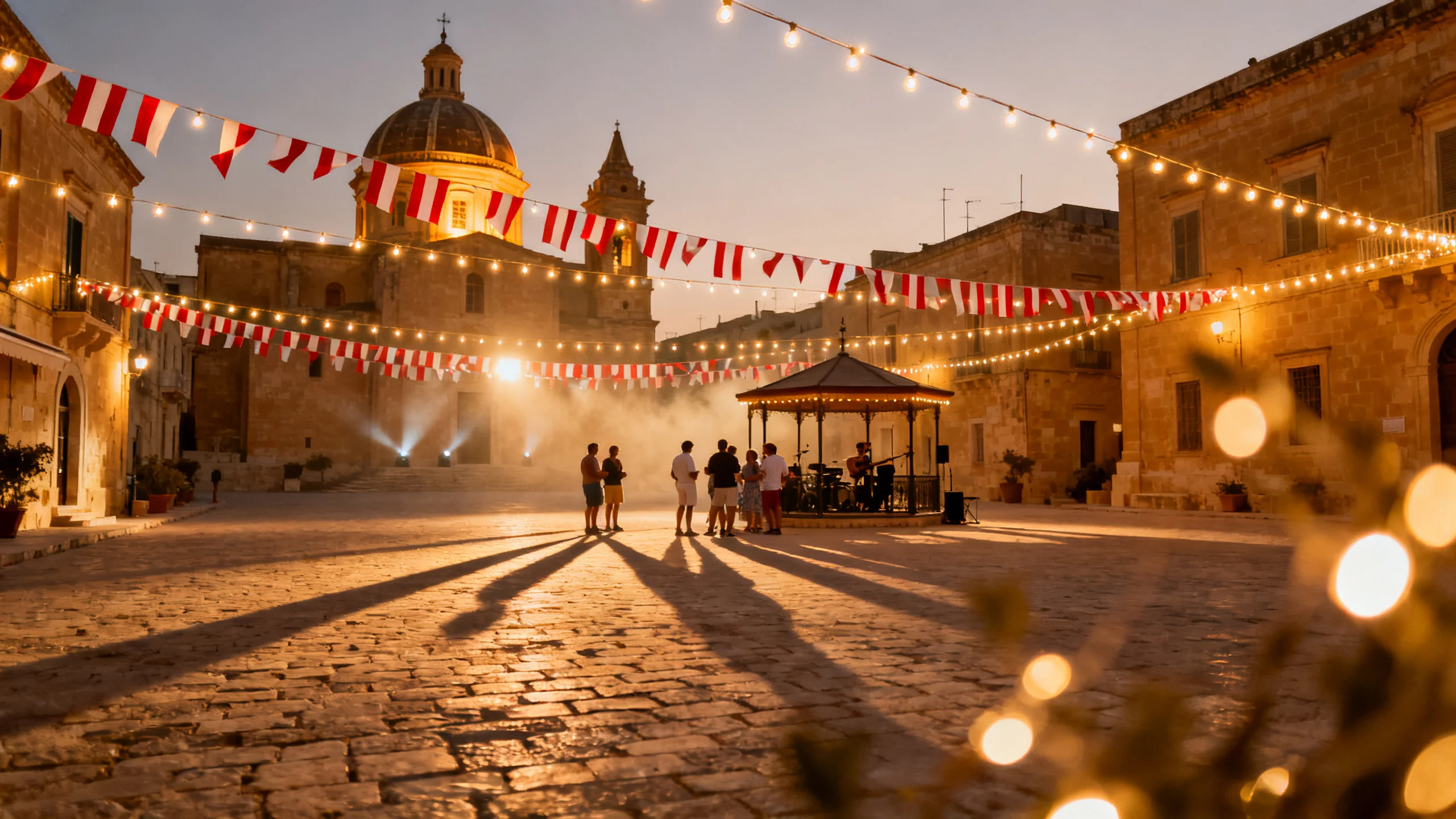
Most Maltese villages have a parish church dedicated to a patron saint, and each parish celebrates its patron’s feast day with a four-day festival in the summer. The festa is the most distinctive cultural event in Malta. Major festas run mid-June to early September.
The pattern of a festa:
- Thursday or Friday evening: opening band march and external festive illumination of the church facade.
- Saturday evening: the main brass-band march through the village, ending in the village square.
- Saturday night around 23:00: the firework display. Each parish has a pyrotechnics committee; the competition between rival villages is genuine and the displays escalate week by week.
- Sunday morning: the church procession with the patron-saint statue carried through the village streets.
- Sunday evening: a final fireworks display (often smaller than Saturday’s) and the close of the festa.
The atmosphere is genuinely participatory: villagers come out, families bring chairs to the square, food kiosks sell pastizzi and qassatat (small savoury pastries), bands play between marches, and the parish church facade is lit by thousands of bulbs in elaborate frameworks.
Major festas, by month
Mid-June to end of June:
- Imnarja (29 June, St Peter and St Paul) at Buskett Gardens near Dingli. The traditional folk festival, with rabbit-stew feasts and folk music. The oldest documented Maltese festival, dating to the medieval period.
- Gharghur (St Bartholomew, around 24 August traditionally, but the modern observance is in late June for crowd-management reasons).
Late July:
- Gozo Mġarr (St Anthony of Padua) on the last Sunday of the month.
- Mqabba (St Mary’s Assumption, on the village schedule rather than the canonical 15 August).
Early to mid-August:
- Lija (Transfiguration, weekend closest to 6 August). Famous for the firework displays; villagers regard this as the most beautiful single firework finale of the year.
- Birgu (Vittoriosa) (St Lawrence, 10 August).
- Birkirkara, Hamrun, Tarxien, Mosta (various, weekends nearest to 15 August).
15 August: the Assumption:
- Mosta (Assumption of Mary), the largest festa in Malta. Expect 20,000+ visitors. The dome is illuminated; the main square fills.
- Attard, Gudja, Mqabba, Qrendi: smaller parallel celebrations in the same week.
Late August to early September:
- Mdina-Rabat (Visitation, often late August or early September; depends on the village calendar).
- Naxxar (Nativity of Mary, 8 September). Large procession and good fireworks.
- Senglea (8 September, Our Lady of Victories). Particularly atmospheric in the Three Cities setting.
For travellers planning around a specific festa, the Malta Tourism Authority publishes the annual festa calendar online (visitmalta.com/festas) typically in early March each year. Verify dates because some villages adjust by a week to avoid conflicts with neighbours.
Other religious calendar moments
Beyond the public holidays and festas:
- Lent: the 40 days before Easter (mid-February to early April depending on the year). No major closures but some restaurants offer Lenten menus.
- Holy Week: the week before Easter. Maundy Thursday and Good Friday see church-procession events in many villages; Mater Dei hospital reduces non-emergency services.
- All Souls’ Day (2 November): cemeteries are particularly busy; not a public holiday but a traditional family-visit day.
- Christmas Eve to Epiphany (24 December to 6 January): the Christmas season. Many small Maltese traditions (crib displays, midnight mass, the Quccija “first foods” celebration for one-year-olds). Restaurants are generally open through this period except 25 December.
What this means for trip planning
If you are visiting in summer:
- Plan around the festas you actively want to attend. The Mosta or Lija festas alone are worth a specific trip-day timing.
- Avoid the festa Saturday nights for sleep nearby. Fireworks until midnight, brass bands until 02:00.
- Note the public holidays for museum closures. 15 August closes Heritage Malta sites; plan cultural visits around it.
If you are visiting in winter:
- The 10 February St Paul’s Shipwreck festival is the largest winter cultural event, with a Valletta procession and a small fireworks display.
- Carnival (movable date, usually February): the Friday-to-Tuesday before Lent. Floats, parades and concerts, mostly in Floriana and Valletta. Smaller-scale than Tenerife or Rio but a real local event.
If you are visiting in shoulder season (April-May or September-October):
- Mnarja at the end of June and the Senglea festa at the start of September are the edge-of-season highlights.
- Most national holidays fall outside this window, so museum and attraction closures are minimal.
The honest paragraph
The festa is the most authentic cultural experience available to a Malta visitor, and most tourism brochures undersell it. The Maltese put genuine resources into their summer festas (a major village’s annual fireworks budget can exceed €100,000), the events have not been packaged for tourist consumption, and the atmosphere is family and community rather than commercial. If you are visiting between mid-June and early September, check the calendar and pick one festa to attend. The experience justifies the late evening.
Related reading
- Village festas (activity guide): how to time and attend one.
- When to visit: plotting the festa peak against the weather.
- Malta year round: the winter calendar of feast days.
- Maltese cuisine: what the festa-day kitchens serve.