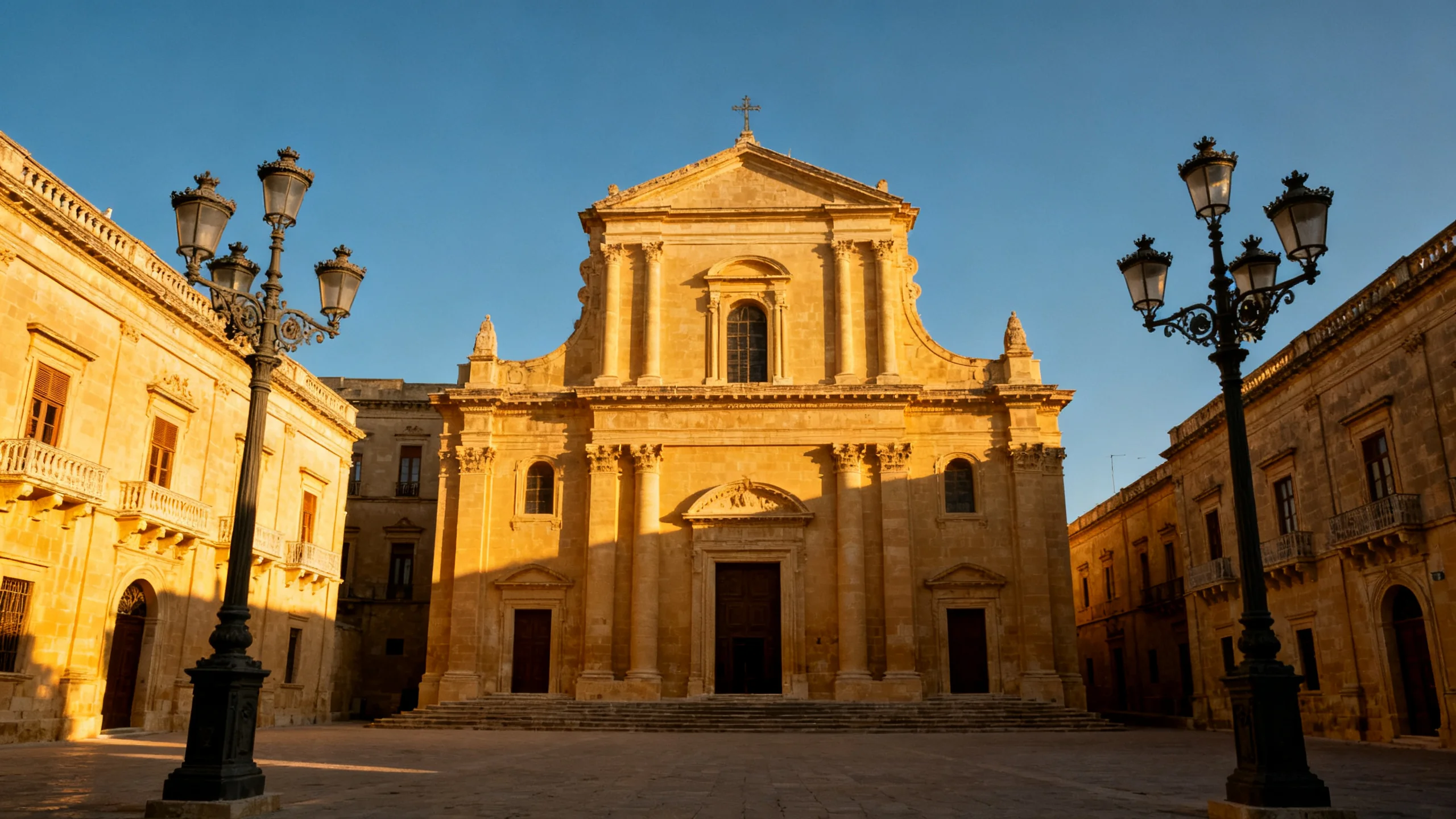
The central region is best understood as one full day, split between a late-afternoon Mdina visit, a morning at the catacombs and Mosta, and an optional extra half-day for the inland villages. The single most important practical decision is the time of day for Mdina; everything else is secondary.
The Mdina walking sequence (late afternoon to evening)
Aim for 17:00 in spring and autumn, 18:30 in summer. The cruise excursions leave by 17:00, the temperature drops, and the limestone catches the low sun and turns from grey to honey. A 90-minute walk takes the time it should.
Enter through the Mdina Gate, the baroque main entrance built in 1724 with the Vilhena coat of arms. The drawbridge slot is still visible in the limestone above the gate. Walk through, pause at the small square just inside, and turn left for the main spine.
Triq Villegaignon runs from the gate to the bastions overlooking the central plain. Slow walk, 600 m end to end, lined with palazzi:
- Palazzo Falson (Vilhena’s residence in the 16th century) on the right, now a small museum of the Falson family’s collected antiques. €10, 60 minutes if you take the audio tour.
- St Paul’s Cathedral in the central square, with the Mattia Preti vault painting. €10 includes the Cathedral Museum next door. 60 to 90 minutes total.
- Carmelite Priory and Church at the back of the cathedral square, free, often empty, 15 minutes.
- Bastion Square at the end of Triq Villegaignon, the viewpoint over the central plain. Free.
If you have time, return down Triq Inguanez (parallel to Triq Villegaignon) for a quieter walk. The mid-19th-century Palazzo Santa Sofia at the corner of Triq Santu Rokku is the oldest verified building in Mdina (the lower floor dates to around 1233).
End the visit with sunset at Bastion Square or, if you have a car, drive the 4 km to the Mtahleb cliffs west of Mdina for a different sunset angle over the open Mediterranean.
For dinner inside the walls: The Medina Restaurant in a converted 11th-century building (good Maltese), The Trattoria AD 1530 for casual pasta, or Fontanella Tea Garden for cake and the view from the bastions (terrace open year-round, no reservations, queue at peak times).
Rabat: catacombs in a morning
Rabat is the next morning’s program. The walk from inside Mdina is 8 minutes downhill out of the gate.
St Paul’s Catacombs is the headline. A 2,000 m² underground network of early Christian and Roman burial chambers, dating mostly from the 4th to 9th centuries. The visitor route covers about half the complex with lit corridors. €6, audioguide included, allow 90 minutes. The agape tables (low rock-cut communal dining slabs) are unique in the central Mediterranean.
Domus Romana, a 5-minute walk from the catacombs, is the only excavated Roman house on the island, with intact mosaic floors. €6, 45 minutes.
St Paul’s Grotto under the parish church of Rabat is the small cave where the apostle reportedly sheltered after the AD 60 shipwreck. Free, 15 minutes, no audio.
St Agatha’s Catacombs is a smaller variant 200 m from St Paul’s, with more visible early Christian wall frescoes. €5, 45 minutes, worth the visit if you are already at St Paul’s.
For lunch: Crystal Palace at the bottom of the Rabat hill is the famous pastizzeria (under €3 for two pastizzi and tea, cash only). For a sit-down lunch, Ta’ Doni on Triq Santu Wistin (Maltese kitchen) or Diar il-Bniet (a working farm-to-table restaurant on the Mdina side of Rabat) are the local picks.
Mosta and the dome
Mosta is 15 minutes from Mdina by car, 25 by bus. The Rotunda of the Assumption (the Mosta Dome) was finished in 1860, modelled on the Pantheon, and is the third largest unsupported dome in Europe. Free to enter (donation requested), 30 minutes inside.
The story to know: on 9 April 1942, a Luftwaffe SC 500 bomb pierced the dome during afternoon mass with around 300 people inside, and failed to detonate. The original (defused) bomb is on display in the sacristy. The hole in the dome was repaired but the story turned the church into a national symbol.
Beyond the dome, Mosta itself is a working market town. Acceptable for a coffee in the main square; not a destination on its own.
San Anton and the Three Villages
A separate half-day program if you have one.
San Anton Gardens in Attard, the formal gardens around the President of Malta’s official residence. 17th-century layout, old cypress trees, a small aviary, and the orange groves that gave the area its name. Free, open daily, 45 minutes.
The Three Villages (Attard, Balzan, Lija) walk takes the slow road between the three parish churches, with the early 20th-century villa belt as the architectural draw. Limestone facades, gallarija balconies, the over-the-top village mansions of merchant families. Around 2 km total, 90 minutes at a slow pace. The cafés in Lija main square are good lunch stops.
Summer village festas
Mid-June to early September, each village in the centre celebrates its patron saint over four days. The fireworks competition between rival villages is genuine: every parish has a pyrotechnics committee, and the ground-level and high-altitude displays escalate week by week.
Major festas in this region:
- Mosta: 15 August (Assumption Day), the largest in the centre, expect crowds.
- Lija: weekend closest to 6 August (Transfiguration), famous for the firework displays.
- Naxxar: 8 September (Nativity of Mary), large procession, good fireworks.
- Gharghur: late June (St Bartholomew).
- Attard: weekend after 15 August (Our Lady of Victory).
Plan ahead because the schedule is fixed by saints’ days, not tourist convenience. Festas run from around 19:00 to 02:00 with the main band march at 20:30 and the firework finale around 23:00. The church procession is on the Sunday morning.
Skip
- Mdina Dungeons, an underground “torture museum” with mannequins and red lighting. Tourist trap.
- Karozzin horse-drawn carriages at the Mdina gate. The streets are 600 m end to end; walk.
- Most Game of Thrones walking tours unless you came specifically for the King’s Landing exteriors. The filming locations are obvious without a guide.
- The Howard Gardens car park souvenir kiosks, all the same imported lace and mass-produced limestone sculpture.
Half a day vs a full day
A half-day visit (one afternoon, 14:00-19:30) covers Mdina, lunch at Fontanella, Bastion Square sunset. Doable as a daytrip from Valletta or Sliema; misses everything else.
A full day adds either Rabat (morning catacombs) or Mosta (morning dome) or the Three Villages (separate half-day). To do all three properly, plan two days in the region.
For travellers willing to sleep here, one full day plus a half-day works well: Mdina/Rabat afternoon-evening on day one, Mosta/Three Villages morning on day two, depart after lunch.