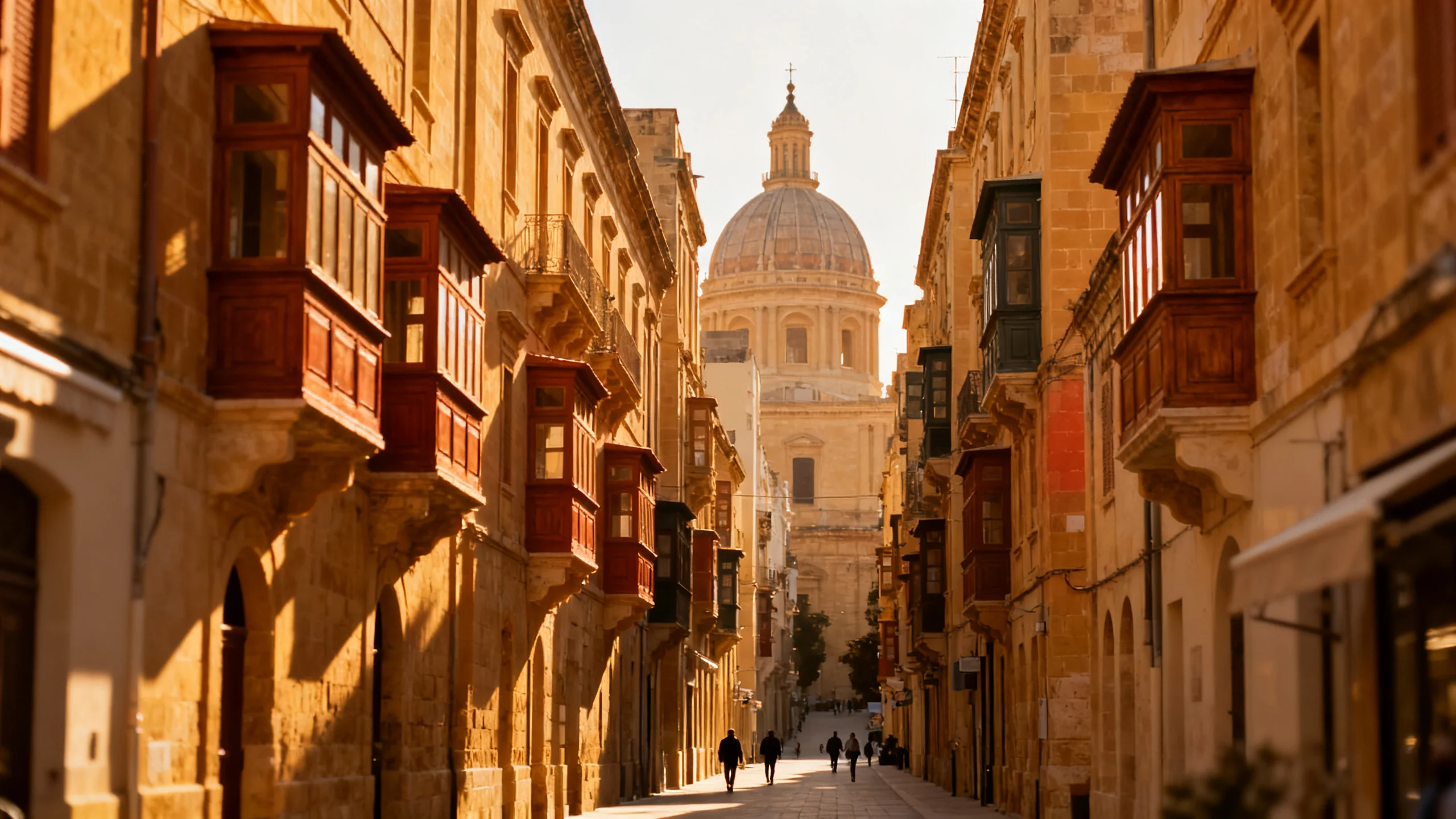
Valletta is short enough to see in one organised walking day, and dense enough that the same walking day repays a second visit. The honest order, north to south, uses gravity in your favour and ends with sunset at the harbour. Allow six to seven hours including a lunch break and reasonable time inside the cathedral.
The Valletta walking spine
Start at the Triton Fountain outside the city gate. The three bronze tritons holding a wide basin were sculpted by Vincent Apap in the 1950s, restored in 2017 as part of the city’s European Capital of Culture year. Walk through the modern Renzo Piano city gate (controversial when built in 2014, accepted as part of the city now).
Republic Street is the pedestrianised spine. Walk it slowly: the upper section, between the gate and Triq il-Merkanti (Merchants Street), holds the Auberge de Castille (now the Prime Minister’s office), the National Library, and the small Republic Square with its statue of Queen Victoria.
St John’s Co-Cathedral, off Republic Street, is the unmissable interior of Valletta. Built between 1572 and 1577 as the conventual church of the Knights of St John, the outside is intentionally austere, the inside is one of the most heavily ornamented baroque interiors in Europe. The marble inlaid tombstone floor covers the entire nave; each slab is the grave marker of a Knight, with the family arms and a Latin epitaph. The Oratory off the nave holds the two Caravaggios: The Beheading of St John the Baptist (1608, the largest canvas Caravaggio ever painted and the only one he signed in full) and St Jerome Writing. Both originals, both restored. €15 admission, audioguide included, dress code enforced (no shorts, no bare shoulders). 90 minutes minimum, two hours if you take the time on the Caravaggios.
Casa Rocca Piccola is the still-occupied 16th-century palazzo on Triq San Pawl, a five-minute walk from the cathedral. The current Marquis de Piro lives there with his family and personally shows visitors around twice an hour. The wartime air-raid shelter cut into the limestone below the house was used by the family and neighbours during the 1940-42 siege; the original family wine cellar, repurposed. €9, tours hourly, 60 minutes. The marquis is a character; the tour is one of the best small-museum experiences in Malta.
Continue down Republic Street to St George’s Square (Pjazza San Ġorġ) with the Grandmaster’s Palace and the State Rooms (closed for major restoration through 2026, check status). The square is the main civic space, with the Grandmaster’s Palace facade, the Police Headquarters and the National Library framing it.
Cut west to Upper Barrakka Gardens, the city’s main viewpoint over the Grand Harbour. Built on top of the St Peter and St Paul bastion in 1661, originally a private garden for the Italian Knights, opened to the public in 1824. The view sweeps from the Three Cities directly opposite (Birgu, Senglea, Cospicua) across the entire harbour mouth and out to Fort Ricasoli on the right. The Saluting Battery sits below the gardens; ceremonial cannons fire at noon and 16:00 daily (€3 to descend to the battery level, free to watch from above).
Walk the Lower Barrakka Gardens at the south-east tip of the city for a quieter view of the harbour mouth. The neoclassical memorial to the Great Siege of 1565 and the small chapel of Our Lady of Liesse are here.
End at Fort St Elmo at the tip of the peninsula. The original star-shaped fort held out for a month against the Ottoman siege in 1565, was rebuilt by the Knights in the 17th century, served as a British prison and then a barracks, and now houses the National War Museum. The 1942 material (the Siege of Malta, the George Cross awarded to the entire island) is the strongest section. €10, allow two hours.
For a full day, that is the walking spine. Add 90 minutes for lunch (one of the small wine bars on Triq San Lucia or Triq Sant’Anna, away from the Republic Street souvenir shops) and you have a serious six-to-seven-hour day.
Other things inside Valletta
If you have a second day or a strong interest in a specific theme:
- Manoel Theatre (1731) is one of the oldest working theatres in Europe. The interior is small, intimate, and decorated with painted boxes. Cheap tours when no performance is on (€7, 30 minutes). Catch a chamber music concert here if your dates align.
- The National Museum of Archaeology holds the original artefacts from the megalithic temples, including the famous “Sleeping Lady” figurine from the Hypogeum. €6, allow two hours if you have visited any of the temples.
- The Lascaris War Rooms are the underground command bunkers used to direct the defence of Malta in 1942-43 and then the Allied invasions of Sicily and Italy. €15, 75 minutes, weak signage but the atmosphere is genuine.
- St Paul’s Shipwreck Church on Triq San Pawl is the smaller of Valletta’s two parish churches, where the relic of St Paul’s wrist bone is kept. Free, ten minutes, walk in if you are passing.
- Strait Street (Triq id-Dejqa) is the parallel back street that the British navy nicknamed “The Gut”. Once the bar-and-brothel strip, now a slow gentrification of small wine bars and live-music venues. Worth an evening walk.
Half a day in the Three Cities
The Three Cities (Birgu, Senglea, Cospicua) sit across the Grand Harbour and reward a half day if you have one to give. Take the dghajsa water taxi from Lascaris Wharf (€2, 10 minutes including loading).
The route once you arrive in Birgu:
- Walk up the limestone steps from the dghajsa landing into the Collachio, the walled quarter where the Knights’ auberges (lodgings by language group) were concentrated.
- Inquisitor’s Palace on Triq il-Mina l-Kbira housed the Roman Inquisition in Malta from 1574 to 1798. The courtroom, the dungeons and the prison cells are preserved. €6, 60 minutes.
- Fort St Angelo at the tip of Birgu peninsula was the Knights’ first headquarters and the centre of the defence in 1565. Restored, the upper levels are the British-era naval portion. The view from the rampart, looking back at Valletta with the harbour foreshortened between you, is arguably better than Upper Barrakka. €10, 75 minutes.
- Cross over to Senglea (10 minutes’ walk via the harbour-front road) for Gardjola Gardens at the tip, with the famous limestone watchtower carved with an eye, an ear and a crane (the symbols of vigilance). Free, no admission, sunset is the best time.
- Cospicua is the largest of the three and the most residential. The waterfront is being redeveloped (mixed warehouses and marinas); skip the dock area unless you specifically want to see it.
Total time for the Three Cities half-day: 4 to 5 hours including lunch. Return to Valletta on the same dghajsa operator if they agreed in advance; otherwise queue at the Birgu landing for the next one.
Evening Valletta
After 19:00 in spring and autumn, after 20:00 in summer, Valletta becomes the city the cruise day-trippers never see. The cafés in St George’s Square fill up with locals. The Manoel Theatre’s small bar (open to non-ticket-holders) is a quiet drink in baroque surroundings. The Strait Street wine bars run from 19:00. The streetlight throws long shadows across the limestone, and the bastions are walkable in the dark.
This is the strongest argument for sleeping inside the walls. The day is shared with the cruise crowd; the evening is the city’s own.
Skip
- The horse-drawn karozzin carriages at the gate. The streets are 900 m end to end; walking is faster, cheaper, and the horses look tired.
- The Valletta Tourist Train, a road-train circuit aimed at coach tours. The whole city is a 30-minute walk.
- Most of the Republic Street souvenir shops between the gate and the cathedral. The limestone sculptures are mass-produced, the lace is largely imported, the Maltese honey is fine but cheaper at any village shop.
- The Mdina Dungeons-style “torture museum” attractions advertised on flyers in the street; there is none of these in Valletta proper, but tour pitches try to upsell them.
When to go inside the cathedral
St John’s Co-Cathedral is the single most crowded interior in Valletta between 11:00 and 14:00, when the cruise excursions are inside. The cathedral opens at 09:30 (closed Sundays); arrive before 10:00 or after 15:00. Book the timed ticket online at stjohnscocathedral.com to skip the door queue, which can be 30 minutes in summer.
For the Caravaggios specifically, the Oratory is small (capacity about 40 people) and the cathedral staff move you through in waves. The closer you get to opening or closing, the more time you have alone with the paintings.