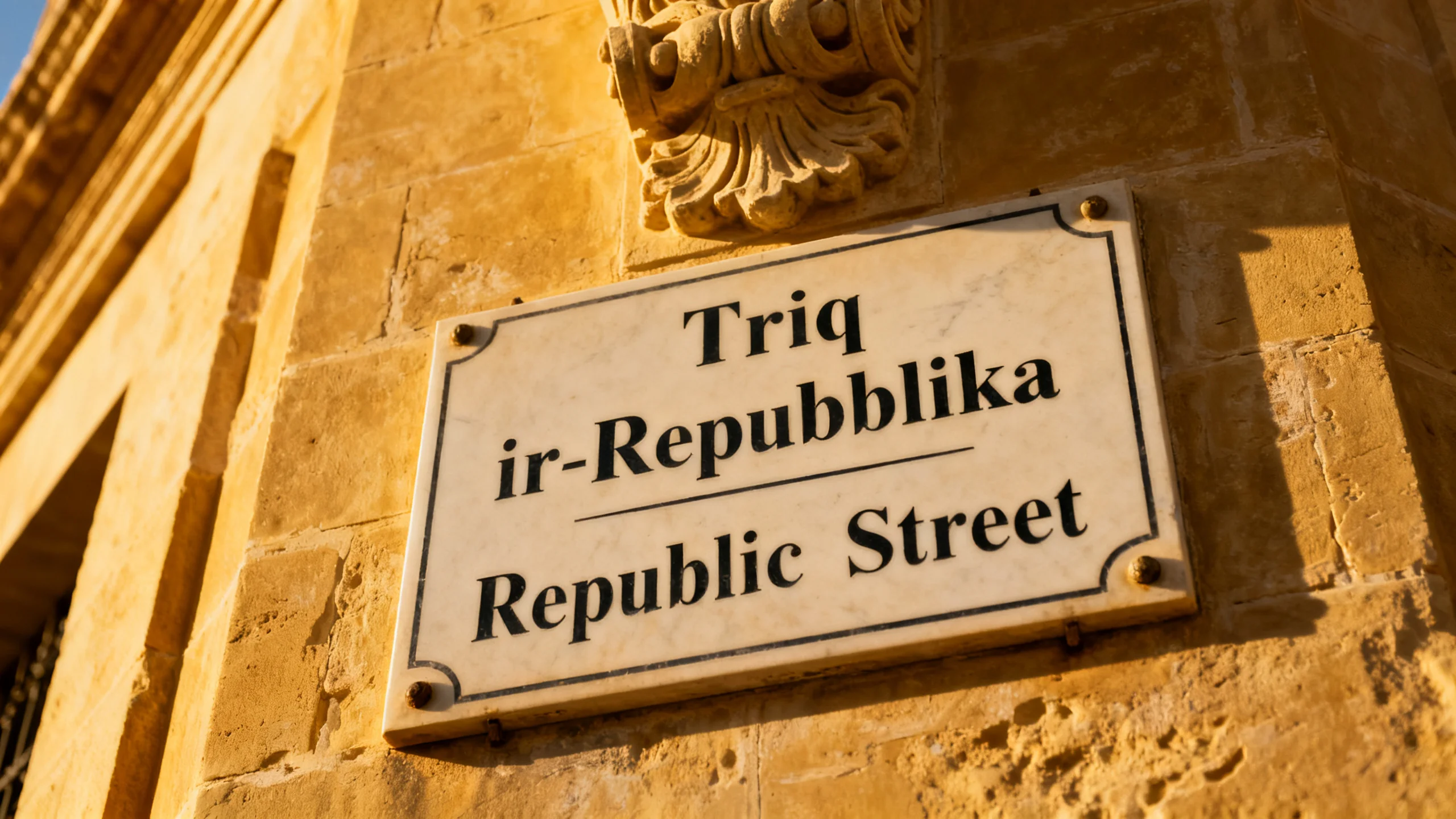
An Arabic-rooted language with Italian and English layered on top, written in Latin script. A short history of how Maltese became the linguistic anomaly of the EU.
There are 24 official languages in the European Union. Twenty-three are Indo-European (the Romance, Germanic, Slavic, Baltic, Hellenic and Celtic branches, plus Albanian and Greek). Maltese is the 24th. It is a Semitic language: structurally related to Arabic, Hebrew and Aramaic, with no Indo-European ancestor. The shorter practical brief sits at Language in Malta for travellers who just want phrases and pronunciation.
It is also the only Semitic language anywhere written natively in Latin script, the only Semitic language that is an official EU language, and possibly the most heavily mixed-vocabulary language in continuous everyday use anywhere on earth.
Origins
The Arab conquest of Malta in 870 AD brought Arabic-speaking settlers. Before that, Malta had been Phoenician-Punic, Greek, Roman, and Byzantine in succession; what language was actually spoken in everyday Maltese homes in the 7th century is debated, but it was probably a late Latin vernacular with Greek and Punic remnants.
After 870, the population spoke Arabic, specifically the Sicilian-Maghrebi variant that was also spoken in nearby Sicily and Ifriqiya (modern Tunisia). The Norman re-conquest of Malta in 1090 introduced Sicilian-Norman-French-speaking elites, but the everyday population continued to speak Arabic, and continued speaking it for the next several centuries even as Latin Christian rule consolidated.
By around 1200, the Maltese Arabic had begun to diverge significantly from mainland Arabic. The first written Maltese texts (in Latin script, with very irregular spelling) date from the 15th century. By the time the Knights arrived in 1530, the local population spoke a distinctively Maltese form of Arabic with extensive Sicilian and Italian loanwords, written occasionally in Latin script for record-keeping but not yet standardised.
The systematic written form developed in the 19th century under British colonial rule. The current orthography was standardised in 1924 by the Society of the Maltese Language (Għaqda tal-Kittieba tal-Malti). It uses the Latin alphabet plus four diacritical letters: ġ (g-dot), ħ (h-bar), ż (z-dot), ċ (c-dot).
The structure
Maltese morphology is Semitic. Verbs use the triliteral root system common to Arabic and Hebrew: three consonants form a root, and vowels are inserted to create different tenses, moods, and derived forms. For example, the root K-T-B (to write) produces:
- kiteb: he wrote
- kitbet: she wrote
- niktbu: we write
- miktub: written (passive participle)
- kitba: writing (noun)
- kittieb: writer (noun)
This is identical in structure to Arabic (k-t-b producing kataba, katibun, kitab, etc.) and impossible in any Indo-European language.
The plural system is also Semitic: many nouns have a “broken plural” formed by changing the internal vowels rather than adding an ending. For example, ktieb (book) → kotba (books); dar (house) → djar (houses).
The vocabulary, however, is heavily mixed:
- About 50% Arabic-origin (for basic concepts: body, family, numbers, weather, food preparation).
- About 30% Romance-origin, mostly Sicilian and Italian (for civilisation, religion, abstract concepts, urban vocabulary).
- About 15% English-origin (modern technology, business, administration, sports).
- About 5% from other sources (French during the Napoleonic period, Spanish, occasional Greek).
A typical Maltese sentence mixes these freely:
“Il-bar tal-università huwa abbastanza moderne.” (The university bar is fairly modern.)
In this sentence: “Il” (Arabic article), “bar” (English), “tal” (Arabic preposition + Arabic article), “università” (Italian), “huwa” (Arabic pronoun), “abbastanza” (Italian), “moderne” (English with Italian adjective ending). The grammar is Arabic; the vocabulary is everyone’s.
The diacritics and pronunciation
The four special letters mark sounds that exist in Maltese but are written differently in modern Maghrebi Arabic:
- ħ is silent (a marker for a historically Arabic h that has gone quiet in modern Maltese pronunciation). Example: ħamsa (five) is pronounced “AM-sa”, not “HAM-sa”.
- ġ is “j” in English. Example: ġarr (neighbour), pronounced “JARR”.
- ż is “z” in English. Example: ża (nothing), pronounced “ZAH”.
- ċ is “ch” in English. Example: ċittà (city), pronounced “CHEE-tta” (an Italian loanword).
- q is a glottal stop (a brief catch in the throat). Example: qalb (heart), pronounced “AHLB” with the glottal at the beginning.
- x is “sh”. Example: xemx (sun), pronounced “SHEMSH”.
- għ is a silent letter marker that lengthens the preceding vowel. Example: Għawdex (Gozo), pronounced “OW-desh”.
- j is “y” in English (not the English “j”).
This last point matters because place names use x, għ, and j frequently and outsiders consistently mispronounce them:
- Xagħra (a village) is “SHAH-ra”.
- Marsaxlokk is “marsa-SHLOKK”.
- Birżebbuġa is “birr-zeb-BOO-ja”.
- Mġarr is “im-JARR” with the i lightly voiced.
- L-Imdina is “lim-DEE-na”, with the i in “im” only lightly voiced.
Status today
Maltese is one of two official languages of Malta (the other is English) and is an official EU language. It is taught from primary school as the first language of instruction; English is taught from age 4-5 as the second language. Most government documents are bilingual.
In everyday use:
- Older Maltese (60+): predominantly use Maltese, often switching to English with foreigners but otherwise speaking Maltese.
- Middle-aged (30-60): bilingual, often code-switching mid-sentence between the two.
- Younger (under 30): heavy English use in professional and online contexts; Maltese still used at home and in religious/family settings.
There is no serious risk of Maltese dying out (around 520,000 native speakers, almost all of them resident in Malta plus the diaspora in Australia and Canada). But the proportion of pure-Maltese speech vs code-switched English-and-Maltese speech is steadily shifting toward more English.
How to engage as a visitor
Five greetings to learn:
- Bongu (BON-ju): good morning. Italian-origin.
- Bonswa (bon-SWAH): good evening. Italian-origin.
- Grazzi (GRAT-tsi): thanks. Italian-origin.
- Skuzi (SKOO-zi): excuse me. Italian-origin.
- Iva (EE-va): yes. Arabic-origin.
These are universally appreciated. Older Maltese speakers will often respond in Maltese; younger ones will switch to English to be helpful. Either way, the gesture matters.
For more, see the language-in-malta practical page.
Why this language is worth knowing about
Maltese is not just a curiosity. It is the only living example of a language that has continuously existed at the intersection of three major linguistic families (Semitic, Romance, English/Germanic) for close to a thousand years, while remaining structurally faithful to one of them. It is one of the strongest pieces of evidence we have for how language contact works in practice.
It is also, more simply, the language of a country you are visiting. Listening for the difference between Italian-sounding loanwords and Arabic-sounding ones is one of the small pleasures of a Malta trip. You can do it from your café table.
Related reading
- Language in Malta (practical): the traveller-facing version with phrases.
- The Knights of St John: the Italian-speaking ruling class that shaped half of modern Maltese vocabulary.
- Village festas: the village-square setting where the spoken language is at its purest.
- Maltese cuisine: half the food words are Sicilian, half are Arabic — the table is a language lesson.