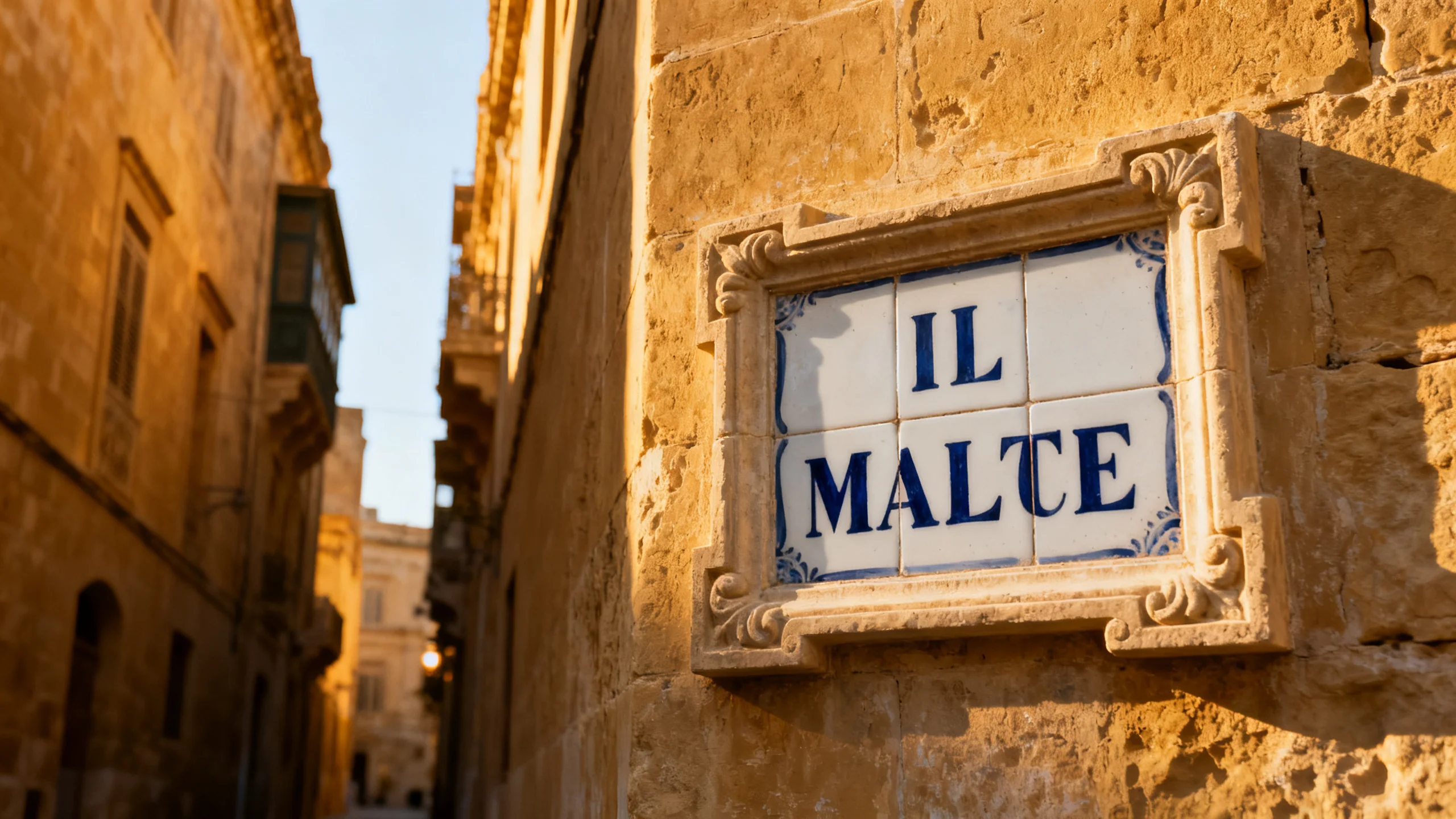
The only Semitic language in the EU, why English works everywhere, what signs actually look like, and a few useful Maltese words and phrases.
Malta has two official languages: Maltese (Malti) and English. Both have legal status, both appear on every public sign, and both are spoken by virtually every Maltese person you will encounter. For a traveller, this means you can navigate the entire country in English without learning a word of Maltese, but the moment you do learn a few words, doors open quickly. The longer-form essay on how the language works sits at The Maltese language.
Maltese is unusual
Maltese is the only Semitic language in the European Union, descended from the Arabic spoken on Malta and Sicily in the medieval period. Roughly the structure is Arabic; the vocabulary is heavily layered with Italian and Sicilian (the Knights ruled in Italian for two centuries), then with French (briefly, during the Napoleonic occupation), then with English (during the British colonial period from 1800 to 1964).
The result is a Semitic backbone with Romance and English loanwords, written in Latin script (the only Semitic language to use it natively). This produces written Maltese that looks superficially familiar to readers of Italian or English but reads completely unlike either:
- “Il-bieb tat-tama” (the door of hope): three Arabic-derived words plus an article.
- “Grazzi mill-qalb” (thanks from the heart): Italian “grazzi” plus Arabic “qalb”.
- “Iva, please” (yes, please): common modern code-switching.
The accent marks matter: ħ (h-bar), ġ (g-dot), ż (z-dot), ċ (c-dot). The pronunciation:
- ħ is silent (a marker for an Arabic-derived h that has gone quiet over time, like in “ħamsa” = five)
- ġ is “j” in English (as in “ġarr” = neighbour)
- ż is “z” in English (as in “ża” = nothing)
- ċ is “ch” in English (as in “ċittà” = city)
- q is a glottal stop (a small catch in the throat, like the t in British “butter” spoken Cockney)
- x is “sh” in English (as in “xemx” = sun)
This last one matters because place names use “x” frequently and outsiders consistently mispronounce them: Xagħra = “SHAH-ra”, Xemxija = “shem-SHI-ya”, Marsaxlokk = “marsa-SHLOKK”.
Where English works (everywhere)
The entire tourism economy operates in English. Hotels, restaurants, museums, taxi drivers, bus drivers, the airport, the cruise terminal, the dive schools. English is the primary professional language of younger Maltese people (under 40), often the language of higher education, and the de facto written language of business.
If you only speak English, you will not have a single practical language problem in Malta.
What signs look like
Public signage is bilingual by law. Road signs, museum panels, bus destinations, restaurant menus, and government communications all appear in both languages. The Maltese version is usually on top:
ID-DAĦLA
ENTRANCE
TRIQ IR-REPUBBLIKA
REPUBLIC STREETStreet names are almost always in Maltese only. “Triq” = street. “Pjazza” = square. “Pont” = bridge. “Wied” = valley. “Marsa” = port (Arabic). “Mġarr” = a small port (literally “the pulling place”).
Place name conventions are worth knowing:
- Marsa- prefix: a port. Marsamxett (harbour-at-Mxett), Marsaxlokk (south wind port), Marsalforn (the lighthouse port), Marsaskala (the long port).
- Wied- prefix: a valley. Wied iz-Zurrieq (the valley by Zurrieq), Wied il-Ghasel (honey valley).
- Ta’- prefix: “of” or “belonging to”. Ta’ Pinu (the basilica of Pinu/Joseph), Ta’ Frenc (the restaurant of Francis).
- Il- or Ir- or Iz- prefixes: definite articles (“the”). Pronunciation changes based on the following letter.
Useful Maltese words and phrases
Learn five words and the response from Maltese people is consistently warm. Twenty words and you have unlocked the genuine local respect.
The minimum five:
- Bongu (BON-ju): good morning. Used until noon. Italian-origin.
- Bonswa (bon-SWAH): good evening. Used from late afternoon. Italian-origin.
- Grazzi (GRAT-tsi): thanks. Italian-origin.
- Skuzi (SKOO-zi): excuse me. Italian-origin.
- Iva (EE-va): yes. Arabic-origin.
The slightly broader set:
- Le (lay): no. Italian-origin.
- Saħħa (SAH-ha): cheers (literally “health”). Arabic-origin.
- Tajjeb (TY-yeb): good, fine, okay. Arabic-origin.
- Mhux problema (MOOSH pro-BLE-ma): no problem.
- Kemm? (kemm): how much? Useful at markets.
- Fejn? (fayn): where?
- Imnejn? (im-NAYN): from where?
- Inti minfejn? (IN-tee min-FAYN): where are you from?
The really useful ones for travellers:
- Ġawhra (JOW-ra): jewel. As in Ġojjell. The Maltese word for the Cittadella, “Iċ-Ċittadella,” is sometimes informally called “il-ġawhra ta’ Għawdex” (the jewel of Gozo).
- Pastizz (pas-TITS, plural pastizzi): the iconic flaky pastry. With ricotta (irkotta) or mushy peas (pizelli).
- Hobż biz-żejt (HOBS bid-zayt): Maltese bread with olive oil and tomato. The traditional snack.
- Fenek (FE-nek): rabbit. The national dish (fenek bil-birra, rabbit stew with beer).
- Lampuki (lam-POO-kee): dolphinfish, in season September-November. Lampuki pie is the autumn speciality.
- Bizzilla (bid-ZIL-la): lace. The traditional Maltese lace work.
When to use Maltese vs English
The rule of thumb:
- Open with English in any commercial or formal situation. The person you are talking to will respond fluently in English unless they specifically want the conversation in Maltese.
- Try Maltese for greetings (“Bongu”, “Grazzi”) in any face-to-face exchange. This is universally appreciated.
- Switch to Maltese only if you can actually conduct the conversation. Halfway-Maltese-with-English-fallback can feel awkward to the local speaker.
Younger generations (under 30) often respond in English even when greeted in Maltese, because they consider it more efficient for foreign visitors. Older generations (over 60) often prefer to continue in Maltese once you have started in it.
On accents and varieties
There are slight regional accents (Gozitan Maltese sounds different from Valletta Maltese) but no major dialect divides. The language is taught in schools, used in parliament, and the literature (poetry mostly, but also some novels) is a recognised cultural form.
The Maltese emphasise the second-to-last syllable of most words, which is why “Marsaxlokk” lands on the LOKK, not the MAR.
Italian and other languages
Maltese understand Italian readily; many speak it conversationally. The same goes for Sicilian dialect. French is taught in some schools but is not widely spoken. German, Spanish, Dutch and the Scandinavian languages are spoken at the tourism-business level (in 4 and 5-star hotels) but not generally.
Mandarin, Russian and Arabic are spoken by visitor-facing staff in some larger hotels and certain shops, but you would be unwise to depend on it.
The two-letter abbreviations
- MT: Malta (ISO country code)
- GZ or GZO: Gozo (informal)
- MLA: Malta International Airport
- VLT: Valletta (sometimes seen on postal addresses)
For travellers planning a longer stay, the University of Malta runs Maltese language courses for foreigners. The minimum entry-level course is 30 hours over a month and gets you to a working Bongu-Grazzi level plus a small grammar foundation.
Related reading
- The Maltese language (the long version): the Semitic-Romance-English structure unpacked.
- Village festas: the parish square is where you hear the spoken language at full speed.
- Maltese cuisine: food words are the easiest entry to the vocabulary.
- Public holidays and festas: the calendar in Maltese.