Three meals you will not find in the guidebooks. The Friday lunch at a working farmhouse, the fenek place that does not advertise, the Marsaxlokk weekday boats.
Most travellers in Malta eat in three places. Their hotel for breakfast. A Sliema or St Julian’s restaurant for dinner. A Marsaxlokk seafront seafood place for one Sunday lunch. This is a reasonable approximation of a Maltese food trip, and it produces a competent set of meals at competent prices.
It also misses entirely the food culture that the Maltese themselves participate in. The Sunday-roast family lunch at a working farm. The casual mid-afternoon coffee at a small village square. The mid-week working-fisherman lunch at the Marsaxlokk quay before the tourist boats come in. The pre-Lenten meal at a village kitchen that has been making the same dishes for sixty years. None of this appears in the standard tourist food itinerary.
Three meals that are worth specifically targeting, with names and addresses.
The Friday lunch at Diar il-Bniet
Diar il-Bniet is a working farm and restaurant in Dingli, set on the edge of the central plateau with a view down toward the southern cliffs. The farm has been in the same family for several generations. The restaurant began as a way to use the farm produce in 2008; it now serves lunch six days a week and dinner three.
The Friday lunch is the meal to target. The Maltese tradition is that Friday lunch is the major family meal of the week (the Sunday lunch is also major, but it is typically eaten at home; the Friday is more often the public-restaurant version). At Diar il-Bniet, Friday lunch is anchored by:
- A bigilla appetiser, with house sourdough and local olive oil.
- A starter of fresh ġbejna (Gozitan sheep’s-milk cheese) with farm-grown tomatoes, capers, and the season’s vegetables.
- A pasta course: either the farm’s slow-cooked rabbit sauce on linguine, or a vegetable risotto if you prefer.
- A main course of fenek (rabbit stew) or a fresh-fish option from the small daily delivery, or a vegetarian option built around the farm vegetables.
- A dessert: the kannoli, the imqaret (date-filled pastries), or whatever the kitchen has made fresh that day.
- Coffee or a digestif of bajtra liqueur.
The full lunch takes two and a half hours and costs €35-45 per person including wine (the house carafe of Gellewża or Girgentina). The pace is the genuine Maltese family-meal pace; the staff understand that nobody is in a hurry and the courses come at the rhythm of conversation.
How to find it: Triq il-Buskett, Dingli. 15-minute drive from Sliema or Valletta. Reservations essential for Friday lunch (book a week ahead in shoulder season, three weeks in summer). The farm shop sells olive oil, honey, jams, and ġbejna for take-home; budget €15-25 for a small selection.
Why this matters: most travellers eat their “Maltese food” at a tourist-tier restaurant where the bigilla is made from a packet and the fenek is farmed and fast-cooked. Diar il-Bniet shows what the Maltese kitchen is when the ingredients are local, the slow cooking is real, and the family meal pattern is respected.
The fenek place that does not advertise
The single best fenek (rabbit) in Malta is, by most local accounts, at United Bar and Restaurant in Mġarr (the north-Malta village, not the Gozo port). The restaurant is unmarked from the street: no signage beyond a small “United” plaque next to the door, no online presence beyond a basic Facebook page, no website. The atmosphere inside is a working village kitchen with fluorescent lighting, formica tables, and an extended family running the front of house. The food is exceptional.
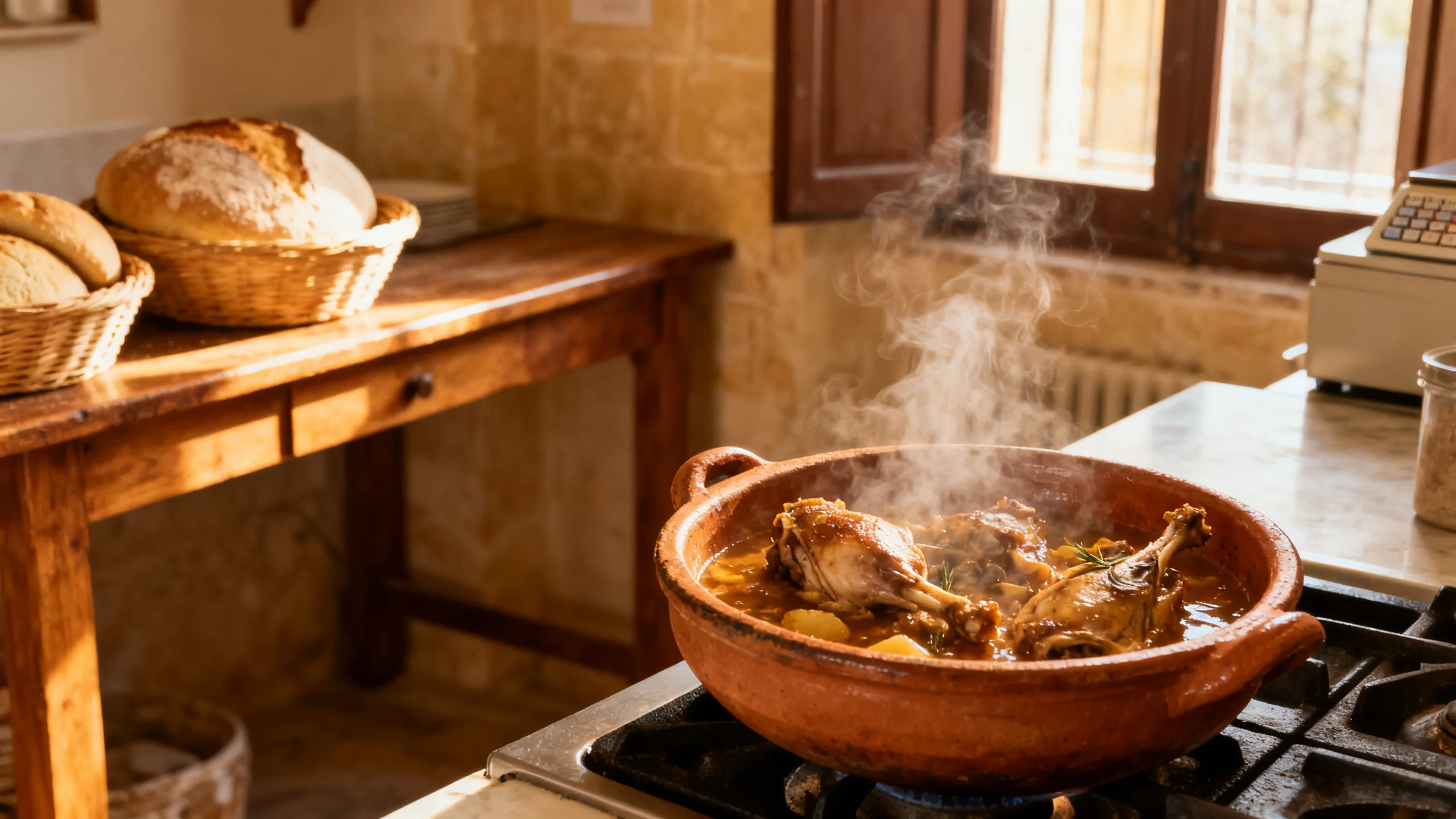
United’s fenek bil-birra (rabbit with beer) is the signature dish:
- The rabbit is wild, sourced from a network of hunters.
- The cooking is slow: 4 to 5 hours in a wide pan over low heat, with onions, garlic, red wine, beer (Cisk lager), tomato concentrate, bay leaves, juniper berries, and the rabbit’s own liver added at the end as a thickener.
- The pasta course (the sauce served on linguine or spaghetti, traditional in Maltese fenek service) is included.
- The main course is the rabbit pieces in the reduced sauce.
The full fenek service costs €25-30 per person, including the pasta. Add a starter (the house bigilla and bread, €4), a glass of house wine (€4), and dessert (€6), and you have a €40 dinner that competes with anything on the country.
How to find it: 7 Triq il-Knisja, Mġarr (the village near the church). Bus #44 from Valletta to Mġarr; then walk uphill to the church square. By car: 25 minutes from Sliema, 35 from Valletta.
The mechanics: reservations are required and need to be made by phone (Facebook messages get checked occasionally, voicemails get returned). No website, no online booking. The phone number is on the Facebook page and at the door. The owner-cook prefers two days’ notice for fenek because the cooking starts on the morning of service.
Why this matters: this is the unmarked, working version of Maltese cuisine. The food is better than any of the marketed-as-traditional restaurants because the operation is genuinely a family kitchen serving its own community first and visitors second.
The Marsaxlokk weekday quay
Marsaxlokk is famous for two markets: the Sunday tourist market (full of stalls along the seafront promenade selling preserved foods, lace, kitchenware, ceramics, and fake football shirts) and the daily fresh-fish market (a smaller operation on the inner quay, open every morning until about noon).
The Sunday market is the photogenic one. The weekday market is the working one. The difference matters.
On a Tuesday or Wednesday morning between 09:00 and 11:00, the inner quay of Marsaxlokk operates as a working harbour. The luzzu fishermen unload their overnight catch. The restaurant buyers from Valletta, Sliema and Mdina come to negotiate. The local Maltese who know the fishermen by name buy a few kilos directly for their own kitchens. The atmosphere is conversational, not commercial.
The meal to target is lunch immediately after the fish market. The seafood restaurants on the quay (Tartarun, Ir-Rizzu, Pisces, and a few smaller spots) source from the morning’s market. On a Tuesday or Wednesday, the kitchen has just received fresh-off-the-boat tuna, swordfish, octopus, or whatever the local fishermen brought in. The chef will tell you what is freshest.
The order to recommend:
- A plate of mixed fritters to start: small fried fish, calamari, octopus.
- A pasta with sea urchin (rizzu in Maltese, only on the menu in late winter when the urchins are in season).
- A main course of the freshest fish, simply grilled with lemon and parsley.
- A side of caponata (the Sicilian-Maltese aubergine and pepper stew).
- A glass of local white wine (Girgentina is the right pairing).
This is a €40-55 lunch, two and a half hours of patient eating, in the actual working harbour version of Marsaxlokk that the Sunday tourists do not see.
Reservations are easier for weekday lunch than for Sunday (when restaurants are fully booked from Friday). Book the day before; ask for a table on the upper terrace if you want the harbour view.
Why this matters: the Sunday market is the photographed Marsaxlokk; the weekday market is the real one. Eating at the same place on a Tuesday with one hundred fewer people on the quay, with the same kitchen serving the same fish, is a different experience. It is also where the local fishing families actually eat lunch.
Bonus: the small Gozo fishing-village kitchen
For travellers with a Gozo overnight, the equivalent of the Marsaxlokk weekday lunch on the Gozo side is Rew Rew in Mġarr ix-Xini.
Mġarr ix-Xini is a deep narrow inlet on the south coast of Gozo, accessed via a small road from Sannat village. The bay is used for swimming (limestone-shelf access, deep clear water) and as a small fishing dock for local boats. At the foot of the slipway, a single small restaurant operates from a converted boathouse.
Rew Rew has no menu and no booking system. The fish is whatever was caught that day. The cooking is grilling, frying, or steaming with lemon. Cash only. Queue from 12:30; first served at 13:00. By 14:30 the day’s catch is sold out.
The meal is whatever the kitchen has plus bread, olives, and a glass of house white. €25-35 per person. Two and a half hours including the long lunch pace and the swim before or after.
This is genuinely one of the best fish lunches available in Europe. It does not advertise; it does not need to.
How to find it: drive from Sannat village down the narrow road toward Mġarr ix-Xini bay. The boathouse is at the bottom of the slipway. The walk down from the road takes 5 minutes.
The honest paragraph
The Malta you eat depends on where you eat. The standard tourist-zone restaurants serve a competent representation of Maltese cuisine. The working-family kitchens (Diar il-Bniet, United, Rew Rew) and the working harbours on their non-tourist days (weekday Marsaxlokk) serve the same cuisine in a different register: less polished, less English-language-friendly, more rewarded by patience and a phone call instead of an online booking. For travellers who came specifically for the food, these three meals are worth structuring days around. For everyone else, they are worth knowing about as an alternative to the third Tuesday dinner at the same Sliema strip restaurant.
Related reading
- Maltese cuisine: the structured overview of the food culture.
- Maltese food experience: the bookable cooking class and food tour options.
- Marsaxlokk fish market: timing the Sunday market vs the weekday quay.
- Village festas: when whole villages eat in the street.
- South Malta region: the region behind Diar il-Bniet, Marsaxlokk and the southern village kitchens.