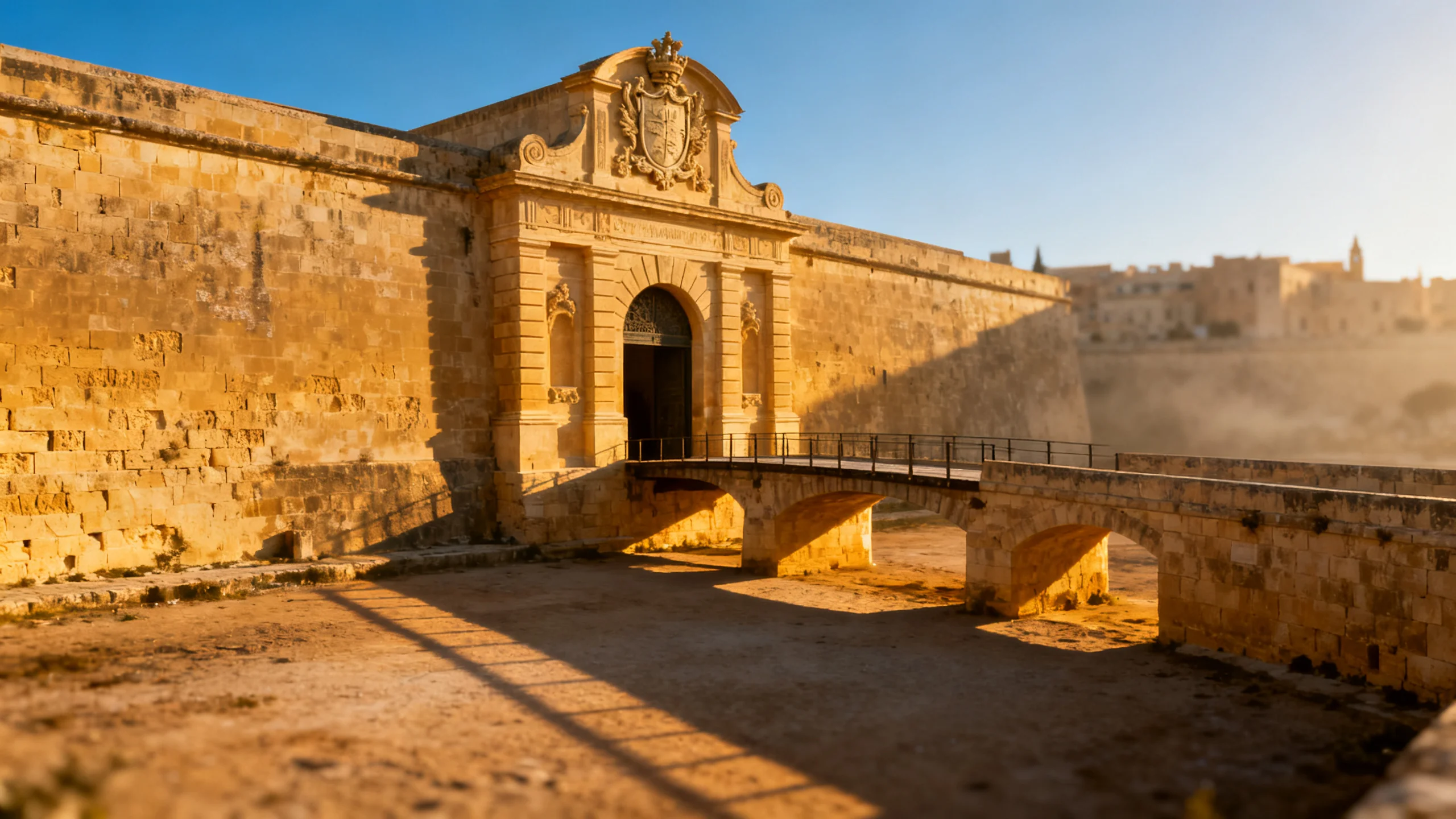
Why this small country is one of the most-filmed locations in Europe. The major productions, the visible sites, and the locations that have been altered beyond recognition.
Malta has been the location for more major films per capita than any other country in Europe, and possibly any country anywhere. The country’s small size, intact historic limestone streetscapes, year-round Mediterranean light, accessible film-friendly bureaucracy, and the existence of Mediterranean Film Studios at Rinella (one of the largest water-tank studios in the world) have combined to produce a steady stream of major productions since the 1960s.
This piece is the honest version of which films were actually shot here, which locations are recognisable when you visit, and which sites have been so heavily altered by digital post-production that the on-set footage no longer matches the place.
The major productions
In rough chronological order:
- Sons of Thunder (1957), the first significant Malta production, using the harbour and the Three Cities for a wartime drama.
- The Malta Story (1953), filmed locally for the 1942 siege.
- Cleopatra (1963), water-tank work at Rinella, plus some location shooting.
- Murphy’s War (1971), the Manoel Island shipyard.
- Pulp (1972), Michael Caine in Mdina and Valletta.
- Midnight Express (1978), Fort St Elmo as the Turkish prison interior.
- Christ Stopped at Eboli (1979), Italian production using the central villages.
- Popeye (1980), the Robert Altman film that built the kitsch Popeye Village set at Anchor Bay.
- The French Lieutenant’s Woman (1981), parts.
- U-571 (2000), water-tank work at Rinella.
- Gladiator (2000), the Fort Ricasoli set built as Zucchabar; the opening scenes in the German forest were filmed in Surrey, but the Algerian arena and the various Roman provincial scenes used Maltese locations.
- The Count of Monte Cristo (2002), Fort Ricasoli and the Three Cities.
- Troy (2004), the Sweethaven set at Fort Ricasoli used as ancient Troy.
- Munich (2005), various central villages.
- Helen of Troy (2003 miniseries), similar Trojan locations.
- Captain Phillips (2013), the Manoel Island shipyards.
- World War Z (2013), Valletta’s seafront and the city gate.
- Game of Thrones season 1 (2011), Mdina, Fort Manoel, San Anton Gardens, the Azure Window on Gozo.
- By the Sea (2015), Brad Pitt and Angelina Jolie production set on Gozo.
- Assassin’s Creed (2016), Mdina and Valletta.
- Murder on the Orient Express (2017), the Manoel Theatre interior.
- Napoleon (2023), Fort Ricasoli, Mdina, Valletta.
This is not a complete list. Mediterranean Film Studios handles dozens of smaller productions per year. The website maltafilmcommission.com maintains a current production list.
What is visible to a visitor
The single most asked question by visitors is some variation of “where can I see the Game of Thrones locations?” The honest answer, by location:
Mdina was used for the King’s Landing exterior shots in season 1 of Game of Thrones (2011). The locations are:
- Mdina Gate: the front gate of the city, used as the main entrance to King’s Landing in several scenes.
- The Cathedral square: used in the Ned Stark execution scene (which was actually filmed in Dubrovnik in later seasons, but the season-1 King’s Landing was Mdina).
- The alleyway behind the Cathedral: where Catelyn Stark meets Petyr Baelish.
- Bastion Square at the back of Mdina: smaller scenes.
The Mdina locations are obvious without a guide. The cathedral square looks essentially the same as it did in 2011; the limestone has aged slightly, the door frames have been repainted, but the urban geometry is unchanged. Most travellers walk into the area and recognise it within 30 seconds.
The Game of Thrones production moved entirely to Croatia from season 2 onwards because of disputes over location fees, so the famous later King’s Landing scenes (the Red Keep, the Sept of Baelor) are all Dubrovnik, not Malta. Visitors who came specifically to see Mdina because of Game of Thrones often expect more than is there.
Fort Ricasoli, on the south side of the Grand Harbour mouth, has been the location for:
- The Sweethaven set in Troy (2004), used as ancient Troy. The set was dismantled after filming.
- The arena set in Gladiator (2000), used as Zucchabar. The set was dismantled.
- The Roman fort in Assassin’s Creed (2016).
- Various other major productions.
Fort Ricasoli is not open to the public as a tourist site. It is owned by the Maltese government and managed by Heritage Malta but is not on the standard visitor circuit. The fort can be viewed from across the harbour (Upper Barrakka Gardens has the best vantage point) but the interior is closed to general visitors. Specialist film-location tours occasionally arrange access; check with the Malta Tourism Authority for the current status.
San Anton Gardens in Attard appeared in Game of Thrones season 1 as the King’s Landing palace gardens. The gardens are public, free, and look essentially the same as in the filming.
The Azure Window on Gozo appeared in Game of Thrones season 1 as the Dothraki wedding location. The Azure Window collapsed on 8 March 2017 during a winter storm. It is gone. AI-generated images suggesting the arch still exists should be ignored.
Anchor Bay (Popeye Village) still has the 1980 Robert Altman film set, now operated as a theme park. The set is the actual set built for the film. It is photogenic and kitsch. The €18 admission fee is hard to justify for adults; it works for families with young children. The bay next to it is fine for a swim without entering the park.
Manoel Theatre in Valletta appeared in Murder on the Orient Express (2017) as the interior of the train’s first-class lounge. The theatre offers tours (€7, 30 minutes when no performance is on); the interior is unchanged.
The Manoel Island shipyards were used for the underwater submarine sequences in Captain Phillips (2013) and for several other water-tank productions. The shipyard is largely industrial; the public-facing parts are minimal.
Fort St Elmo at the tip of Valletta peninsula appeared as the Turkish prison interior in Midnight Express (1978). The fort is now the National War Museum and is fully accessible; the prison-cell parts of the fort are visible but identified primarily as 18th-century Maltese cell blocks rather than as film locations.
What has been digitally altered
A practical warning: many of the films above have used Maltese locations as backdrops that were then digitally extended, recoloured or composited with other locations. The famous Troy beach scene with the wooden horse, for example, used the Sweethaven set at Fort Ricasoli as the base but added a fully CGI background. The fortress walls visible in Gladiator’s arena scenes were largely built sets that have been dismantled; the visible Roman city in the background is digital.
The result is that watching a film and then visiting the location often produces mild disappointment. The location is real, but it is smaller than the film made it look, and the digital extensions are no longer there.
The single most common example is Mdina in Game of Thrones. Viewers expect a larger and more imposing King’s Landing; what they get is a small walled town with a cathedral and a few streets. The town is genuinely beautiful but it is not the scale the show implied.
The Mediterranean Film Studios at Rinella
The water-tank studios at Rinella in the Three Cities are the technical anchor of the Maltese film industry. Three large water tanks (one of them with a 360-degree horizon backdrop), plus several smaller tanks and indoor sound stages, allow for marine and underwater productions that cannot be done elsewhere in Europe at the same scale.
The studios are working production facilities and not generally open to the public. Specialist tours can sometimes arrange visits during off-production periods; ask the Malta Film Commission about current availability.
A film-location walking day
For visitors who want a Game of Thrones / film-history Malta day:
Morning in Mdina: walk the gate area, the cathedral square, and the alleys behind the cathedral. Identify the locations from the show. Lunch at Fontanella Tea Garden on the bastions.
Afternoon return to Valletta: visit Fort St Elmo (the Midnight Express location, plus the war museum), Manoel Theatre (the Orient Express interior), and walk Republic Street as a general filming location.
Optional Gozo daytrip: San Anton Gardens (Game of Thrones palace gardens), Dwejra (the former Azure Window site, which is now a swimming spot but no longer an arch).
This is a reasonable one-day film-tourism circuit. It is not as cinematic as visitors expect but it does include genuine sites used in major productions.
What to skip if you came for the films
- Anchor Bay’s Popeye Village unless you have young children. The €18 admission is hard to justify for adults.
- Specialised Game of Thrones tour packages sold from Sliema and Valletta. These cover the same sites described above; you can walk them yourself for free.
- AI-generated images of the Azure Window. The arch collapsed in 2017 and is not coming back.
- “Filming location” T-shirts and gift shops. The country has a serious film history but the gift-shop version of it is generic.
The honest paragraph
Malta on film is real. The country has been the location for some of the most significant productions of the last 25 years, from Gladiator to Game of Thrones to Murder on the Orient Express to Napoleon. The visible Maltese sites in these films are genuine and walkable. But the films are larger than the locations in a digital-effects sense, and visitors who arrive expecting a more cinematic version of the country are often slightly disappointed. The better way to engage with film-Malta is to visit the genuine sites for their own architectural and historical interest first, and treat the film associations as a secondary layer. Mdina is a beautiful medieval walled city that incidentally appeared in Game of Thrones. The reverse framing is the wrong one.
Related reading
- Mdina and Rabat: the King’s Landing gate up close.
- Three Cities harbour cruise: the Fort St Angelo and Birgu sets from Gladiator and the Knights productions.
- Valletta walking tour: Republic Street and St John’s, used as multiple film locations.
- Limestone architecture: the visual reason the country films so well.